Who is the ST200 Class of 2010? If you took a composite picture of the typical ST200 owner, you would see a salon and spa that ...
by Web Editor
July 10, 2011
3 min to read
Class Picture
Who is the ST200 Class of 2010? If you took a composite picture of the typical ST200 owner, you would see a salon and spa that ...
Opened its doors in 2000.
Occupies 4,915 square feet of space.
Earned an average of $1,665,466 in gross revenue in 2008.
Experienced an average 21-percent increase in revenues from 2007 to 2008.
Received 33 percent of their gross revenues from hair cutting and color service sales.
Charged an average of $48.75 for a shampoo, cut and style.
Charged an average of $64.70 for a single-process color.
Employed an average of 35 employees.
Spent almost half (48%) their expenditures on labor costs.
Is a member of one or more professional associations.
Ad Loading...
Through the Years
Who says 2008 ended on a bad note? Even though SALON TODAY broadened the focus of the competition to include best practices, the SALON TODAY 200 as a class continued to demonstrate strong growth. In 2003, the average gross revenue was $1,025,730 compared with the $1,665,466 reported for 2008. Despite the economic crash, 2008 gross revenues demonstrated an average 21 percent increase over 2007-a few percentage points slower than years earlier, but still a healthy growth rate.
What's in a Name?
The SALON TODAY 200 Class of 2010 yields some interesting observations when it comes to the name game:
Five salons had a foreign affair, playing with translations of the word beauty: Beau Monde Spalon; Bella Capelli Sanctuario, Bella Luci Salon, Bella Salon and Day Spa, and Belle Epoque an Atelier Salon.
At least eight got colorful: Green Peridot, Greener Grass Hair Color and Designs, Indigo Home for Hair & Body, Indigo Salon and Spa, Jade Aveda Salon, Jungle Red Salon, Red 7 Salon and Salon Orange Moon.
While others explored the flora and fauna: Lemon Lime, Mango Salon, Tangerine Salons, Wildflowers Salon and Wisteria Salon Spa.
And, 11 got right to the point, starting their name with word, salon.
Raking It In
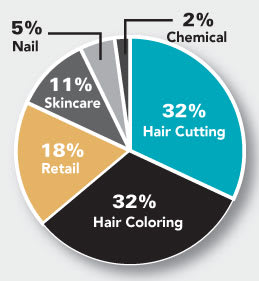
When the SALON TODAY 200 Class of 2010 looks at their gross revenues by category, hair cutting services and hair coloring services are head to head with 32% each, followed by retail sales at 18%, skincare and bodycare services at 11%; nail services at 5% and chemical services at 2%.
And, Breaking it Down
Unfortunately, what comes in also goes out. At 48% labor costs accounts for almost half of all ST200 expenditures, followed by supplies at 11%, rent/mortgage at 8%, taxes at 5%, marketing/advertising at 3%, and conventional employee benefits, education and training, utilities, professional services and insurance at 2% each. Owners did keep some of the pie, with 4% of the expenditures allotted for owner compensation and 6% making its way into profit. (Other responses accounted for 5%.)
Ramping Up
On average, for each $25,000 to $34,000 in sales, the ST200 add on another employee.
Ad Loading...
Regional Differences
The states with the largest number of ST200 salons were California, Pennsylvania, Texas and Ohio. Regionally, 32% of salons were located in the South; 30% in the Midwest; 20% in the Northeast; 17% in the West and 1% were outside the United States. Regionally, there were some interesting differences:
Salons in the Midwest tend to be larger than other regions.
Salons in the South experienced a much higher growth rate (31%) from 2007 to 2008 than salons in the Midwest or the Northeast.
Salons in the West charge significantly more for both cutting and coloring services than salons in other parts of the country.
Retail sales represent a higher percentage of gross revenues for salons in the Midwest and West.
Rent/mortgage and insurance expenses are a higher percentage of total expenses for salons in the West.
All beauty professionals should know how to identify when a client may need some health guidance. Tracy Rado discusses some common questions that clients ask in the chair, how to advise them, and when to refer them to a specialist.
From managing air traffic on busy days to handling frustrated guests' complaints, your front desk team often serves as the salon's emotional shock absorber. From a customer service lesson from the DMV to a list of strategies for caring for your front line, our experts offer ideas for alleviating stress, celebrating wins, and setting goals.
According to the KIM Report, top-line salon revenue appears steady or slightly up, but that growth is driven primarily by service price increases. Beneath the surface, retail performance and client visit frequency (appointment drift) are under real pressure. In his latest blog, Alain Audet offers strategies for keeping your salon's retail sales strong.
Putting your family to work in the salon offers some real tax benefits, but you have you have to play by the rules of the tax code to claim them. Azarvand Tax Law's Leticia Skrabut, Esq., shows you how.
Discover how to create a true “WOW experience” for every client by first building a culture where your team feels engaged, empowered, and inspired. Drawing on Calvin Stovall’s Iconic Framework, this blog explores how salon, spa, and clinic leaders can strengthen culture, elevate customer experience, and build a business that stands out for the long term.
The wellness industry is growing fast, and salons and barbershops already are an important part of it. In her first blog, Tracy Rado shares where the wellness dollars are heading, and how salons can grow with this movement.
While salon sales are increasing, owners often feel they're working harder for the same or less profit. Leverage Q2 data from The KIM Report, Alain Audet reveals some of the structural changes that are dampening your growth and why your region and your salon size matters.
Weaknesses in your business are amplified during the Holiday Season. Spark Pro Global's Lucy Randall shows you five things to do now to have the strongest holiday season yet.
In Kati Whitledge's latest blog, she shares how salons have moved away from dress codes and embraced appearance standards. But by removing strict dress codes, some businesses may have unintentionally lowered their appearance standards. Whitledge helps you explain to your team why an appearance standard is important and how to smoothly implement a new appearance policy.
The Small Business Health Care Tax Credit is a non-refundable tax credit for for-profit businesses that provides a financial incentive for eligible employers who offer health insurance coverage to their employees. Leticia Skrabut, Esq., walks you through how to claim that credit.
Developing strong work habits early in one's career supports long-term success in the salon industry. Jesse Linares offers new stylists his top five tips.
Most salon owners have no idea what these numbers are.
You can hit record sales and still have a profit problem. The difference comes down to four numbers almost nobody was taught to track.
At Janet St. Paul Studio for Hair and Beauty, Director of Operations Natasha McMillen helps bring her wife Janet St. Paul's vision to life, elevating every system from education to operations.