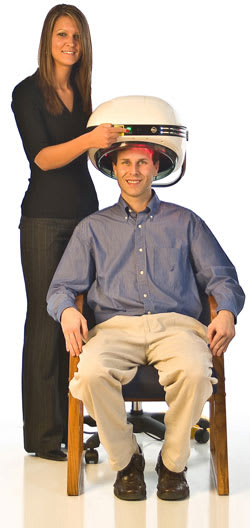
Can cosmetic lasers generate repeat business during a tough economy? Salon owner Pam Matheson says “Yes.”
by Web Editor
July 10, 2011
3 min to read
Can cosmetic lasers generate repeat business during a tough economy? Salon owner Pam Matheson says "Yes."
Hair loss is a multi-billion dollar
Ad Loading...
per year industry, and salons are fortunate to have a broad range of professional services and dedicated products to help their clients-and their own bottom lines-reap benefits. Now, salon laser treatments join the menu of options to serve consumers. They are a potential complement to the proven categories of professional hair enhancements and extensions, category-leading brands like Nioxin, and specialized treatment line extensions from established brand leaders. Here's how one salon partnered with the company Salon Lasers to generate a new segment of service business.
Always one to try the latest innovations, salon owner Pam Matheson was attending Premiere Orlando 2007 when the Salon Lasers demonstration caught her attention. She took some literature, did her own research, and by February 2008 felt ready to add laser hair enhancement to her menu at The Bently Salon in Hickory, North Carolina.
In an act of faith, Matheson chose to introduce the technology to the community in the most public way possible; she invited the local newspaper to follow the progress of hair replacement on one male and one female model she'd recruited to have the service at no charge. The paper ran the story accompanied by a photo of Matheson and her models.
Clients started pouring in as soon as the first story hit the stands. Once she had her first wave of clients, word spread and Matheson has recruited a steady clientele of about 50 men and 50 women.
Craig Black is the man behind Salon Lasers; he's a barber and salon owner, and also a client. Black has been giving himself laser treatments once to twice weekly for five years and getting regular scalp checks by a dermatologist.
PRICING STRATEGY
Matheson began by charging $200 for each month of treatment; at twice weekly that comes to eight sessions at $25 per 30-minute treatment. As Black encourages, she had clients sign a consent form but did not tie them to a contract; they paid month-to-month. Although Black says some salons in upscale or major metropolitan areas are collecting as much as $500 per month, as the economy began to sink Matheson started offering discounts. Today, she is offering treatments for $100 per month/per couple.
Black does not tout that laser hair enhancement is brand new. "It's been available at hair loss clinics for a while," he says. At up to $30,000 a pop though, the lasers have been beyond the reach of salon budgets. With the lower cost (most cosmetic lasers are in the $5,000 to $6,000 range, he says) some owners are beginning to take a look.
And it's not a moment too soon, says Black, because clients are learning about the wider variety of hair enhancement options. "The public is becoming educated about low-level lasers," he reports. "We want to make sure everyone in our industry is as up to speed as the public is."
The Mechanics Salon Lasers sells flat-panel designs as well as hooded lasers. The key component of both is a set of diodes. Each treatment takes 30 minutes and the accepted protocol is for the client to receive the treatment twice a week. Matheson tells clients that in about a month, they may notice that their hair feels and responds a little differently, and within 8-12 weeks, there should be visible results. Black says it takes about nine months to see the full benefit.
Although the operation of the laser is as simple as pushing a button, the all-important consultation requires training. Black supplies salon owners who purchase his lasers with ample information and the latest research.
"You should be able to explain to clients the causes of hair loss and how the laser may help them," he says.
All beauty professionals should know how to identify when a client may need some health guidance. Tracy Rado discusses some common questions that clients ask in the chair, how to advise them, and when to refer them to a specialist.
From managing air traffic on busy days to handling frustrated guests' complaints, your front desk team often serves as the salon's emotional shock absorber. From a customer service lesson from the DMV to a list of strategies for caring for your front line, our experts offer ideas for alleviating stress, celebrating wins, and setting goals.
According to the KIM Report, top-line salon revenue appears steady or slightly up, but that growth is driven primarily by service price increases. Beneath the surface, retail performance and client visit frequency (appointment drift) are under real pressure. In his latest blog, Alain Audet offers strategies for keeping your salon's retail sales strong.
Putting your family to work in the salon offers some real tax benefits, but you have you have to play by the rules of the tax code to claim them. Azarvand Tax Law's Leticia Skrabut, Esq., shows you how.
Discover how to create a true “WOW experience” for every client by first building a culture where your team feels engaged, empowered, and inspired. Drawing on Calvin Stovall’s Iconic Framework, this blog explores how salon, spa, and clinic leaders can strengthen culture, elevate customer experience, and build a business that stands out for the long term.
The wellness industry is growing fast, and salons and barbershops already are an important part of it. In her first blog, Tracy Rado shares where the wellness dollars are heading, and how salons can grow with this movement.
While salon sales are increasing, owners often feel they're working harder for the same or less profit. Leverage Q2 data from The KIM Report, Alain Audet reveals some of the structural changes that are dampening your growth and why your region and your salon size matters.
Weaknesses in your business are amplified during the Holiday Season. Spark Pro Global's Lucy Randall shows you five things to do now to have the strongest holiday season yet.
In Kati Whitledge's latest blog, she shares how salons have moved away from dress codes and embraced appearance standards. But by removing strict dress codes, some businesses may have unintentionally lowered their appearance standards. Whitledge helps you explain to your team why an appearance standard is important and how to smoothly implement a new appearance policy.
The Small Business Health Care Tax Credit is a non-refundable tax credit for for-profit businesses that provides a financial incentive for eligible employers who offer health insurance coverage to their employees. Leticia Skrabut, Esq., walks you through how to claim that credit.
Developing strong work habits early in one's career supports long-term success in the salon industry. Jesse Linares offers new stylists his top five tips.
Most salon owners have no idea what these numbers are.
You can hit record sales and still have a profit problem. The difference comes down to four numbers almost nobody was taught to track.
At Janet St. Paul Studio for Hair and Beauty, Director of Operations Natasha McMillen helps bring her wife Janet St. Paul's vision to life, elevating every system from education to operations.