










You Don't Own a Salon. You Own A Business.
In his latest blog, Leon Alexander Ph.D., challenges industry conventional thinking to help owners add more to their bottom lines.
 MENU
MENU SEARCH
A new study by CommonCentsMom.com looks at the state of maternity leave and early childcare in the United States versus 40 other countries, and finds it wanting.

The study analzyed the costs of early childcare for women in 40 countries, realtive to their incomes, how much time off they are offered and the equivalent of this time in full-rate paid weeks.
Pixabay
The United States is the only country in the developed world that does not offer any paid maternity leave. Countries with around half of the U.S.'s GDP and up to six times lower average salaries are more generous than the U.S. when it comes to offering financial support to mothers.
A study conducted by frugal living experts CommonCentsMom.com analyzed the costs of early childcare for women in 40 countries, relative to their incomes, how much time off they are offered and the equivalent of this time in full-rate paid weeks.
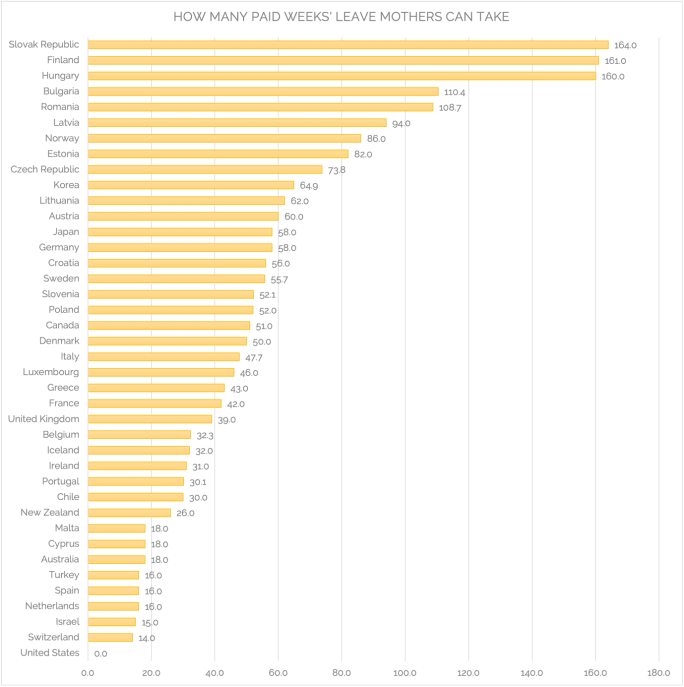
A look at the number of paid weeks of leave mothers can take in different countries.
Image provided by commoncentsmom.com.
The research found that the U.S. is the only country in the developed world to offer zero paid maternity leave. There is no maternity leave structure in place in the United States, meaning women are not allowed any time off immediately after birth, unlike in all the other OECD and EU countries studied by CommonCentsMom.com. Switzerland is the second worst for early childcare-related time off, with only 14 weeks of maternity leave paid at a 53.9% rate of a full wage. Israel follows closely behind, where mothers can only take 15 weeks off, however, these are paid at full rate.
The best countries for the total time allowed for maternity, parental and home care leave are the Slovak Republic (164 weeks), Finland (161 weeks) and Hungary (160 weeks). However, the rates at which mothers are compensated in these countries varies considerably.
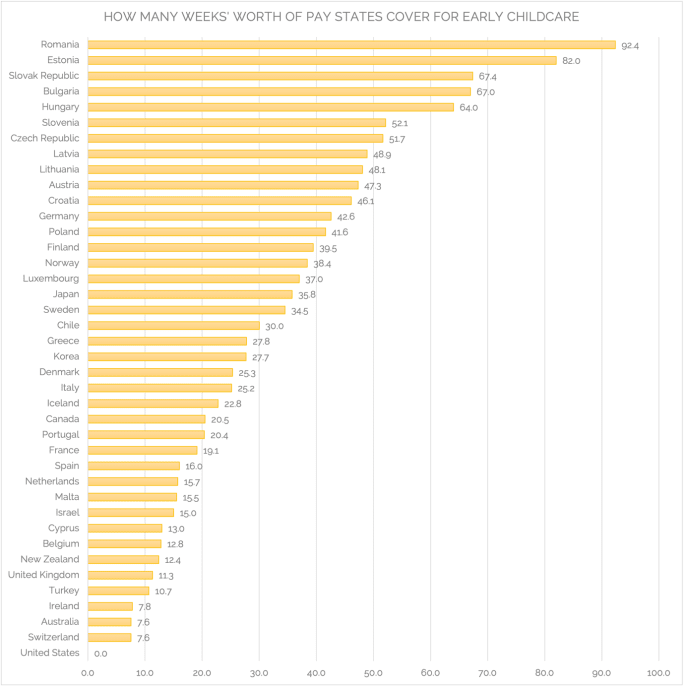
A look at the amount of time different countries cover in early childcare.
Image provided by commoncentsmom.com.
The most generous countries for full-rate equivalent of early childcare leave are Romania, Estonia and the Slovak Republic. For example, mothers in Romania can take a total of 108.7 weeks off to take care of their newborn for which the state covers the equivalent of 92.4 weeks of their full wages. Estonia covers 100% of a mother’s pay, but for a shorter period – 82 weeks, which is the maximum time off possible there. The Slovak Republic, besides offering the longest leaves of all, also compensates mothers generously with 67.4 weeks’ worth of full pay.
The least generous countries are, surprisingly, the US, Switzerland and Australia. Since there is no maternity leave whatsoever in the U.S., the state covers no costs in relation to this. Meanwhile, both Switzerland and Australia only cover 7.6 weeks’ worth of full wages for the care of newborns. The list continues with Ireland, Turkey and the United Kingdom, which are also among the least generous countries in the developed world for maternity leave pay.
The study also evaluated the cost of early childcare once state support lapses and until the child turns two years of age. The calculation is based on mothers on a median female wage, who return to work and share the cost of a childminder on the lowest possible pay equally with another adult. Denmark has the most balanced system in the developed world, where women need only spend 0.45% of their wages on childcare. Romania and Estonia impress yet again, ranking second and third best for how much of their wages mothers must allow for the remainder of the childcare period, with just 2.63% and 6.03%, respectively. Bulgaria and Austria are the only other two countries where mothers need not spend more than a tenth of their salaries on hiring a childminder for their under two-year-old.
At the oppo
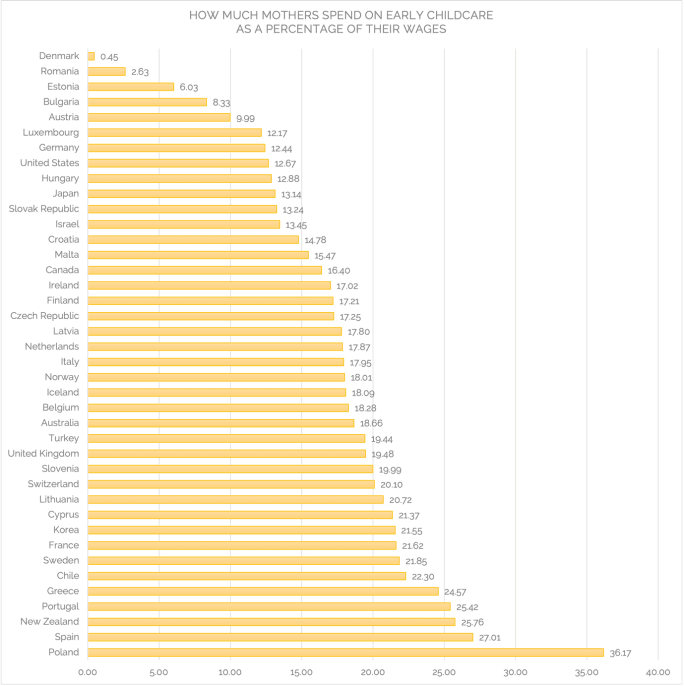
A look at how much mothers spend on early childcare as a percentage of their wages.
Image provided by CommonCentsMom.com.
site spectrum are Poland, Spain, New Zealand, Portugal and Greece, where up to a quarter of mothers’ salaries must go towards the care of their child until the age of two. This number doubles for mothers who are sole caregivers.
In the U.S., mothers on an average salary of $59,507.58 returning to work immediately after giving birth would need to spend at least 1/8 of their wages to hire a nanny on the lowest possible pay. Those who do not split this cost with their partners must allow for at least a quarter of their wages to enlist the services of a childminder.
Katie Ren, the founder of CommonCentsMom.com explains: “We could not find any study looking at real, immediate costs to mothers, as most of them look at childcare after the age of two, at best, when there are more options available such as childcare vouchers and national programs. We already knew that the U.S. had a zero mat leave policy and wanted to understand just how normal that was compared to other developed countries – the results show that America is by far the worst country for childcare in the developed world.
“Our research specifically looked at mothers that are keen to get back to work, but not because they are forced to. However, in many countries, new mothers are left without a choice but to return to work, especially if they are single. Even then, the costs of childcare are sometimes so disproportionate, that returning to work is hardly a financial benefit, which has ripple effects on the opportunities women with children can access.”
The research was carried out by www.commoncentsmom.com – a U.S.-based money wellness magazine sharing smart saving and spending advice.
In his latest blog, Leon Alexander Ph.D., challenges industry conventional thinking to help owners add more to their bottom lines.

In her latest blog, Amy Pal helps you develop your own clear guidelines around complimentary free employee services.

From managing air traffic on busy days to handling frustrated guests' complaints, your front desk team often serves as the salon's emotional shock absorber. From a customer service lesson from the DMV to a list of strategies for caring for your front line, our experts offer ideas for alleviating stress, celebrating wins, and setting goals.

According to the KIM Report, top-line salon revenue appears steady or slightly up, but that growth is driven primarily by service price increases. Beneath the surface, retail performance and client visit frequency (appointment drift) are under real pressure. In his latest blog, Alain Audet offers strategies for keeping your salon's retail sales strong.

Putting your family to work in the salon offers some real tax benefits, but you have you have to play by the rules of the tax code to claim them. Azarvand Tax Law's Leticia Skrabut, Esq., shows you how.

Discover how to create a true “WOW experience” for every client by first building a culture where your team feels engaged, empowered, and inspired. Drawing on Calvin Stovall’s Iconic Framework, this blog explores how salon, spa, and clinic leaders can strengthen culture, elevate customer experience, and build a business that stands out for the long term.
Sponsored by Phorest Salon Software

The wellness industry is growing fast, and salons and barbershops already are an important part of it. In her first blog, Tracy Rado shares where the wellness dollars are heading, and how salons can grow with this movement.

While salon sales are increasing, owners often feel they're working harder for the same or less profit. Leverage Q2 data from The KIM Report, Alain Audet reveals some of the structural changes that are dampening your growth and why your region and your salon size matters.

Weaknesses in your business are amplified during the Holiday Season. Spark Pro Global's Lucy Randall shows you five things to do now to have the strongest holiday season yet.

In Kati Whitledge's latest blog, she shares how salons have moved away from dress codes and embraced appearance standards. But by removing strict dress codes, some businesses may have unintentionally lowered their appearance standards. Whitledge helps you explain to your team why an appearance standard is important and how to smoothly implement a new appearance policy.

The Small Business Health Care Tax Credit is a non-refundable tax credit for for-profit businesses that provides a financial incentive for eligible employers who offer health insurance coverage to their employees. Leticia Skrabut, Esq., walks you through how to claim that credit.

Developing strong work habits early in one's career supports long-term success in the salon industry. Jesse Linares offers new stylists his top five tips.

Most salon owners have no idea what these numbers are. You can hit record sales and still have a profit problem. The difference comes down to four numbers almost nobody was taught to track.
Sponsored by Strata Salon Systems™

A five-area audit every owner-dependent salon needs to run. You built something that looks successful. Now find out if it can survive without you.
Sponsored by Strata Salon Systems™

Every month you put off fixing the problem, it gets bigger, more expensive, and harder to solve.
Sponsored by Strata Salon Systems™

At Janet St. Paul Studio for Hair and Beauty, Director of Operations Natasha McMillen helps bring her wife Janet St. Paul's vision to life, elevating every system from education to operations.

Expand your color service menu with the Pinstripe technique. Brooks and Brooks' Marlon Hawkins walks you through the technique.