In a world dominated by e-commerce, salon owners push back with proven strategies to increase retail sales while motivating team members to educate their clientele and delighting clients with retail-themed events and clever merchandising displays.
Salon owners are utilizing effective strategies to boost retail sales in a market dominated by e-commerce, including launching their own online stores.
Staff education initiatives are implemented to enhance client interactions and knowledge.
Innovative merchandising and retail-themed events are used to captivate and engage clients.
*Summarized by AI
During a client's service, her stylist asks about her hair challenges and selects a few products to address them. As she incorporates the products into the service, the stylist talks about their benefits while placing them on the station, facing the client. To the stylist's dismay, the client whips out her phone, finds the product online, and places an order.
It's not a tale as old as time--it's a fairly recent, but all too frequent, phenomenon.
Ad Loading...
The fact remains it's still easier for a client to go home with that product in a pretty bag right from the salon, so why do they choose to order online? Maybe e-commerce has become an ingrained habit, a behavior accelerated by the Pandemic. Perhaps today's buyers relish the tiny thrill of getting a package at home. Or, maybe that client pulling out her phone during her appointment perceives that those recommended products will be cheaper online.
No matter the reason, e-commerce has been driving down retail sales in most salons, and that's resulted in a blow to the bottom line.
In this feature, we catch up with three owners who are fighting back, recapturing retail sales through creative strategies, including launching their own e-commerce stores, drilling down on product education and consumer behavior with team members, and amping up the creativity in the salon's retail offerings, merchandising displays, and retail-themed events.
Joining the E-Commerce Race
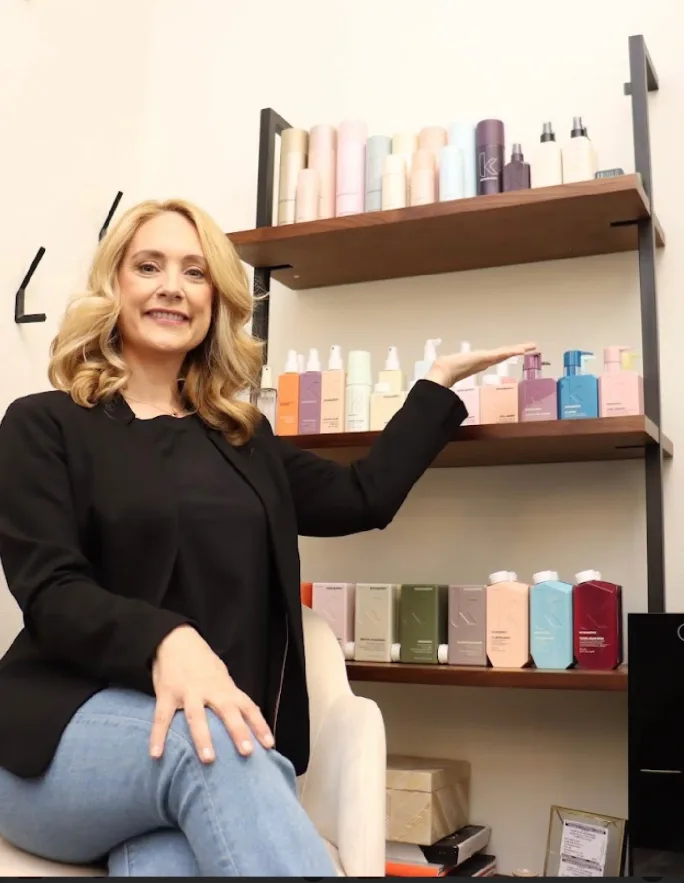
Of the clients who purchase retail from her salon suite, Amy Hazen says half purchase in the salon and half purchase through her customized online store
Credit:
Amy Hazen
Amy Hazen knows she’s a bit of an anomaly. As the owner of a busy suite business (Hazen Hair Studio in Westborough, Massachusetts), she actually loves retailing.
“I have two sinks in my suite and can do two clients at once," she says. “When you’re in a small space, you have to get a little creative and be careful not to get too cluttered. I installed some clean shelving, and I display a few lines.”
Hazen’s retail approach starts with the consultation and asking the client what challenges they are having with their hair.
“They could say that they’re disappointed that their color fades or their hair has been feeling dry, so I pick a line that addresses their specific challenge and talk about what the product is doing for their hair while I’m shampooing them,” she says. “I’ll grab the products and put them on the station facing the client, and after they leave, I’ll follow up by sending the cleint a text with my product recommendations.”
While many of Hazen's clients go home with their products, she points out that others are in a hurry at check out or they feel overwhelmed and need time to consider a purchasing decision.
Through SalonInteractive, Hazen maintains an online storefront where all the products she carries on her shelves are available for sale, as well as products she doesn’t have the space to display in her limited space. By sending the client links to the recommended products on Hazen's online storefront, she helps prevent them from searching for the products elsewhere.
“In the salon, I display SKUs from Eleven Australia, Maria Nila, Kevin.Murphy and Tribe, but online I also carry additional lines like ColorProof as well as Hot Tools that I use on clients in the salon, and they inquire about for use at home,” she says.
She first heard about SalonInteractive from her sales rep about two months before COVID. “The pandemic was a time that clients shifted to Amazon for purchasing everything, and you had to figure out a way to work with it or just complain about it,” she says.
Hazen loves that she can choose what products to carry in her online store and that SalonInteractive has different design templates, so she customized her storefront with her logo and chose a template that reflects the natural, organic vibe of the lines she carries. “I’m an ammonia-free color salon, so the design matches my mission,” she says.
Baiting the Retail Hook
Hazen loves to send new clients a 20% off discount along with links to recommended products on her e-commerce site, encouraging clients to fall in lov.
Credit:
Amy Hazen
If a client is new, Hazen frequently sends them an introductory coupon for 5-20% off their first online order. While the coupon value is deducted from her product commission, she believes it’s worth it.
“I always tell clients that the coupon is thanking them for being a new client. I would rather they use a product at home that I recommend, and the discount encourages that first purchase, which gives them a chance to fall in love with it,” Hazen says. “Plus, a client who purchases is more likely to be retained as a client because they trust you.”
Hazen says she averages commissions on online product sales between 25% and 50%, depending on the product line, and that orders ship directly from the distributor Evolve Salon Systems. “I have nothing but good things to say about them—they are all about supporting stylists, and they have wonderful sales reps,” Hazen says. “I love that I don’t have the hassle of shipping or paying the shipping fees, and my distributor offers free returns, and will take back any products my clients are unhappy with.”
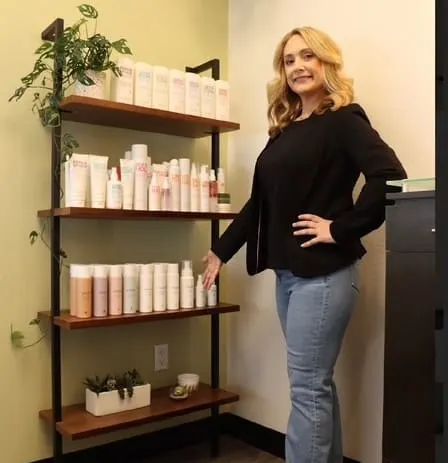
Hazen's clean, neatly arranged retail shelving encourage in-salon product sales, while her e-commerce site lets her expand her offerings to things like tools, which she doesn't have the space in her suite to retail.
Credit:
Amy Hazen
Always in Stock
Because Hazen has limited shelving space in her suite, she may be out of a particular product a client wants to buy. She loves that her clients who order online tend to receive their orders within one or two days. “If I’ve just colored the client’s hair, I’ll remind them they shouldn’t be washing it for two days anyway,” she laughs.
Hazen believes her online storefront is a success, reporting that about half of her clientele purchase in the salon and half purchase online.
“I still think it’s important to keep the retail in my suite, and I’ll try to display one of everything, two if it’s a popular product,” Hazen says. “But many clients will buy in between—if they run out of product at home, they don’t have to wait until their next appointment.”
Hazen also loves being able to research a client’s product history through SalonInteractive. She can see which products she recommended, which ones the client has ordered, and how often.
She's found the e-commerce platform kept commissions coming in even when she's closed. “I had to take a medical leave from December through mid-February, and having the storefront was great, because I didn’t want my clients to get used to purchasing the product somewhere else,” she says.
Social Media Selling
Hazen leans on Instagram to boost her retail sales, saying her clients really respond to her posts. “I’ll do a product spotlight video, and not necessarily with a client. For example, this summer, I targeted products that protects against humidity and curly girl products. I’ll shoot a quick video talking about the shampoo, conditioner, and mask, and maybe use a styling product on myself,” she says.
She cautions that she keeps these social videos quick. “You want to keep them engaged,” she says. “I don’t think clients really care to hear a long list of product ingredients; they’d rather hear one or two things that the product does well. Attention spans are short.”
SALON TODAY's Stacey Soble (right) and Aveda's Dawn Miyazaki-Jovel (left) present the 2025 Retail and Merchandising Innovation Award to Bonnie Conte at the SALON TODAY 200 Award Dinner.
Credit:
Jon Soble
Subliminal Messaging, Retail Events, and Impulse Buys
In 2025, SALON TODAY bestowed Bonnie Conte with its special SALON TODAY 200 Retail and Merchandising Innovation Award at the SALON TODAY 200 Award Dinner. We recently sat down with Conte, owner of Avalon Salon and Day Spa in Lake Zurich, Illinois, to unpack some of the ideas expressed in her essay.
SALON TODAY: What have you observed about consumer behavior in recent years that has changed retail sales for all owners?
Conte: “Probably the number one thing I’ve witnessed in the last five years is that there’s been a major decline in loyalty when it comes to buying products in the salon. Clients are more likely to buy on Amazon or see what’s on sale at Costco. Even though they are paying top dollar for professional hair services, and we’re educating them about the benefits of our products, they just aren’t as loyal."
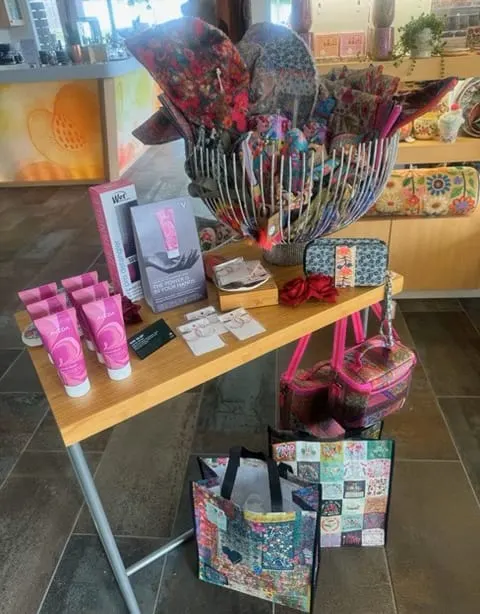
Retail products infused into displays of impulse items bring new energy to retail sales at Avalon Salon Spa in Lake Zurich, Illinois.
Credit:
Avalon Salon Spa
ST: So you say you’ve committed to a new retail strategy, and it starts behind the scenes in the employee break room?
Conte: “I’m very fortunate to have a great retail ambassador on the team. She’s so knowledgeable about products—she educates clients, as well as the staff, during our morning huddles. Caitlin is super artistic, and she makes these big posters that highlight a product’s features and ingredients with beautiful fonts, colors, and little drawings.
“The posters explain what a product does, what hair type it’s for, and what a user can expect when using it. They’ve been such a great tool for our team, so we wallpapered our breakroom with these informational posters. They serve as a kind of subliminal message, but if a team member ever gets stuck on product knowledge, they can run back to the breakroom and boom—it’s right there for them to see.”
ST: Your salon recently brought back a Girls’ Night Out event. How does that work, and how does it tie to retail?
Conte: “We used to do these years ago and then stopped during the pandemic. We market the event, and there’s a $45 reservation fee when a guest signs up. We load that $45 onto a gift card that must be redeemed the evening of the event. The Girls’ Night Out events feature good music, food, beverages, and instruction.
“Taking reservations also helps us know how many people will come, so we know how many staff to have on. But during the event, our team isn’t allowed to touch their tools. The event is BYOB (Bring Your Own Blow-Dryer), and our team gives clients advice on achieving professional looks at home.
“Often, we’ll see that a client’s hairbrush needs to be replaced, or they’re afraid of using a roller brush. The team coaches them on using various tools and styling aids to achieve a look they’ll be proud of between visits.
“I also love that the event reminds them they really should come to the salon between visits for a blowout, whenever they have a special occasion or want to try a fun updo or curls, or something they normally wouldn’t do themselves. The clients love these events, and we sell retail. You’re guaranteed to sell a minimum of $45 per guest.”
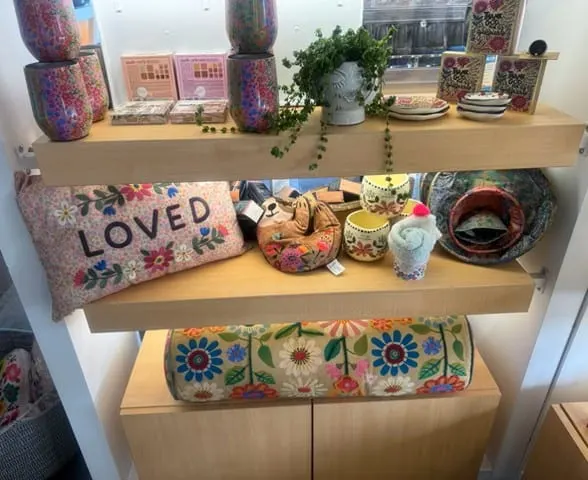
Colorful and fun pillows, insulated cups, signs, and makeup palettes represent some of Avalon Salon Spa's new retail offerings.
Credit:
Avalon Salon Spa
ST: In monitoring your own consumer behavior, you ended up setting up a display of impulse items at checkout. How does that work, and what are some of your favorite items?
Conte: “I noticed when I go someplace like Ulta or Sephora for an item, I would never get out of there without one or two more things. You wait in line, surrounded by bins filled with small products, trinkets in shiny colors, and great fragrances. You can’t get out of there without going through a couple of rows of these bins, and even though you didn’t come in for any of those things, suddenly you feel like you need them before you get to checkout.
So, I went to a resale shop, found this vertical stand with all these little bins, brought it back, and put it right next to the register. I found a brand I really liked that carries accessories—many with inspirational messages, lots of fun colors, and lower ticket prices. They are a great impulse buy, and we have had so much success with them.
For example, we have small brushes in different colors and with flowers—everyone needs one for their car or gym bag. Another favorite is this scrunchie with a zippered secret compartment where you could stash emergency cash or a key.
When team members at Avalon Salon Spa sell five or more retail items in one day, they get the opportunity to choose an item for themselves from the salon's treasure chest.
Credit:
Avalon Salon Spa
ST: You’ve taken that impulse idea and extended it to your team, how does that work?
Conte: “We’re a team-based pay salon, so we don’t really do retail commission. Retailing is an expectation, and that retail portion of what would be in their paycheck is rolled right into their hourly wage.
“However, we’ve been in business for 24 years, and, like everything, we don’t want to stagnate. So, I bought this little treasure chest, put it on the counter behind the front register, loaded it with mystery items, and told my team that if they sell five items during their shift, they can pick an item from the treasure chest the next day. I put in some $20 gift cards to Starbucks and Target, some back bar items, some styling aids, and a little makeup. The team never know what’s going to show up in there.
“When I told some of my suppliers what I was doing and why, they started giving me full-size products that were brand new to get my team fired up about them. It’s been so much fun.”
ST: You’re not afraid to pull at the heartstrings when it comes to talking about retail on social media. Can you give us an example?
Conte: “Again, we decided that we’re just going to get real with it and have some fun. My daughter came in one day to have her hair colored and brought my 18-month-old granddaughter, Violet. So, I was on Grandma duty while her color was processing, and I let Violet have fun in the retail area. She was toddling around, went up to one of our shelves, pretty much knocked a whole section of products onto the floor, and started playing with them.
“I thought it was so cute, so I videotaped it. I gave the video to our social media gal, and she created a reel with some of Violet’s favorite retail picks. It generated all kinds of comments and excitement. In this crazy world we’re living in, just having some fun with things and putting a smile on people’s faces is important. But it also sent a message that we’ve got some great products.”
Lisa Musgrove-Kibler proudly holds the 2026 Retail and Merchandising Innovation Award she won for her LoneStar Retail Lab program.
Credit:
LoneStar Salon
A Retail Bootcamp Shapes Team Behavior
Salon owners know that retail sales boost profit margins, enhance client loyalty, and help clients maintain salon-quality results. Unfortunately, though, team members are reluctant to sell, because they worry about rejection, make judgment calls about a client's willingness to purchase based on their own personal budgets, or they simply don't see or care about the value to overall business.
"Like most salons, we have stylists in every stage of their careers, but in all those stages, one challenge is shared by all--selling retail," says Lisa Musgrove-Kibler, owner of LoneStar Salon & Spa in Tumwater, Washington.
To support her team and help them improve their retail KPIs, Lisa Musgrove-Kibler, owner of LoneStar Salon & Spa in Tumwater, Washington, she launched the LoneStar Retail Lab , a voluntary, four-week, virtual program. Designed to shift how the team thinks about retail, the program was a deep dive into how to market, identify buyer types, and leverage the resources at their fingertips to solve—not sell.
"The volunteers ranged from stylists who had been on the salon floor for almost 20 years, to stylists with less than a year's experience, and the results were phenomenal," she says.
Week 1: Mindset
In order to shift stylist behavior, Musgrove-Kibler felt she needed to help the team identify and shift their self-sabotaging patterns. "We identified everyone's fears, hesitations, natural strengths and goals," she says. "For example, were they afraid of sounding pushy? Of being told No? Did they no feel confident in their product knowledge? Did they worry about the client's budget?"
To find out where those fears lived, the group used the Self-Concept Model to evaluate their own self image, self-esteem and self-ideals. focused on mindset and identifying self-sabotaging patterns by implementing the Self-Concept Model and using study groups to practice strategic sales strategies that paired with their natural strengths.
The group finalized their first week of training by creating 'study groups' so participants could practice strategic selling that paired with their natural strengths.
Week 2: Behavior
"The second week was about creating consistent action," says Musgrove-Kibler.
The team identified avatars for the different guests in their salon. focused on shifting behaviors and identifying the different guest avatars.
For example, as a stylist, are you serving a Kia buyer or a Mercedes buyer? Musgrove-Kibler explains that Kia buyer is going to have different concerns than a Mercedes buyer when it comes to their beauty routine and budget. A Kia buyer may respond to 'value language,' where a Mercedes buyer may be motivated by 'results language.'
"By diving deep into our consultation forms, we started to identify how to use the questions clients answer to ensure they feel seen and heard," she says. "I truly feel this gave our team a new way to talk with guests, while breaking down their own fears about selling."
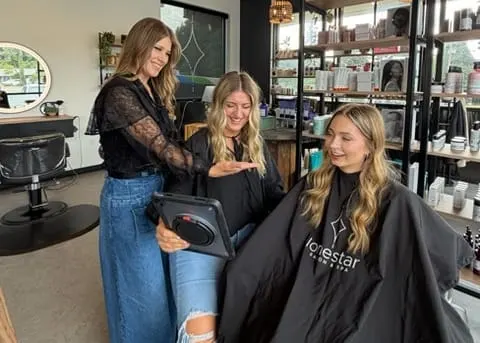
Participants in the LoneStar Retail Lab practice new retailing skills on one another.
Credit:
LoneStar Salon and Spa
Week 3: Product Knowledge and Resources
"Once we started seeing a huge changes in mindset and behavior, it was time to jump into all the tools that LoneStar provides to give confidence and a sense of expert authority," Musgrove-Kibler says.
The group drilled on product knowledge for their top sellers, while walking through all the resources at the team's fingertips, such as their internal LoneStar Library and brand resources, such as the L'Oreal Access, Salon Centric, and Kerastase websites. They even practices using ChatGPT to help with recommendations and after-care scripts.
Week 4: Celebrations and Continuing the Momentum
"By the fourth week, results were already hugely successful,so we had several roundtable conversations about what had worked well and what had fallen short," says Musgrove-Kibler. "Across the board, the biggest success was getting the group n in the mindset of simply teaching their guests, whether they bought something or not. Our goal was simple--we are here to solve problems."
To keep the momentum going, Musgrove-Kibler signed the team up for an additional 30-Day Retail Challenge hosted by High Performance Salon Academy, which gave them daily texts to encourage ideas and excitement.
As a special treat to the Retail Lab trailblazers, Musgrove-Kibler let them choose loyalty point treat redemptions as well as the idea for an upcoming retail promotion. "I am excited to share that the Pick the Pumpkin promotion they chose became the highest-performing retail promotion of the year, and made October our highest-selling retail month," she says. "Units per guest numbers were up, sales were up and it gave our entire team a fun way to initiate conversations about retail."
Results
Overall, Kibler-Musgrove is excited that the team has maintained a 44% increase in upsells and a 56% increase in the salon's retail-to-sales ratio.
"One of our Retail Lab superstars event commented, 'The Retail Lab made me feel proud again, like I had control over my growth,'" she concludes.
Like Bonnie Conte before her, Lisa Musgrove-Kibler was the recipient of the Retail and Merchandising Innovation Award at the 2026 SALON TODAY 200 Award Dinner.
Quick Answers
Salon owners can compete with e-commerce by implementing strategies that enhance the in-store experience, such as hosting retail-themed events, focusing on clever merchandising displays, and ensuring that team members are well-trained to educate and engage with clients. They can also use platforms, such as SalonInteractive to launch their own e-commerce stores.
Proven strategies include organizing engaging events that showcase products, training staff to provide personalized recommendations, and creating inviting merchandising displays that catch the customer's eye and encourage purchases.
Retail-themed events attract clients to the salon, offering them a unique shopping experience that cannot be replicated online. They provide an opportunity to highlight new products, educate clients about hair styling, and build stronger client relationships.
Motivated team members are crucial as they serve as the front-line ambassadors for the salon's retail offerings. They can effectively educate clients about products, provide personalized recommendations, and enhance the overall client experience, leading to increased sales and customer satisfaction.
Clever merchandising creates an appealing and organized product display that attracts clients' attention and encourages impulse purchases. It helps salon products stand out, makes them easily accessible, and can highlight promotions or best-selling items, all contributing to increased retail sales.
From managing air traffic on busy days to handling frustrated guests' complaints, your front desk team often serves as the salon's emotional shock absorber. From a customer service lesson from the DMV to a list of strategies for caring for your front line, our experts offer ideas for alleviating stress, celebrating wins, and setting goals.
Recruiting and hiring new talent continues to be one of salon owners' biggest management challenges, but social media and new tech tools and platforms are streamlining the hiring process, while ensuring owners hire the best talent available.
The winter holidays and Mother's Day are the most popular holidays for gift card campaigns in spas, salons, and medspas. SALON TODAY taps into industry experts for strategies in designing and marketing a successful campaign, as well as how to manage that cash flow influx while avoid getting into trouble with your bottom line or the IRS. Plus, five salons and spas share their case studies.
Planning is in full swing for the most anticipated events and promotions for the 2026 holidays. As owners share their favorite ways to celebrate, they prove that a carefully planned event can also build culture, increase client loyalty, boost sales, and set a business up for a successful 2027.
In a world dominated by e-commerce, salon owners push back with proven strategies to increase retail sales while motivating team members to educate their clientele and delighting clients with retail-themed events and clever merchandising displays.
Spit fests, hostile threats, and even an overachieving matchmaker--SALON TODAY readers share their craziest client tales and how their team handled these tough situations with professionalism and grace.
Ten salon and spa owners share their own proven success stories that have increased sales, saved costs and gained new clients. From hair toppers to festival braiding and bridal to all-inclusive color service pricing, these salons show you how they topped their own expectations.
For Earth Month, we explore how the professional beauty industry is shifting its position as major waste contributor to a leader in sustainability. We take a closer look at Green Circle Salons, as experts and owners share their favorite environmental sustainable business tips. And, Nicole Rechelbacher shares what it was like to grow up with the industry's biggest environmental pioneer as her father.
While color services are the clear revenue driver in most salons, it's up to owners and managers to ensure they also spur profitability. In this digital feature, we explore how owners can help their colorists deliver business-building color services and add-ons, and how today's technology and tools can help forward-thinking salons increase profit margins.
While new clients build your growth, retained ones build your profitability. We examine the importance of client retention and offer four salon-proven ideas for boosting your salon's retention rates.
In our first digital cover feature for MODERN Spa & Wellness, we investigate the business launches of three successful head spa operations, then offer six practical strategies for getting started.
SALON TODAY reached out to the industry’s leading business consultants and invited them to weigh in on what’s top-of-mind for today’s salon leaders. Take a read through this compilation of solid advice on a variety of topics, each designed to give you the managerial tools you need to tweak your business and make 2026 your best year yet.