Upgrade Revolution: Resolve a Thinning Hair Challenge and You Have a Client for Life
Providing answers to hair challenges is a stylist’s main priority. However, there’s one problem many salons have yet to regularly address—thinning hair. Although carrying a line of products for thinning hair is a good start, ...
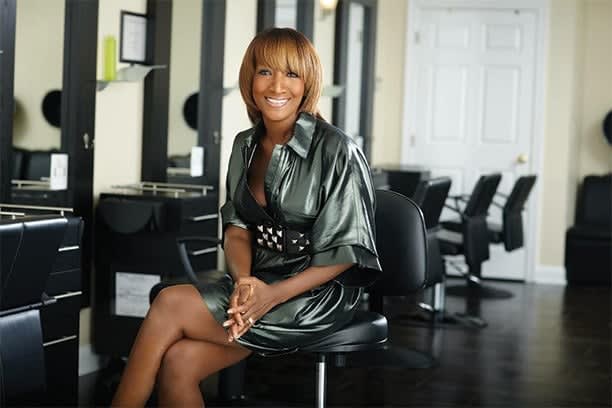
By focusing on offering solutions to clients with thinning hair, Diane Cole Stevens has built an expertise within her Cole Stevens Salons in Washington D.C., as well a on-stage with Nioxin.
7 min to read
Providing answers to hair challenges is a stylist’s main priority. However, there’s one problem many salons have yet to regularly address—thinning hair. Although carrying a line of products for thinning hair is a good start, products alone aren’t going to solve the problem for many clients.
Diane Cole Stevens, owner of two Cole Stevens Salon locations in Washington, D.C., and Maryland, has been tapped into this market for years and has made a name for her salons as the place to go for thinning-hair issues.
Ad Loading...
Starting a dialogue with a thinning-hair client can be a delicate situation. In fact, some stylists avoid it all together. Stevens says that has all changed in recent years.
“We specifically target these clients on social media with makeover photos featuring thin hair made thicker and fuller,” she says. “We also give them lifestyle tips, too, like eating almonds is good for the hair.”
Anthony Crosfield, owner of Union Salon in Vancouver, British Columbia, also built a reputation as a salon that can meet specialized hair needs through advertising on social media and local interest magazines. “Certain stylists in our salon specialize in specific needs, which allow us to customize the stylist to each consumer’s need,” he says.
Most of Stevens’ marketing happens in the chair.
“It all starts with the consultation,” she says. “We first ask our new guests about what their day-to-day life is like. After getting a general idea of their lifestyle, we always ask, ‘If you could change something about your hair, what would it be?’”
Ad Loading...
"We do a lot of treatments because everyone has a hair challenge. Not one person walks in and says, 'My hair is perfect, just give me a cut.'"--Diane Cole Stevens, owner of Cole Stevens Salons in Washington D.C.
This is when guests start opening up about wishing for thicker hair in a certain area, like around the hairline, and Stevens and her staff can address concerns.
“Everything is about options these days,” Stevens says.
Crosfield also prioritizes putting the client at ease before addressing thinning-hair issues.
“Trust is imperative,” he says. “The conversation might take more than one visit because sometimes the client might not realize there has been a change in their hair.”
Ad Loading...
The salon identifies hair loss with three factors: derma (quality of scalp), density (amount of hair) and diameter (fiber size), which allow stylists to open up the conversation by talking about these issues without going directly to hair loss, including other factors like genetics, diet, stress, health and environment.
Introducing Treatment
Once a Cole Stevens stylist has identified the clients’ biggest challenge, the next step is figure out why the hair is thinning.
“Is it stress?” Steven says. “Diet? Medications? The environment? Breakage from hot tools? We start narrowing down the problem and customize a treatment for them.” The salon carries Nioxin products and Stevens is a Nioxin top artist.
“We do a lot of treatments because everyone has a challenge,” Stevens says. “Not one person walks in and says, ‘My hair is perfect, just give me a cut.’
Ad Loading...
“A healthy scalp means healthy hair. So we start with a dermabrasion treatment for the scalp—it’s applied like color. We massage it for one minute and let it sit. It exfoliates all the dead skin cells and makes the scalp a perfect environment for new hair to grow.” This treatment retails for $50, and it’s the first thing stylists are trained to do on new guests.
Crosfield also has a Nioxin salon and uses a Nioscope to examine the scalp skin for an amplified view.
A client is able to achieve the fashion look she wants after Evolve gives her thicker hair.
“It’s a great tool for assessment and educating the client,” he says. “Thin or fine hair has its own set of needs, from cut and color to styling products. We approach the haircut with skill and purpose, being mindful of areas of concern. In coloring, we use gentle colors and shading techniques to create the look of fuller, thicker hair.”
Stevens finds her clients are more comfortable than ever talking about their hair loss issues. However, she’s still sensitive to the language she uses in the salon.
Ad Loading...
“We flipped the script on thinning and just call our treatments and products solutions,” she says. “No one wants to hear the words ‘hair loss’ or ‘thinning,’ They’d rather hear ‘fine hair’ or ‘damaged hair.’ When we started using this language, it opened us up to other markets.”
Evolving Solutions
Unfortunately, some clients need a solution beyond thickening existing hair. Although the bald look has become trendy—even sexy—for men, women still crave a thick head of hair. And some women just want hair, period.
At Glenn Michael Salon in Metairie, Louisiana, owner Glenn Milliet specializes in transforming clients who are virtually bald with the Evolve Volumizer, a wearable solution with a poly-mesh, lightweight base that allows the scalp to breathe and self-molds to the head. It’s flexible and doesn’t cause damage to existing hair.
“It’s immediate texture, density, length and style,” Milliet says. “There’s no gluing, sewing, braiding or shaving of the head. The system is 100-percent human hair and is attached with aluminum connecting points that are rounded so they don’t cause any bending or breakage of the hair.”
Ad Loading...
Milliet’s salon does eight to 16 of these a day—they only take about 30 minutes to put on—and clients can go home that day and shampoo and condition their hair. After that, they come back every four or five weeks for maintenance.
The client cost is $1,200 for a basic system and $1,500 for the Invisible Part system. The first install includes the price of the product and haircut. Maintenance appointments are $120 (the system is taken off and put back on).
The system is a major investment for clients, but Milliet says it’s not a hard sell because you are breaking through the frustrations clients have had with past services.
“Hair is a woman’s most versatile fashion accessory,” he says. “It goes with every outfit she puts on from an evening gown to a night gown, and it’s an integral part of a woman’s self-esteem and self-image. It can be the difference between a woman with self-confidence and a woman who is self-conscious.”
Many of Milliet’s clients come to him after they have had little or no success with volumizing and cosmetic products.
Ad Loading...
“They only work if you have hair,” he says. Some of his clients have even tried pharmaceuticals or hair transplants, to no avail.
“There’s no guarantee drugs will work, and women stand a less than 75% chance of success with a hair transplant. Plus, it takes a minimum of six months just to get stubble.”
Although clients are thrilled with the Evolve results and come back to the salon regularly for maintenance, Milliet cannot rely on them for word-of-mouth marketing for obvious reasons. Their friends and family think it’s their real hair, and clients aren’t about to confess.
So Milliet places a huge sign in front of the salon with before-and-after photos, he runs an ad in the local newspaper every month, and he has a copy of the ad placed on the right side of all his station mirrors right at the client’s eye level.
“Not everyone is a volumizing client,” Milliet says. “But everyone knows someone who is. There are myriad reasons women are thinning out, but at no other time in history have we had women more concerned than now—it’s a huge market.”
Ad Loading...
A client with severe thinning hair issues finds beautiful new hope with an Evolve system.
In October 2011, Milliet saw the opportunity with these clients and started focusing on it. Now, it’s 40% of his business.
“Of all the clients we have today, 90% were not clients until I started doing this service,” he says. “All eight of my stylists do it, and we’ve found price is not a factor.”
For some clients, Milliet offers a payment plan, but he says it’s mostly a non-issue.
“What kind of price can you put on happiness?” Milliet says. “Feeling sexy? Feeling like a woman? We are not in business to sell what we want to sell; we’re in business to sell what the customer wants to buy. It’s our job to figure out what that is.”
Discover how to create a true “WOW experience” for every client by first building a culture where your team feels engaged, empowered, and inspired. Drawing on Calvin Stovall’s Iconic Framework, this blog explores how salon, spa, and clinic leaders can strengthen culture, elevate customer experience, and build a business that stands out for the long term.
The wellness industry is growing fast, and salons and barbershops already are an important part of it. In her first blog, Tracy Rado shares where the wellness dollars are heading, and how salon's can grow with this movement.
While salon sales are increasing, owners often feel they're working harder for the same or less profit. Leverage Q2 data from The KIM Report, Alain Audet reveals some of the structural changes that are dampening your growth and why your region and your salon size matters.
Weaknesses in your business are amplified during the Holiday Season. Spark Pro Global's Lucy Randall shows you five things to do now to have the strongest holiday season yet.
In Kati Whitledge's latest blog, she shares how salons have moved away from dress codes and embraced appearance standards. But by removing strict dress codes, some businesses may have unintentionally lowered their appearance standards. Whitledge helps you explain to your team why an appearance standard is important and how to smoothly implement a new appearance policy.
The Small Business Health Care Tax Credit is a non-refundable tax credit for for-profit businesses that provides a financial incentive for eligible employers who offer health insurance coverage to their employees. Leticia Skrabut, Esq., walks you through how to claim that credit.
Developing strong work habits early in one's career supports long-term success in the salon industry. Jesse Linares offers new stylists his top five tips.
Most salon owners have no idea what these numbers are.
You can hit record sales and still have a profit problem. The difference comes down to four numbers almost nobody was taught to track.
At Janet St. Paul Studio for Hair and Beauty, Director of Operations Natasha McMillen helps bring her wife Janet St. Paul's vision to life, elevating every system from education to operations.
The strongest salons, spas, and med spas know which numbers tell the real story of their business. In this practical guide, Phorest breaks down the five essential KPIs every business should track to improve retention, boost revenue, and make smarter decisions with confidence.
At Bella Style Salon in Slidell, Louisiana, Director of Operations Angela Meyer tackles inventory, team management, and guest relations. Read all about her in our latest Meet the Manager.
Starting at Impressions front desk in 2006 when he was 19 years old, General Manager Paul Petrowsky is a seasoned professional who owner Sarah Taylor says is responsible for much of her own success.
Planning is in full swing for the most anticipated events and promotions for the 2026 holidays. As owners share their favorite ways to celebrate, they prove that a carefully planned event can also build culture, increase client loyalty, boost sales, and set a business up for a successful 2027.
When things run amok at Mane Attraction Salon, Owners Chris and Jenny Knudsen say General Manager Sami Hernandez is their go-to resource and ultimate sounding board. Meet Sami in this installment of Meet the Manager.