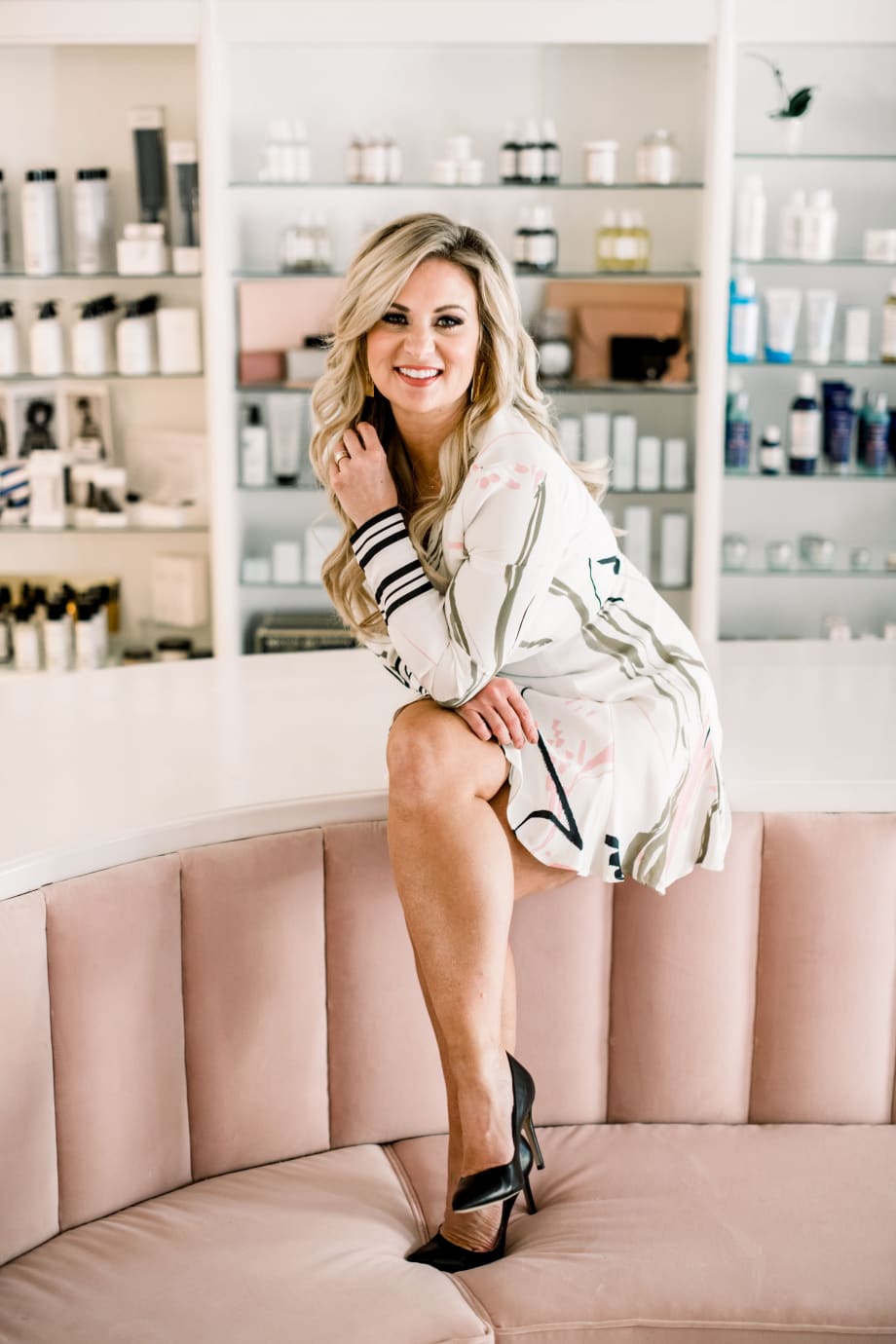
After years of struggling to achieve profitability in a large salon, Elisha Smith buys a boutique salon and shifts her focus to retail.
Elisha Smith opened Lavish in Wilmington, North Carolina, in 2006, in a 3,000-square-foot space with 12 stations, 38 employees, and a full-service salon and spa.
She had barely gotten her business off the ground when the recession hit in 2008. Smith knew she needed to make some changes to stay afloat, so she enrolled in business programs to determine her best course of action.
“The main thing they kept telling me was my profits should be 85/15 (service/retail),” she says. “But at the end of the day, you only make 4% profit on services, and I realized I didn’t love managing people.”
What Smith did love was retail. So she decided to ignore the advice she had received and completely change the way she was doing business. But first, she needed a new space.
Flipping the Script
At Lavish, Smith had a hard time keeping her small inventory stocked because she was so in debt from payroll.
“In my first year, we did more than a million in business, and we were in the red by $300,000,” she says. “The overhead was killing me and I was paying employees what they wanted—in some cases up to 60% commission.”
When Smith realized she couldn’t continue paying commissions that high, she had a massive walk out.
“Morale was down, and that’s when I decided to get training to figure it all out,” she says. “But I realized I still wouldn’t get out of the hole, even if I did everything they said.”
So when the opportunity to buy Blush Haus of Beauté, a small retail and cosmetics boutique, arose in 2010, she seized it, even though it was floundering.
“I purchased at a low price and was able to use a different tax ID so I wasn’t responsible for the previous owners’ debt,” she says. “At Lavish, I had a tiny retail section with a huge salon. With Blush, I have a retail boutique with a small service area in the back.”
Blush has four stylists and the boutique carries more than 25 retail lines, including hair care, skin and body care, makeup, gifts and more.
“If everyone left, I could still manage the business on my own,” Smith says. “Even though the gross profits went way down from my previous business, the net profits went way up.
“I just switched it around—now I manage products.”
Creating a Retail Haven
For one year, Smith managed both Blush and Lavish before closing the latter in 2011. The loan she took out in 2006 to begin Lavish will be paid off in the next year, a huge feat for Smith.
“It was the last bit of debt I had,” she says. “I now use an Amex because I have more flexibility. I’m able to order retail, gift cards for stylists, book travel, etc. It has been a huge game changer for me in ordering inventory.”
At Blush, a well-stocked, diverse inventory is the number-one priority. Smith carries hair care lines like Kerastase, Shu Uemura, Balmain and more, as well as Mason Pearson brushes, makeup, bath and body lines, hand towels and other supporting beauty brands.
“I wanted clients to stop in and shop with us, even when they weren’t getting a service,” Smith says. “I didn’t want the service to be why they come in.”
From candles to skin care to perfume, all the brands Smith carries are luxury items her clients crave.
“We’re in a quaint shopping area with other high-end stores near a beach,” she says.
The results of Smith’s carefully curated retail are an average retail ticket of $42.85 and profits that are 45% retail and 55% service. “I have not seen retail drop below 40% in five years,” she says.
Cultivating an Experience
Blush provides a luxury experience to serve its high-end clientele and match the retail lines on the shelves.
“My mom was a stylist as well, but she had a walk-in salon where she did $7 hair cuts,” Smith says. “Mine are $75. She would see 70 people a day, and I see 12 for the same numbers. You have to cater to your market and know who you’re selling to.”
And when Smith hires, she trains her stylists to deliver a luxury service and to educate clients on retail.
“The products we educate them on will allow them to take care of the style we just delivered in the salon,” she says. “We guarantee our work if they use the support products.”
Occasionally, Smith has a stylist who worries her client can’t afford to purchase the luxury shampoos and styling products.
“I always tell them the most expensive part of buying a boat is not the boat,” she says. “If you’re getting a $600 service, are you really going to use a $5 bottle of shampoo?”
She emphasizes her point by reminding her stylists that it’s not their job to decide what their clients can or cannot afford.
“Their job is to educate clients,” she says. “I make sure every person who walks in the door knows what’s available, because I would be upset if someone didn’t educate me.”
The result has been higher profit margins, which Smith also attributes to her pay structure.
“Stylists start out working as an assistant for me at minimum wage,” she says. “They also get tips from clients, a service commission of 10% and a retail commission of 4.5%.”
During their year as assistants, they learn the blow dry bar, makeup applications and waxing, so they can support other technicians.
“After they consistently meet their numbers, they move up to a level-one stylist at 40% commission on service and 10% on retail,” she says. “After that, if they make their numbers for three months, they can move up the levels. Service commission can go up as high as 50%, but that’s the top. I pay myself 51%.”
This structure, which Smith clearly outlines, has allowed her to maintain profitability.
Bringing Blush to the Community
Smith works hard to make Blush the go-to beauty retail spot in Wilmington. On Fridays, she speaks on a local radio show about beauty, and she attends charity functions in the community.
“I love my business and what I do, and that includes reading about it, researching it and learning my market,” she says.
And for now, she believes her sales belong in Blush, not online. “I wouldn’t want to buy items like makeup or foundation on Amazon,” she says. “You miss out on the experience of the store and the purchase loses its sense of specialness.”
Smith makes shopping at Blush an experience, so her clients want to return, not go online. While she has considered e-commerce on her site, Smith says her next step is education.
“I want to show people you can be at rock bottom and come out,” she says. “I want to devote my time to coaching them and showing them how to learn their market and what people are buying.”
Going through hard times has given Smith the ability to be a valuable resource for other owners looking for change.