In his latest provocative blog, Eurisko's Leon Alexander proposes a new business model for the salon industry that is a hybrid between a commission-based salon and salon suites.
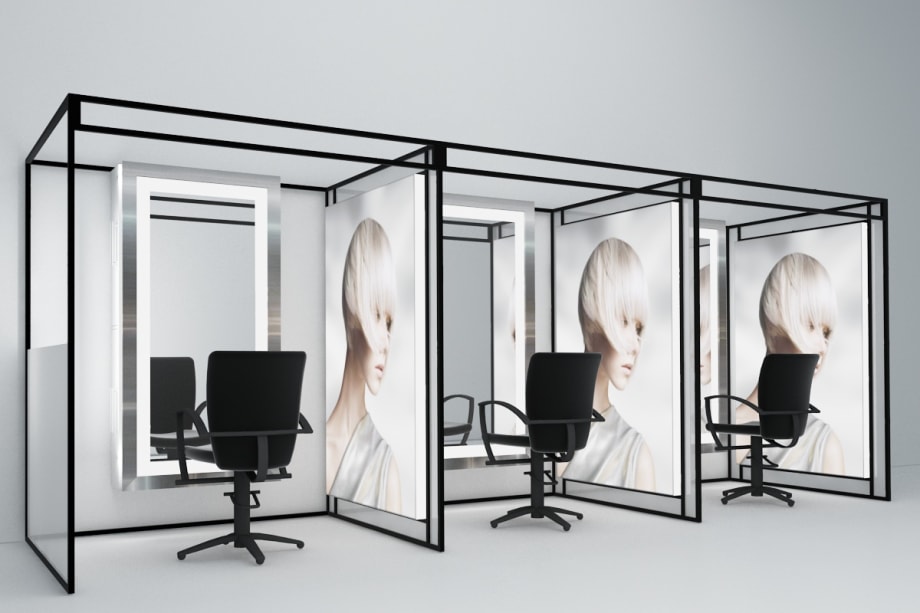
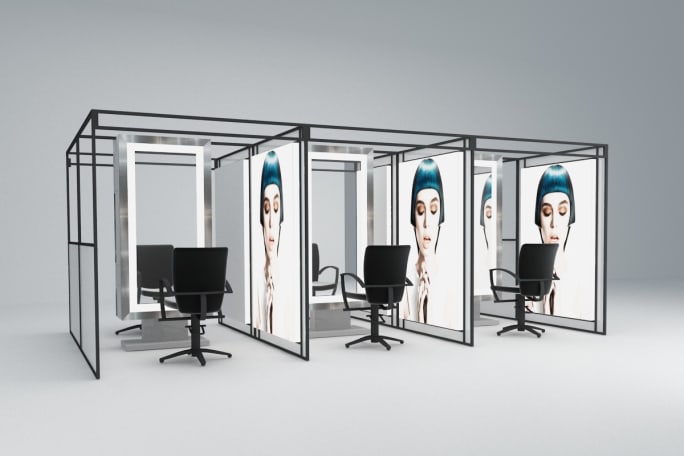
A rendering of the salon pod concept with LED image.
5 min to read
The COVID-19 crisis has made it necessary for many industries to shift their business models quickly. Many are repurposing their assets to create new value, protect their brand and survive. For the beauty industry, it means the existing business model has been disrupted--in some cases, obliterated--and cash flow is drying up.
But COVID-19 isn’t the only reason, it’s just the tipping point. The growth of salon suites, and companies like Amazon meant the current salon business model had been disrupted and affected for many years. It some cases, it was one disaster away from moving from the back burner to crisis mode.
Ad Loading...
The history of the beauty industry is based on a formula of salon owner and service provider. Many salons are commission-based and some are team-based. This formula served the industry well up until the new millennium. The evolution of the internet created a monumental change in the buying habits of consumers, allied to a millennial work-force with a different mindset.
Over the last 10 years, we have seen a rapid growth of both salon suites and consumer online buying. As a result, the profitability of most salons has diminished. The question is, “How can a commission-based model survive in the next ten years?”
In 2017, I wrote an article called, “It's Time for A New Business Model.” In it I challenged readers with the following: How can the existing model survive with increasing overheads, a changing workforce and a savvier consumer? Little did I know at the time, an additional major challenge called COVID-19 would compound our industries challenges.
As a result, a number of salon owners changed their business model and offered additional services and retail other than wet products. As we exit the pandemic, those salons will be in a position to survive and grow, as their business model is formulated with good margins and high profitability.
In addition, the grass isn’t always greener for service providers who made the leap to suites. There are also many challenges for individuals that have moved from a commission salon, to owning their own independent business. Most have a lack of business acumen, little marketing knowledge, no ongoing training, have shortfall in finance, and feel isolated. As a result, it hasn’t worked out for many who have made the change.
Ad Loading...
As we have now established, the industry disruption has affected both salon owner and service provider. What is required is a duality strategy, a third way that must work for both parties within this new business formula. This model would have to be profitable for the salon owner, desirable for the service provider and attractive for the consumer.
A rendering of the salon pod concept with LED image.
The Hybrid Salon Model
The new hybrid salon model has the independent service provider working within an existing recognized salon brand. Nothing new at this stage! It’s when we look at the components below, we begin to see how it benefits both parties:
Service providers will work independently in self-contained Pods within the salon.
The salon owner receives a license fee for leasing the pod.
The salon owner also receives an additional 5-10% of sales from each independent service provider to enable them to market the brand to new customers, arrange business and technical education, and to employ a Maître D-type individual to greet and escort the consumers to each service provider. This keeps the consumer connected and gives additional service.
The salon owner can offer an optional bookkeeping service for the service provider's business.
Data will be collected by a mobile device or monitor in each Pod.
Service provider will own their own business, and can still work the hours they desire.
Service provider will agree to comply with salon dress code. This enables the consumer to continue to see the salon as a brand and not a group of individuals. Consumers don’t want to feel isolated and are generally social. If nothing else, the pandemic has shown the essential connectivity of the human race.
A community area will enable all staff to not feel isolated.
In some cases, the salon owner's haircolor and retail buying power will be a benefit to each individual business. All individuals will have a facility to lock away all of their own color products.
Retail can be purchased from the styling chair and activated by the consumer via an Alexa-type system on a mobile device.
A post COVID-19 refreshment area will enable consumers to connect with other if they desire.
This model with enable service providers to be in business with the support of the salon's systems and programs. They will also be part of a brand and team community, at the same time keeping their own independence.
Ad Loading...
Be the disrupter instead of the disrupted.
We have all heard the common phrase, “Don’t rest on your laurels.” Essentially, resting on your laurels means you are being complacent in your mindset and business model. You may be unwilling to change your mindset because you fear what the change could cause.
Christopher Columbus once wrote, “You can never cross the ocean until you have the courage to lose sight of the shore,”
A couple of examples of complacent companies are Toys 'R Us and Blockbuster. They were huge companies and enjoyed massive amounts of success; however, this was all brought to an end due to their failure to innovate and change their business model. People became reliant on methods which caused them the least amount of hassle and the two aforementioned companies did not adapt or change their business model.
Conclusion
Ad Loading...
There is no one system that is ideal for all salons. It's naturally easier designing a new location to accommodate this new salon model, but it will work for a number of salons that can convert their existing salon to the new business model thinking.
If you want your business to grow, flourish, and ultimately succeed, the only way to do it is to embrace change. No matter how good your business seems in certain areas, it can always be better, and striving for better is what sets you apart.
We must stop thinking we own a salon and start thinking we own a business that operates in the beauty industry. That business needs to operate on best business practices with profitability as the primary objective.
“It’s not the strongest of the species that survive, nor the most intelligent, but the ones most responsive to change.” - Charles Darwin
Discover how to create a true “WOW experience” for every client by first building a culture where your team feels engaged, empowered, and inspired. Drawing on Calvin Stovall’s Iconic Framework, this blog explores how salon, spa, and clinic leaders can strengthen culture, elevate customer experience, and build a business that stands out for the long term.
The wellness industry is growing fast, and salons and barbershops already are an important part of it. In her first blog, Tracy Rado shares where the wellness dollars are heading, and how salon's can grow with this movement.
While salon sales are increasing, owners often feel they're working harder for the same or less profit. Leverage Q2 data from The KIM Report, Alain Audet reveals some of the structural changes that are dampening your growth and why your region and your salon size matters.
Weaknesses in your business are amplified during the Holiday Season. Spark Pro Global's Lucy Randall shows you five things to do now to have the strongest holiday season yet.
In Kati Whitledge's latest blog, she shares how salons have moved away from dress codes and embraced appearance standards. But by removing strict dress codes, some businesses may have unintentionally lowered their appearance standards. Whitledge helps you explain to your team why an appearance standard is important and how to smoothly implement a new appearance policy.
The Small Business Health Care Tax Credit is a non-refundable tax credit for for-profit businesses that provides a financial incentive for eligible employers who offer health insurance coverage to their employees. Leticia Skrabut, Esq., walks you through how to claim that credit.
Developing strong work habits early in one's career supports long-term success in the salon industry. Jesse Linares offers new stylists his top five tips.
Most salon owners have no idea what these numbers are.
You can hit record sales and still have a profit problem. The difference comes down to four numbers almost nobody was taught to track.
At Janet St. Paul Studio for Hair and Beauty, Director of Operations Natasha McMillen helps bring her wife Janet St. Paul's vision to life, elevating every system from education to operations.
The strongest salons, spas, and med spas know which numbers tell the real story of their business. In this practical guide, Phorest breaks down the five essential KPIs every business should track to improve retention, boost revenue, and make smarter decisions with confidence.
At Bella Style Salon in Slidell, Louisiana, Director of Operations Angela Meyer tackles inventory, team management, and guest relations. Read all about her in our latest Meet the Manager.
Starting at Impressions front desk in 2006 when he was 19 years old, General Manager Paul Petrowsky is a seasoned professional who owner Sarah Taylor says is responsible for much of her own success.
Planning is in full swing for the most anticipated events and promotions for the 2026 holidays. As owners share their favorite ways to celebrate, they prove that a carefully planned event can also build culture, increase client loyalty, boost sales, and set a business up for a successful 2027.
When things run amok at Mane Attraction Salon, Owners Chris and Jenny Knudsen say General Manager Sami Hernandez is their go-to resource and ultimate sounding board. Meet Sami in this installment of Meet the Manager.