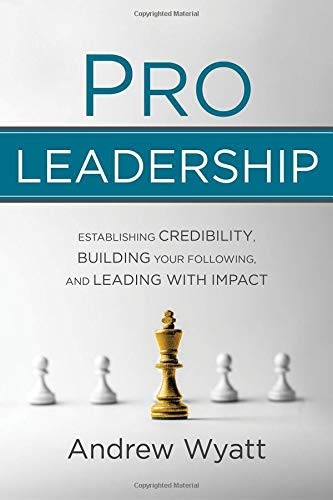
Emotional intelligence, or EQ, is quickly becoming a coveted gold standard for leaders. Here, Andrew Wyatt, an author and an authority on the subject shows you how to build on your credibility as a lead with impact.
In many ways, being an effective leader boils down to your ability to influence people—a proficiency that is driven by one’s Emotional Intelligence Quotient (EQ). Leadership is more about soft skills—the ability to inspire, persuade, guide, sway and communicate in a way that’s “heard” rather than just “listened to”—than it is about being the best relative to hard skills. As a leader, if you do not understand your team’s motivations and feelings, you will never be able to establish an optimally-functioning team and reap the copious rewards related thereto. The result is needless opportunity loss.
To become more adept at such soft management skills, leaders can actively work to improve their EQ. This effort includes—and actually starts with—understanding your own emotions and triggers. What motivates and demotivates you, evokes feelings of stress or satisfaction, compels you to go “above and beyond” or not participate at all? You can conduct these inner exploration exercises on your own in a journal or daily walk, perhaps, while some leaders amp up the effort by conducting self-assessments with a coach, mentor or therapist.
“If you are to lead with maximum efficacy, you must build an enthusiastic following,” notes leadership authority Andrew Wyatt, author of the new book, Pro Leadership: Establishing Your Credibility, Building Your Following and Leading With Impact. “This requires relational and people skills as well as all of the related soft skills that contribute to one’s EQ. And, a leader cannot staff EQ out. You must to have it yourself. Those who don’t will need to develop it to realize truer and more unencumbered success.”
According to Wyatt, whose eponymous company develops leaders worldwide through coaching, speaking, training and consulting, the good news is that everyone can develop their EQ. Unlike IQ, which pretty much is what it is, EQ can be nurtured, developed and increased. Below are a few excerpted insights from Wyatt’s book on why EQ matters to leadership, how to lead amid different EQ/IQ types and developing your leadership EQ—both in your organization and within yourself.
Why EQ Matters to Leadership
Pro leaders must have the ability to influence others to follow them, and the most important ingredient in influence is relationship. The key to a winning relationship is winning the heart, and doing so is not possible without EQ. You may have a high IQ and natural giftedness in your vocation, but if you are unable to influence others—you may be effective as a manager—you will never be a leader.
Remember, leadership is about people, and people will follow with their head for only so long before they eventually grow weary and peel off or fade away. But if, through your relational abilities, they feel your love and care for them, they will follow you even when times get tough. That is why it is vital to your leadership to allow your EQ to lead.
But EQ alone won’t be enough. In fact, it must be balanced with IQ. Although IQ is not a natural leader attribute, and as a result is best relegated to the back seat, it is important to the success of any enterprise. Your role as leader will be to balance both EQ and IQ, to manage the balance and tension between the two. That balancing act will be manifested through how your team works together.
Recall that EQ builds companies and IQ builds products; it is not possible to have one without the other. At the same time, one is not valued over and above the other. Although the theme of this lesson is to let your EQ lead, that does not make it more valuable than IQ—both are required to win.
3 Types of Players
When filtering for EQ and IQ, there are three categories of people you will find. I have worked with, followed, or led all of these: EQ dominant; IQ dominant; and EQ/IQ flexible. A strong culture, organization and team will have all three types of players on their roster. Where the two dominant types will normally be position players, most pro leaders will be flexible. Let me explain.
To be great a company, you must add value through offering a great product. IQ builds products. People who are IQ dominant have high IQs—a natural gift that, when applied, results in great products that add value to people’s lives. Consider the advances in medicine, science and technology. None would have been possible without the work of IQ-dominant people.
To successfully lead an IQ-dominant player, you will need to first satisfy their intellect through a clear and rational articulation of your vision and strategy. Next, they need to be enlisted in forming the tactics you will employ to accomplish the strategy. Since they are the product designers, they will want to have shared ownership of the product before they follow your lead and buy into your vision. Once you have satisfied their intellect, you are free to win their hearts.
The second player type is the EQ-dominant individual. This person is also a position player. You will most often find them in advertising and creative positions, client service, marketing and sales—critical roles if a company is to be successful. Rarely will they build a product, but their EQ is invaluable in product development, specifically in refining products in order to bring forward the product the market is demanding. These individuals are valuable because they understand the basic truth that no one has ever bought anything; they are sold on something.
To lead EQ-dominant players, a leader must always start with the heart. You must offer a creative vision and strategy and they must see you as the courage behind the plan. They want to be led, from their heart to their head. And while you must appeal first to their creative side, you may not ignore their rational side because that is where their fears exist. As their leader, they will naturally look to you for courage and to help them overcome their fears.
The third type of player on your roster will be what I define as EQ/IQ flexible. Every great leader I have met or studied fell into this category. The defining characteristic of this person is her ability to balance EQ and IQ—specifically, having the ability to discern which attribute needs application to a particular circumstance and to execute the proper timing of the use of the attribute. In athletics, this is called hand-eye coordination. All athletes have it to one degree or another, and the degree to which they do is what separates the amateur from the professional. EQ/IQ flexible personalities have the ability to walk into a room and immediately judge the chemistry, while subsequently activating the attribute most suited to the current environment. Whether a board room or a lunchroom, they are comfortable in both environments because they have the ability to adapt instantly to each environment.
This is my personality type and, as a result, I find these people the most difficult to lead. Nevertheless, to lead EQ/IQ personalities effectively, start with their heart by appealing to their deepest motivations. But don’t stop there. You will need to follow with the logical argument as you clearly build your case. If you win them to your cause, they will become your greatest ally because they will naturally become spokespersons for that cause. However, this is a two-edged sword. If you lose their trust—or if they simply do not accept your vision and the mission—it may hinder their work. In the end, these personalities are a strong proof-source that the true measure of leadership is influence—nothing more, nothing less.
Developing EQ in Yourself and Others
Setting an EQ standard starts where every other cultural development begins, with leadership. That would be you. Based on the principle you read about in the last chapter, to develop a culture-wide EQ you will need to start with yourself, beginning with your attitude toward the people you are leading. As humans, we naturally favor ourselves. That means, if I am an EQ-dominant person, I will naturally be drawn to other EQ-dominant people. The same is true for the IQ-dominant person. This is fine for friendships. However, favoring one trait over the other in your organization will create a culture of favoritism, resulting in dysfunction caused by this imbalance. As the leader, it is critical for you to have no favorites, with the ability to defend both camps.
Developing EQ among your leadership team is a necessary activity of pro leadership. These leaders realize they cannot succeed alone. As John Maxwell astutely commented, “If you want to go fast, go alone; if you want to go far, go with others.” The extent to which you foster EQ among the members of your inner circle is the extent to how far your leadership team will go. To do this as a leader, you will need to start at the same place you did with your cultural EQ: your attitude. Leadership development of any type is a process, not a destination. It is a journey that never ends. When you stop developing, you stop growing.
No matter what your own EQ level is, ongoing personal development is always important. Read all you are able to find on the topic. Second, if you don’t have one, consider working with a coach. Third, join a peer group or start one yourself. It is true that iron sharpens iron. Developing EQ is not a solo sport, you will need to have some people to rub up against. Leadership is a lonely business; you need to have someone to talk to, a safe environment to share and people who will tell you the last 10 percent—that bit of information most people won’t tell you.
“IQ builds products, but EQ builds companies and followings. So, as you step out today to lead, let your EQ lead the way,” Wyatt urges. “Develop your EQ, your culture’s, your team’s, and your own. Do so, and you will have taken a big step in developing your following and your pro leadership abilities, putting yourself in a prime position to be able to motivate the people you lead.”