Change Makers: A Feel-Good Tale of 10 Salons Giving Back
While most salons generously donate gift cards or product baskets to organizations who ask, others rally behind a cause in their community and create their own events or awareness campaigns.
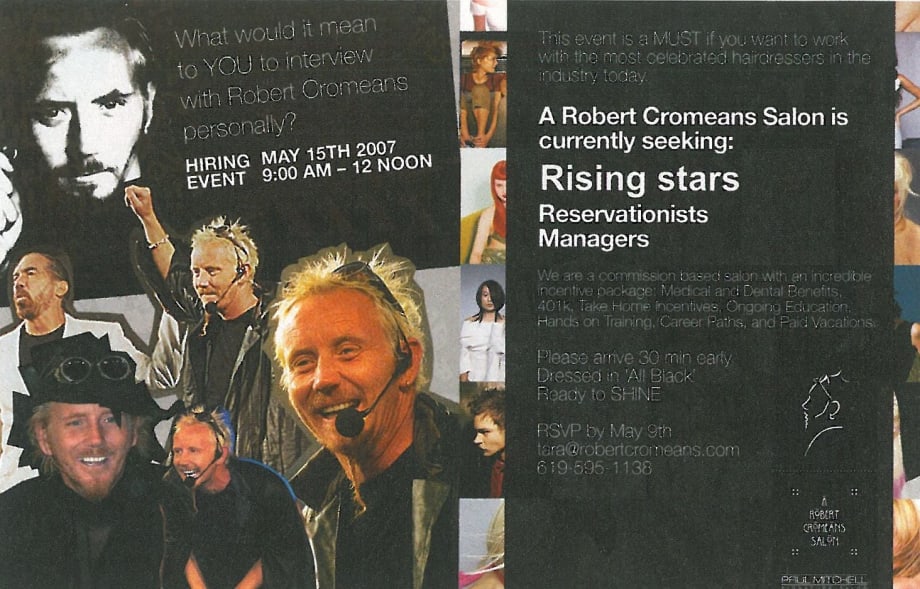
Every two months, the salon hosts a hiring event in Las Vegas and San Diego, and Cromeans personally attends each event. It’s important to him since it is where people get their first impression of the company.

“I put 100 percent of my energy into thinking about how to get hairdressers and clients,” says Robert Cromeans, owner of A Robert Cromeans Salon in San Diego, California. “We’re always developing new staff. We’re in the headhunting business. It’s a 365-day-a-year recruitment campaign. No matter how much staff we have, we’re always looking for more.”
Every two months, the salon hosts a hiring event in Las Vegas and San Diego, and Cromeans personally attends each event. It’s important to him since it is where people get their first impression of the company. “That’s where I’m putting my time. You may spend all day working behind the chair for a $1,000 day, when working on campaigning and getting hairdressers may be a much better value,” he says. The company also has a policy of not hiring staff from other salons in the area; the only way to get hired at A Robert Cromeans Salon is to start at the beginning.
The company developed the recruitment events at the beginning of last year, and has decided to make them the constant focus this year. The company gets between 60 and 100 potential new employees at each one. When they arrive (“30 minutes early, dressed in black and ready to shine!”), each person fills out an application form with 20 to 30 questions (with some “crazy questions,” too). After a tour of the salon—including unique areas like the Lather Lounge (a quiet area where clients are shampooed)—the students get a chance to talk to Cromeans about what would make them.
At each event, they end up bringing back about 10 students for a longer interview process —a full, eight-hour day. This gives the staff a chance to see how they handle themselves and how comfortable they are with the team. But even if they are not hired in either round, Cromeans always encourages them to come back and try again. “It’s a never-ending audition,”
“In all of my organization, the salons are at about half capacity of where I think we should be,” says Cromeans. It’s all a part of his idea that the industry needs to think bigger—filling chairs double or triple to keep the energy consistent and to give opportunities to part-timers, keeping them in the industry, too. It’s all about thinking ahead, he says. “We lost a few people last year, and we didn’t lose any ground. The more people, the better.”
Once you’ve hired the staff, the flip side is keeping them—and keeping them happy. Cromeans also makes addressing that aspect an important part of his job. “Most of the time as an owner, I was getting my heart broken. You train staff and then they move on, and it’s not always to other salons,” he says. “So we looked at the patterns of why people were leaving, then gave them 10 reasons to stay. That’s why we have a daycare on-site. We’re a career path-minded company and we know how important the employees are to growth and substance.” Ultimately, he says, it is up to salon owners to have the right things in place to keep people coming into the industry—and staying. That includes a career path, education and a good benefits package. “The pay scale has to be clear, stepping stones have to be clear, you have to make the culture self-evident, and they have to know where they can get coaching on their weaknesses,” says Cromeans, “Getting a well-trained team is the hardest thing to achieve, but once you get it in motion, it takes off.”


While most salons generously donate gift cards or product baskets to organizations who ask, others rally behind a cause in their community and create their own events or awareness campaigns.

Are one of your traditional, handed-down salon management practices actually breaking the law. The pros from Paragon HR Consulting walk you through seven common Human Resources mistakes that could land you in hot water.

All beauty professionals should know how to identify when a client may need some health guidance. Tracy Rado discusses some common questions that clients ask in the chair, how to advise them, and when to refer them to a specialist.

In his latest blog, Leon Alexander Ph.D., challenges industry conventional thinking to help owners add more to their bottom lines.

In her latest blog, Amy Pal helps you develop your own clear guidelines around complimentary free employee services.

From managing air traffic on busy days to handling frustrated guests' complaints, your front desk team often serves as the salon's emotional shock absorber. From a customer service lesson from the DMV to a list of strategies for caring for your front line, our experts offer ideas for alleviating stress, celebrating wins, and setting goals.

According to the KIM Report, top-line salon revenue appears steady or slightly up, but that growth is driven primarily by service price increases. Beneath the surface, retail performance and client visit frequency (appointment drift) are under real pressure. In his latest blog, Alain Audet offers strategies for keeping your salon's retail sales strong.

Putting your family to work in the salon offers some real tax benefits, but you have you have to play by the rules of the tax code to claim them. Azarvand Tax Law's Leticia Skrabut, Esq., shows you how.

Discover how to create a true “WOW experience” for every client by first building a culture where your team feels engaged, empowered, and inspired. Drawing on Calvin Stovall’s Iconic Framework, this blog explores how salon, spa, and clinic leaders can strengthen culture, elevate customer experience, and build a business that stands out for the long term.
Sponsored by Phorest Salon Software

The wellness industry is growing fast, and salons and barbershops already are an important part of it. In her first blog, Tracy Rado shares where the wellness dollars are heading, and how salons can grow with this movement.

While salon sales are increasing, owners often feel they're working harder for the same or less profit. Leverage Q2 data from The KIM Report, Alain Audet reveals some of the structural changes that are dampening your growth and why your region and your salon size matters.

Weaknesses in your business are amplified during the Holiday Season. Spark Pro Global's Lucy Randall shows you five things to do now to have the strongest holiday season yet.

In Kati Whitledge's latest blog, she shares how salons have moved away from dress codes and embraced appearance standards. But by removing strict dress codes, some businesses may have unintentionally lowered their appearance standards. Whitledge helps you explain to your team why an appearance standard is important and how to smoothly implement a new appearance policy.

The Small Business Health Care Tax Credit is a non-refundable tax credit for for-profit businesses that provides a financial incentive for eligible employers who offer health insurance coverage to their employees. Leticia Skrabut, Esq., walks you through how to claim that credit.

Developing strong work habits early in one's career supports long-term success in the salon industry. Jesse Linares offers new stylists his top five tips.

Most salon owners have no idea what these numbers are. You can hit record sales and still have a profit problem. The difference comes down to four numbers almost nobody was taught to track.
Sponsored by Strata Salon Systems™

A five-area audit every owner-dependent salon needs to run. You built something that looks successful. Now find out if it can survive without you.
Sponsored by Strata Salon Systems™