Hate seeing salon products in drugstores? Here's what's new and what you can do.
Ad Loading...
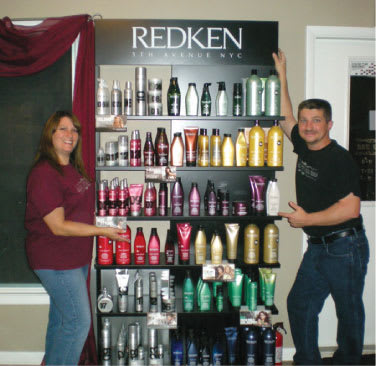
Mike O'Neill, Sr., co-owner of Hair Studio 322 in Glenmoore, Pennsylvania, says he's hip-deep in the diversion trenches. For the past three years, he's been working closely with several manufacturers and distributors, using most his salon's profits, he says, to fight diversion. Why? Because it impacts salons' bottom line, decays trust and hinders the ability to carry more inventory or hire support staff.
IN THE SALON
Mike and Jennifer O'Neill Hair Studio 322, Glenmoore, PA hairstudio322.com
Passionate diversion fighters, the O'Neill's share what worked for them.
SALON TODAY: What are your top, strategic successes? MIKE O'NEILL: Having Target and ACME remove their products due to a complaint we made to the Better Business Bureau. We're getting the manufacturers, distributors and salons working together, but there's still a long way to go.
ST: How do you address diversion with clients? MO: We educate them on our website, blogs, manufacturer sites, in print ads and in the salon. We address diversion when discussing products and answering clients' questions. Time spent with the client is the best way to address the issue. Don't be shy, but know the facts first.
ST: How have your clients reacted toward diversion? MO: We get a lot of surprised clients who are happy to learn the issues. One said, "Thank you for letting me know about the dangers and price differences." Every time they take note of the price difference or a new label covering the UPC codes, we hear about it on their next visit. Since educating clients, we've had an increase in new clients doing word-of-mouth for us, fighting diversion. We've also seen increased products sales.
ST: What can other salons do to fight diversion? MO: It's not up to us to tell another salon how to run its operations. But the best advice is to get involved. A great starter is contact your distributor and/or manufacturer. Also, inform your clients about diversion issues.
"Yes, we can hire more support staff from product revenue," says O'Neill. "Most salon owners are surprised to find out what retail does to their bottom line. From handouts to T-shirts, travel to legal help, we spend a lot of time and money fighting diversion. My goal is to put products back in the professional hands that know what's best for clients. We also want to help end diversion for the sake of future generations."
At Empire Group, which has 94 schools in 20 states, chairman and CEO Frank Schoeneman is also future-focused. His students are highly aware of diversion, he says, and are becoming numb to it, which is dangerous.
"We teach young people to believe in service and sales components," says Schoeneman. "But students are not hard-wired to sell; they have to learn about it in a real salon. Diversion hurts their future earning potential."
By just how much? According to Paul Finkelstein, chairman and CEO, Regis, and president of the Beauty Industry Fund (BIF), which tracks diverted sales using ACNielsen's SCANTRACK, nearly $1 billion or about 22 percent of the professional market is in diverted sales.
"It's hard to determine the professional numbers, but the products represent between $3 billion to $5 billion at retail," says Finkelstein. "Fifteen years ago it was under $1 billion."
The good news, according to BIF: Between the second quarter of 2008 and the second quarter of 2009, diverted dollar volume for total hair care decreased by 14.4 percent. The bad news: Diverted dollar volume across all outlets between Q1/2009 and Q2/2009 increased by 1.3 percent. This is the first increase in dollar sales of diverted products observed since Q3/2008, and it follows the lowest dollar volume quarter in the last two years. It's time to get active, and a history lesson shows how.
The How and Why of it Diversion is nothing new. In the '70s, Mike Nave, an industry sales and marketing consultant at PDD/BIR Inc., Calabasas, California, was owner of Mercury Beauty Supply. Major professional manufacturers, he says, picked his operation as one of six nationally that was authorized to sell to the mass market.
"We were redistributors; it was perfectly legal," says Nave. "It was also a way for manufacturers to say they did not personally divert. I was selling Costco half a million dollars a year in TreSemme. Sometimes, products were drop-shipped and simply billed through me, and I billed Costco in turn."
Eventually, he says, companies cut out the middle man and began selling directly to retailers. Brands like Aussie Three-Minute Miracle and others eventually became full-fledged consumer brands.
"Nexxus was diverted for years; it was a huge success when it went retail," notes Nave.
Today, Nave works with clients who are developing new embedded technology to track diversion. At each step, the products are scanned-even when a professional-only store sells to a solo stylist. The result: It's simple to discover who along the chain diverted.
The history between Nave's career shifts goes something like this: Salons created demand for professional lines; demand increased with direct-to-consumer advertising. Companies with rising costs had to meet numbers by raising prices or selling more; the pressures increased with consolidation and publicly-held parent companies with shareholders to satisfy. Salons, traditionally poor retailers, never reached a national retail average above 10 percent of service. Something had to give. Consultants say salons are rarely the culprits: Collectors buying from salons couldn't possibly account for hundreds of millions of dollars in diverted products.
"If consumers want professional products, sources will appear to supply them," Neil Ducoff, founder and CEO of Strategies, Centerbrook, Connecticut, says. "The primary reason they buy them in non-salon outlets is convenience. Throughout my 39 years in this industry, I've seen documented proof of some manufacturers diverting their own products. I've heard executives state, ‘Diversion is a line item on our profit and loss statement.'"
Several manufacturers have tried to fight through the courts, with mixed results. In Matrix Essentials v. Quality King (1998), the industry lost in a U.S. Supreme Court ruling that basically said after the first sale, you cannot dictate who can resell a product to whom. So, diversion was legal, breach-of-contract not withstanding. However, in Davidoff v. CVS (2009), the U.S. Court of Appeals for the Second Circuit ruled that if label tampering was involved, it was illegal.
Says O'Neill, "Ninety-nine percent of diverted products have the UPC labels tampered with or covered totally, which means the FDA cannot control problems or issue recalls, based on the labels."
Adds Finkelstein, "Today, any company can stop diversion through distributor contracts and coding that is invisible to consumers. But if there is no demand for $4 million more of a product in salons and a company wants to do $4 million more, there's a problem."
What's Being Done Activist salons and schools are switching to less- or non-diverted brands, filing complaints and educating consumers. Finkelstein says Regis cut off one vendor and cut back on purchases of another, using buying power to register his diversion aversion.
Manufacturers are enforcing detailed distributor contracts, and are taking advantage of new technologies like embedded codes, which allow them to precisely track diverted product.
Says Cyrus Bulsara, president of Professional Consultants & Resources, a Plano, Texas-based strategic consulting company, specializing in the professional salon and beauty industries, "Several companies secretly print their containers with invisible batch-codes, in ink that can be seen only under special lights. Some are dropping electronic and other ‘tags' into the products, which only they can identify. In one case, where we represented a large corporation, a police raid caught a diverter using forceps to remove such ‘tags,' and utilizing instruments and chemicals to wipe off the secretly embedded batch-codes. Many products have also been found to be diluted and/or adulterated."
What You Can Do Today At Salon Posh in Taneytown, Maryland, owner Danielle Hanfman says she carefully educates her clients about bacteria and black-market products.
"I explain why they need my recommendation," she says. "Many clients pick the wrong product. Most commonly, women with fine, curly hair think they need a volumizer, which ends up blowing out the cuticle."
RETAIL 4 REAL
Chelly Vitry, an industry consultant who runs thestyliststoolbox.com, an online resource for salon professionals, says many salons don't want to compete on price. They don't "discount" when products are on sale from the manufacturer or pass along the deal. But having everything the same price all of the time contributes to the false notion that professional products cost more in the salon, she says.
"Retail is a tool that generates income, rewards clients, boosts loyalty and grows the business," says Vitry. "Salons should use creativity to retail instead of focusing on diversion as a roadblock." Her strategic salon-sales ideas:
• Build the retail into the cost of the service and give it away. • Ask salon clients to trade in their grocery-store shampoo for a few dollars off a new bottle; give the old stuff to charity. • Give away a bottle of shampoo as a new client gift. • Reward referrals with professional products. • Offer frequent-buyer incentives, using punch cards. • Feature a specially priced product of the month, such as finishing spray at 25% off. • Give clients a $1 rebate for bringing back an empty bottle of shampoo.
Ad Loading...
A former distributor salesperson, Hanfman says the job opened her eyes. Many salons blamed her for diverted lines, even though she played no part in diversion and her employer had bought back diverted product just to get it off drugstore shelves. When her salons began switching to smaller, non-diverted brands, she advised them to call manufacturer hotlines and display their salon price side-by-side with a drugstore sales receipt, so clients could see that the products cost more outside the salon. (Several news investigations show diverted products are priced higher.)
Today's technologies make reporting diversion easy, says Bulsara-use your cell phone to record diversion; add a time/date stamp and the banner of the diverting store. Then report to the professional company concerned by phoning or e-mailing the designated sales or security department.
Gordon Logan, president, International SalonSpa Business Network, and CEO/founder of Sport Clips, Inc., says the tragedy is that the demand for salon products was created by the very stylists who suffer the most from diversion. He says salons should report diverted products to local distributors, and if they get no action, remove the line or switch to a less-diverted brand.
"Diversion is a very difficult problem, and the internet makes it harder to police," says Logan. "Surveys show that a sizable majority of salon clients never receive product recommendations from their stylists and that most would buy if their stylist recommended. We can't keep complaining about diversion, while we are not doing our part to keep sales in salons."
Comments Ducoff, "The accountability of controlling diversion falls squarely on the shoulders of the professional product manufacturers. But in order to truly stop diversion, manufacturers will need to rethink how their products are sold to consumers through salons. Simply put, they will need to reengineer their approach to distribution to ensure accountability and compliance."
Nave agrees, noting it's time for everyone to think outside the box.
"Salons should consider hiring a retailing professional," says Nave. "Retailing isn't just selling; it's following a plan-o-gram, merchandising and more. Ten years ago, OPI's George Schaeffer suggested Pro Beauty Centers; professional-only stores that are split, with one section open to the public, selling only hair care. Or, why not let distributors take over the salon's retail section, merchandise it and give the salon 30 percent?"
Nave adds that convenience buyers care more about time than money, and a dollar difference between salon and drugstore purchase doesn't make much of a difference. Women won't go out of their way for a shampoo they can get anywhere, so you'd best recommend it while they're in your salon.
Ultimately, says Ducoff, the logistics and cost of completely overhauling a distribution approach is massive. The chances of an interruption in product availability and delivery is high. And, there is no guarantee that the new approach will finally and permanently slam the door on diversion.
"Yes, diversion is an annoyance; I stress the word annoyance," Ducoff says. "The primary reason consumers buy professional products in non-salon outlets is convenience. Given this, I am dumbfounded at the number of salons that surrender retail sales to convenience outlets. They fail to use what convenience outlets can never compete with-the professional recommendation.
"Salon technicians have their client's undivided attention for extended periods of time. The advantage is clearly in the salon's favor-but only if salons capitalize. Sadly, salons surrender retail sales to convenience outlets because they just don't build the systems and skills to play the professional retail game to win. Those who do have little reason to waste energy on diversion."
Discover how to create a true “WOW experience” for every client by first building a culture where your team feels engaged, empowered, and inspired. Drawing on Calvin Stovall’s Iconic Framework, this blog explores how salon, spa, and clinic leaders can strengthen culture, elevate customer experience, and build a business that stands out for the long term.
The wellness industry is growing fast, and salons and barbershops already are an important part of it. In her first blog, Tracy Rado shares where the wellness dollars are heading, and how salon's can grow with this movement.
While salon sales are increasing, owners often feel they're working harder for the same or less profit. Leverage Q2 data from The KIM Report, Alain Audet reveals some of the structural changes that are dampening your growth and why your region and your salon size matters.
Weaknesses in your business are amplified during the Holiday Season. Spark Pro Global's Lucy Randall shows you five things to do now to have the strongest holiday season yet.
In Kati Whitledge's latest blog, she shares how salons have moved away from dress codes and embraced appearance standards. But by removing strict dress codes, some businesses may have unintentionally lowered their appearance standards. Whitledge helps you explain to your team why an appearance standard is important and how to smoothly implement a new appearance policy.
The Small Business Health Care Tax Credit is a non-refundable tax credit for for-profit businesses that provides a financial incentive for eligible employers who offer health insurance coverage to their employees. Leticia Skrabut, Esq., walks you through how to claim that credit.
Developing strong work habits early in one's career supports long-term success in the salon industry. Jesse Linares offers new stylists his top five tips.
Most salon owners have no idea what these numbers are.
You can hit record sales and still have a profit problem. The difference comes down to four numbers almost nobody was taught to track.
At Janet St. Paul Studio for Hair and Beauty, Director of Operations Natasha McMillen helps bring her wife Janet St. Paul's vision to life, elevating every system from education to operations.
The strongest salons, spas, and med spas know which numbers tell the real story of their business. In this practical guide, Phorest breaks down the five essential KPIs every business should track to improve retention, boost revenue, and make smarter decisions with confidence.
At Bella Style Salon in Slidell, Louisiana, Director of Operations Angela Meyer tackles inventory, team management, and guest relations. Read all about her in our latest Meet the Manager.
Starting at Impressions front desk in 2006 when he was 19 years old, General Manager Paul Petrowsky is a seasoned professional who owner Sarah Taylor says is responsible for much of her own success.
Planning is in full swing for the most anticipated events and promotions for the 2026 holidays. As owners share their favorite ways to celebrate, they prove that a carefully planned event can also build culture, increase client loyalty, boost sales, and set a business up for a successful 2027.
When things run amok at Mane Attraction Salon, Owners Chris and Jenny Knudsen say General Manager Sami Hernandez is their go-to resource and ultimate sounding board. Meet Sami in this installment of Meet the Manager.