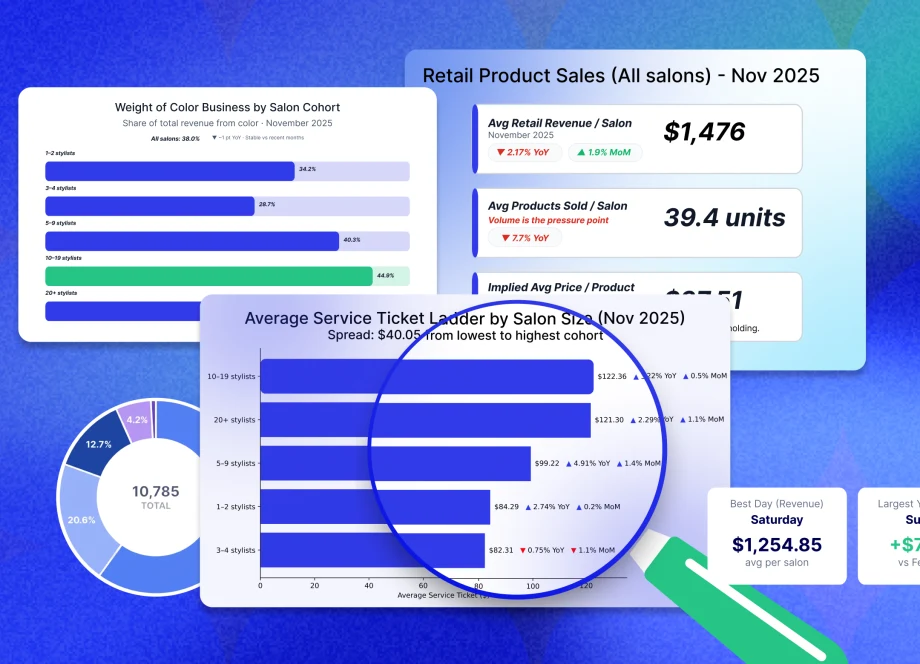
The KIM Report was created to address the industry's fundamental data gap by conducting a monthly anonymous national census of U.S. salons. The report sorts the industry into five distinct groups, based on the number of service providers you have, allowing you to compare yourself to your peers.
by Alain Audet, VP of Sales and Marketing for SalonInteractive and the KIM Report
April 17, 2026
Credit: KIM Report
4 min to read
For the longest time, running a salon has felt much like a guessing game. As an owner or manager, you may have found yourself asking, 'Are we keeping up with the salon down the street?' or maybe worrying, 'Is this slow week just me, or is the whole industry struggling?'
The problem is that, with over 222,000 independent businesses in the U.S., from solo artists in suites to big, multi-location salons, there has never been a single, reliable answer or a true benchmark. You were forced to base major business decisions on gut feelings, word-of-mouth rumors, or reports that just didn’t reflect your actual business.
Ad Loading...
Today, data isn't just numbers anymore; it's the absolute best foundation you have for building a smart, strategic plan. Data gives you an objective way to see exactly how you stack up against other salons of your size. More than that, reliable information helps you move past the guesswork, allowing you to set real, achievable goals for your business growth. Shifting from relying on anecdotes to using concrete numbers is the single biggest move you can make for success.
The Truth About the U.S. Salon Market: Meet Your Peers
The KIM Report was created to address this fundamental data gap by conducting a monthly anonymous national census of U.S. salons. The key to the report’s accuracy is its commitment to market segmentation through cohorts.
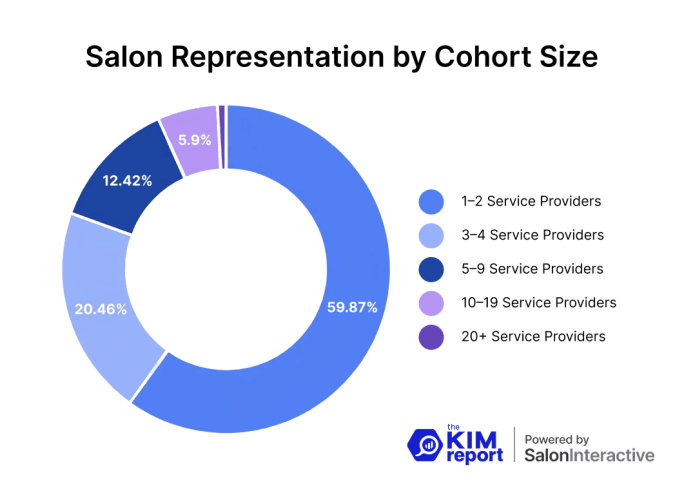
The KIM Report sorts the entire U.S. industry into five distinct groups, or cohorts, based on one simple thing: the number of service providers you have. Why? Because comparing your four-chair salon to a multi-location salon is useless. You need to compare yourself to your direct peers and service provider count is the key to accuracy.
How the U.S. Salon Industry Segments
To create a truly representative view of the vast U.S. market, The KIM Report segments all independent beauty businesses into five distinct size cohorts based solely on the number of service providers:
Credit: KIM Report
Why This Segmentation is Your Competitive Edge
KIM’s segmentation is vital because it recognizes that your operational and financial model is fundamentally different from a business twice or half your size. When data is fragmented, the entire professional beauty supply chain, from brands to distributors, suffers, creating inefficiencies that ultimately cost you money. Accurate, cohort-specific data, however, creates a focused, profitable path for everyone.
Ad Loading...
How Accurate Data Improves Your World (The Ultimate Win)
When brands and distributors operate with clear, accurate data, the salons are the ultimate winners:
Relevant Support: You stop receiving generic, one-size-fits-all business advice and start getting education and support programs that directly align with your operational scale and financial realities. For example, a suite renter would get a program designed for maximum profitability in a one-person business. At the same time, a 15-provider salon receives training opportunities about leadership and team management, ensuring the support is always actionable.
Better Product Access: A more efficient, data-driven supply chain means product availability is more reliable, and pricing structures are better aligned with the purchasing power of your specific cohort, ensuring you have what you need to serve clients without logistical headaches.
How The KIM Report Delivers Actionable Data
The KIM Report breaks down its national census data in distinct ways, all designed to give the most relevant context for specific businesses:
Data by Cohort: This is where salon owners and managers find the most value. You can compare your performance to direct peers, businesses of comparable size, enabling realistic, actionable planning.
Ad Loading...
All Salons Excluding Solos: This view excludes the large 1–2-provider cohort, providing a more accurate benchmark for owners of traditional, team-based businesses, as their financial models are fundamentally different from those of independent/suite renters.
Per-Stylist Benchmarks: To normalize the data and ensure fair comparisons, The KIM Report measures performance at a per-stylist level. This view is key to setting realistic growth goals, as you can compare your revenue per stylist to the average for your specific cohort size, or even target the numbers of the top 10% of businesses within your cohort for an ambitious yet attainable goal.
By applying KIM’s cohort-specific information, you can move beyond guesswork. Stop panicking when business slows down by checking objective data to see if your dip is part of a broader industry trend. More importantly, you can use the industry median for your cohort's key metrics to set concrete, measurable targets, giving your business a reliable, data-backed roadmap for growth.
KIM Salon View
The KIM platform is not brand new. Its manufacturer and distributor version has already been in market for more than a year, while KIM for Salons, the version designed specifically for verified salon owners and managers, is expected to become available in late summer 2026.
Reserve your spot HERE for when the salon view is available.
Ad Loading...
About the Author: Alain Audet is a beauty industry veteran who holds an MBA from the University of Hull in England. He has held leadership roles across professional haircare, salon technology, and industry organizations, with a special focus on growth and education for the salon channel. Alain currently serves as vice president of sales and marketing at SalonInteractive, where he leads market development, partnerships, and sales enablement initiatives for The KIM Report and On Behalf Marketing.
Discover how to create a true “WOW experience” for every client by first building a culture where your team feels engaged, empowered, and inspired. Drawing on Calvin Stovall’s Iconic Framework, this blog explores how salon, spa, and clinic leaders can strengthen culture, elevate customer experience, and build a business that stands out for the long term.
The wellness industry is growing fast, and salons and barbershops already are an important part of it. In her first blog, Tracy Rado shares where the wellness dollars are heading, and how salon's can grow with this movement.
While salon sales are increasing, owners often feel they're working harder for the same or less profit. Leverage Q2 data from The KIM Report, Alain Audet reveals some of the structural changes that are dampening your growth and why your region and your salon size matters.
Weaknesses in your business are amplified during the Holiday Season. Spark Pro Global's Lucy Randall shows you five things to do now to have the strongest holiday season yet.
In Kati Whitledge's latest blog, she shares how salons have moved away from dress codes and embraced appearance standards. But by removing strict dress codes, some businesses may have unintentionally lowered their appearance standards. Whitledge helps you explain to your team why an appearance standard is important and how to smoothly implement a new appearance policy.
The Small Business Health Care Tax Credit is a non-refundable tax credit for for-profit businesses that provides a financial incentive for eligible employers who offer health insurance coverage to their employees. Leticia Skrabut, Esq., walks you through how to claim that credit.
Developing strong work habits early in one's career supports long-term success in the salon industry. Jesse Linares offers new stylists his top five tips.
Most salon owners have no idea what these numbers are.
You can hit record sales and still have a profit problem. The difference comes down to four numbers almost nobody was taught to track.
At Janet St. Paul Studio for Hair and Beauty, Director of Operations Natasha McMillen helps bring her wife Janet St. Paul's vision to life, elevating every system from education to operations.
The strongest salons, spas, and med spas know which numbers tell the real story of their business. In this practical guide, Phorest breaks down the five essential KPIs every business should track to improve retention, boost revenue, and make smarter decisions with confidence.
At Bella Style Salon in Slidell, Louisiana, Director of Operations Angela Meyer tackles inventory, team management, and guest relations. Read all about her in our latest Meet the Manager.
Starting at Impressions front desk in 2006 when he was 19 years old, General Manager Paul Petrowsky is a seasoned professional who owner Sarah Taylor says is responsible for much of her own success.
Planning is in full swing for the most anticipated events and promotions for the 2026 holidays. As owners share their favorite ways to celebrate, they prove that a carefully planned event can also build culture, increase client loyalty, boost sales, and set a business up for a successful 2027.
When things run amok at Mane Attraction Salon, Owners Chris and Jenny Knudsen say General Manager Sami Hernandez is their go-to resource and ultimate sounding board. Meet Sami in this installment of Meet the Manager.