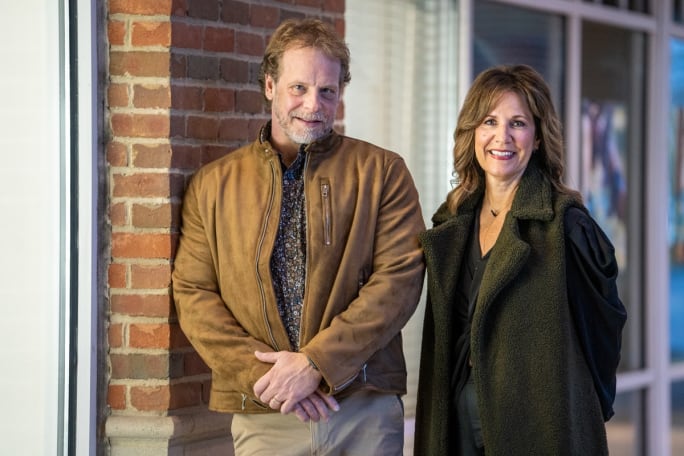
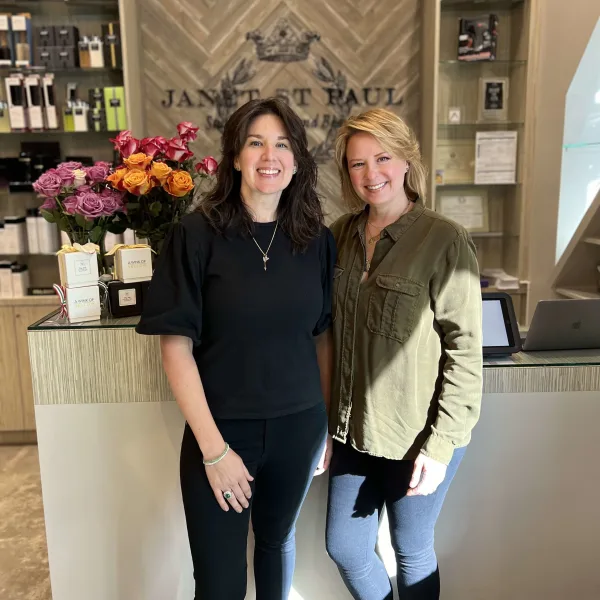
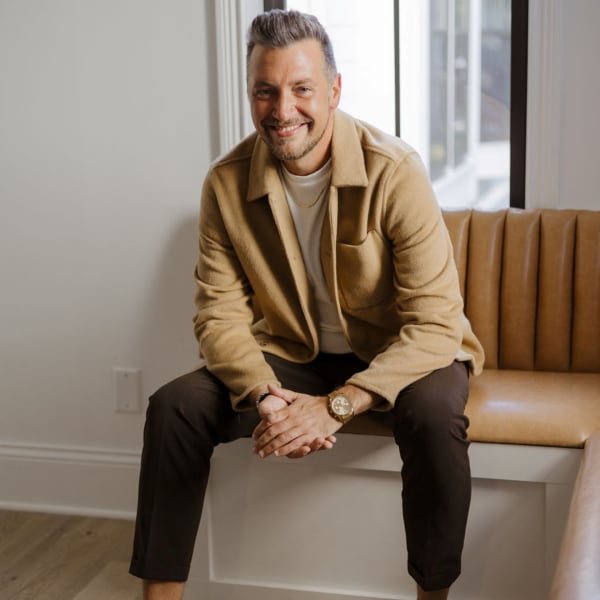
Tony Anders and Kenneth's Salon Manager Jody Achatz
Kenneth’s Hair Salons and Day Spas is quite the outlier. While Employee Stock Ownership Plans (ESOPs) are relatively common in other industries, the structure is practically unheard of for salons, which typically have a single owner or a small number of partners.
For 30 years while growing his Columbus, OH, salon to 10 locations, founder Kenneth Anders was a more traditional salon owner. As he began to look ahead to retirement, he started contemplating what would come next for the business he loved and its more than 300 employees.
Ad Loading...
Exit Strategy
“There was never a succession plan,” says Tony Anders, the son of Kenneth Anders and a member of the administrative team. “When my father was creating an exit strategy in 2007, he said he didn’t want to be the only guy on the beach celebrating the creation of this company.” When it didn’t feel right to someday ride off into the sunset while risking the stylists’ jobs through a sale or even a transfer to the next generation, Kenneth sought other options for the salons that had his name on their doors. An ESOP seemed like the perfect solution.
“A lot of people helped to build this company,” Tony Anders explains. “When the employees were made part of the future, it helped leverage this forward. Now everybody has a chance to gain and profit from the company. My father is still CEO, but now he lives in Florida and pops up here in the summer.”
Even before he launched his own salon, Kenneth was a hairdressing pioneer and visionary.
“In the mid-1960s when my dad started out, he was among the first to bring in a blow dryer and curling iron,” Tony Anders says. “He was told he’d never make it as a hairdresser that way, because people would never style their own hair! And after that he was always about elevating the hairdresser. ‘Take it, teach it,’ he’d say.”
How ESOPS work
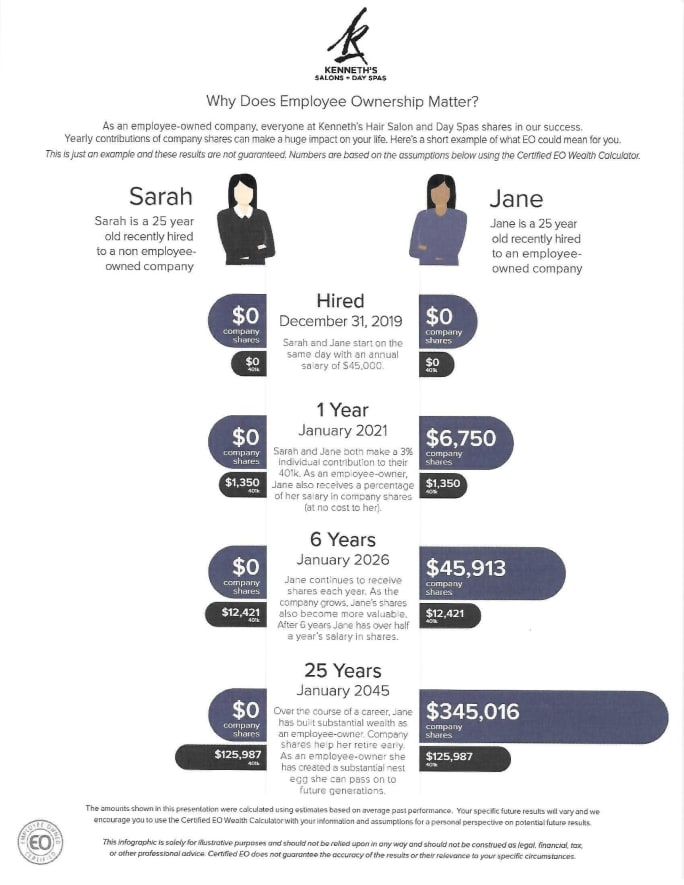
A comparison of staff income between a traditionally owned salon and an ESOP salon that both offer 401k benefits.
When an ESOP is formed, every employee has a stake in the business. There is a board of directors and other legal considerations of a corporation, and there’s a leadership team as in any salon, but everyone on staff is a part owner.
Ad Loading...
“I’m an employee like anybody else,” Tony Anders says. “I clock my hours and show up for my job.”
At Kenneth’s, a new employee is fully vested after three years. This is automatic; the employee does not invest money or take any action to become a fully vested stock owner.
An independent ESOP trustee is responsible for overseeing the company’s stock, which is held in a trust. At the end of each year, the trustee hires an independent valuation expert to calculate an estimated fair value of the company and determine the annual stock price. An independent recordkeeper tracks and reports the shares held by the trust on behalf of each employee-owner. Each year shares are allocated by the recordkeeper to employee-owners using a specific compensation-based formula. ESOP participants receive a personalized statement with the stock price determining the value of the shares allocated and held by the trust on their behalf. If the company has grown during the year, the employee’s stock value will have grown accordingly. Anders reports that the annual ESOP benefit has averaged about 20% of each employee’s yearly earnings. It can feel like a nice bonus.
The company is obligated to repurchase shares from ESOP participants when they retire or after a five-year waiting period for employees who leave the salon before reaching retirement age. If the company is ever sold, the purchaser will be obligated to pay employees their stock value.
Educated “Owners”
Seeing the salon’s success financially benefit them has increased the employees’ interest in how their income is calculated and in money management in general.
Ad Loading...
“I went through my whole career not knowing much about my earnings,” says Tony Anders, who returned to salon work after a 10-year break for a second career as a therapist. “Now we’re working on staff compensation literacy—what benefits look like, where your taxes go, understanding the paycheck.” The management team uses a “wealth calculator” to project each employee’s annual growth both short- and long-term, based on the number of clients they want to service per day and the number of days they work per week.
Transparency is built into the structure. When COVID forced a two-month shutdown, that transparency helped Kenneth’s salons navigate the bumps.
“Because we’re 100% employee-owned, everyone saw that we were maintaining a profitable position,” Anders reports. “We were able to continue to pay people through the first pay period by projecting out what their pay would have been, and then we helped them maintain their insurance payments. Becoming a 100% employee-owned ESOP company was a natural fit for a salon that has always been managed from an employees-first perspective. The voice of our employee-owners is important to determining our path forward."
Anders further explains that committees of staffers do much of the planning.
“You might be new and sit on a committee next to long-time decision-makers,” he says. “The answer is never ‘no because I said so.’ People tend to have the most say in their areas of passion—education or marketing or numbers, whatever their niche. We ask, ‘What are your passions from an ownership standpoint?’ Then they join that committee and learn why retail is important, how the budget works. They become a more educated voice, and then the management team in the ‘office’ is not seen as corporate.”
Ad Loading...
They’re all corporate, really, and that changes things. They understand that every staffer’s performance contributes to the salon’s growth, and they all benefit financially when the salon’s value increases.
“They invest themselves differently, and they cheer on each other from within,” Anders says. “I think my dad did the most fair and generous thing he could have done by giving the business back to the people who have been working here. The very first employee he hired in 1977 still works here as a stylist. She will have a nice ability to retire. And for right now? She comes in and wants to cut and color hair.”
Discover how to create a true “WOW experience” for every client by first building a culture where your team feels engaged, empowered, and inspired. Drawing on Calvin Stovall’s Iconic Framework, this blog explores how salon, spa, and clinic leaders can strengthen culture, elevate customer experience, and build a business that stands out for the long term.
The wellness industry is growing fast, and salons and barbershops already are an important part of it. In her first blog, Tracy Rado shares where the wellness dollars are heading, and how salon's can grow with this movement.
While salon sales are increasing, owners often feel they're working harder for the same or less profit. Leverage Q2 data from The KIM Report, Alain Audet reveals some of the structural changes that are dampening your growth and why your region and your salon size matters.
Weaknesses in your business are amplified during the Holiday Season. Spark Pro Global's Lucy Randall shows you five things to do now to have the strongest holiday season yet.
In Kati Whitledge's latest blog, she shares how salons have moved away from dress codes and embraced appearance standards. But by removing strict dress codes, some businesses may have unintentionally lowered their appearance standards. Whitledge helps you explain to your team why an appearance standard is important and how to smoothly implement a new appearance policy.
The Small Business Health Care Tax Credit is a non-refundable tax credit for for-profit businesses that provides a financial incentive for eligible employers who offer health insurance coverage to their employees. Leticia Skrabut, Esq., walks you through how to claim that credit.
Developing strong work habits early in one's career supports long-term success in the salon industry. Jesse Linares offers new stylists his top five tips.
Most salon owners have no idea what these numbers are.
You can hit record sales and still have a profit problem. The difference comes down to four numbers almost nobody was taught to track.
At Janet St. Paul Studio for Hair and Beauty, Director of Operations Natasha McMillen helps bring her wife Janet St. Paul's vision to life, elevating every system from education to operations.
The strongest salons, spas, and med spas know which numbers tell the real story of their business. In this practical guide, Phorest breaks down the five essential KPIs every business should track to improve retention, boost revenue, and make smarter decisions with confidence.
At Bella Style Salon in Slidell, Louisiana, Director of Operations Angela Meyer tackles inventory, team management, and guest relations. Read all about her in our latest Meet the Manager.
Starting at Impressions front desk in 2006 when he was 19 years old, General Manager Paul Petrowsky is a seasoned professional who owner Sarah Taylor says is responsible for much of her own success.
Planning is in full swing for the most anticipated events and promotions for the 2026 holidays. As owners share their favorite ways to celebrate, they prove that a carefully planned event can also build culture, increase client loyalty, boost sales, and set a business up for a successful 2027.
When things run amok at Mane Attraction Salon, Owners Chris and Jenny Knudsen say General Manager Sami Hernandez is their go-to resource and ultimate sounding board. Meet Sami in this installment of Meet the Manager.