









You Don't Own a Salon. You Own A Business.
In his latest blog, Leon Alexander Ph.D., challenges industry conventional thinking to help owners add more to their bottom lines.
 MENU
MENU SEARCH
Both clients and staff members can overwhelm you with negative emotions. A new book shows you how to use systematic reasoning and critical thinking to control the negative emotional contagion.

A smile is contagious but so are toxic negative emotions such as pessimism, cynicism, depression, fear, hate, panic, anxiety and suspicion, as well as conspiracy theories, explains retired clinical psychologist Dr. Bruce Hutchison.
“We live in a time when America and the world are facing an invisible enemy,” he said. “Social and political relations are fraught with turmoil … but turmoil does not come without emotions. Little has been written about the power of toxic negative emotions and emotional contagion in this time of global turmoil.” Until now.
Dr. Hutchison’s innovative book, Emotions Don’t Think: Emotional Contagion in a Time of Turmoil, describes toxic emotional contagion as one of the most powerful forces at play in society and in politics in the last few decades, building to a crescendo.
“Emotions are usually thought of by analysts as a ‘soft’ factor in politics, when, in reality, they are critical ‘hard’ factors because they cause the turmoil of our times,” Dr. Hutchison said in his groundbreaking book. “We need to learn how to handle it to help us adapt to today’s stress.”
Emotions Don’t Think describes how to use systematic reasoning and critical thinking to put necessary limitations and stipulations on incoming emotions.
“In this book, I use my psychological knowledge to explain how to stem the flow of negative emotional contagion in our current social and political environment,” he said. “It is important to know how to evaluate an emotion that comes at you in order to decide if it should be acted on as is, tempered, minimized or blocked.”
Emotions Don’t Think presents a psychological perspective on events in contemporary society, with an emphasis on the effects of emotions and how they are contagious and impact the people who may absorb them. There are five chapters on overcoming the effects of contagious toxic emotions by using healthy psychological principles. It is Dr. Hutchison’s hope that these principles can be used to help society mitigate and cope with emotional contagion in this day and age.
“People use these emotions to think, but emotions can only feel,” Dr. Hutchison added. “Emotions don’t think.”
About the Author:Dr. Bruce Hutchison received his Ph.D. in Clinical Psychology from the University of Ottawa in Canada in 1984. He received his M.A. in Psychology from the University of Manitoba in 1969. As a clinical psychologist with 50-plus years of experience performing psychotherapy, counselling, consultation and assessment to thousands of clients and patients in various settings, he understands people, emotions, relationships, allegiances, social trends, thoughts, behavior and what makes people tick. He has worked as a psychologist in prisons, hospitals, social agencies, mental health programs and for many years in independent private practice, providing psychological services in three Canadian provinces. He has worked for private companies assessing candidates' psychological suitability to carry firearms. He has been an oral examiner of candidates striving to become a psychologist. He has served on boards of psychology in two Canadian provinces and on a national basis in Canada. He has appeared on TV and radio, speaking about various topics, such as managing stress, handling emotions, building self-esteem, overcoming depression and conquering phobias. Now retired, Dr. Hutchison lives in Ottawa, Ontario, Canada, with his wife, Catherine, and their cat, Spring. He has two adult children and 10 lovely grandchildren.
In his latest blog, Leon Alexander Ph.D., challenges industry conventional thinking to help owners add more to their bottom lines.
In her latest blog, Amy Pal helps you develop your own clear guidelines around complimentary free employee services.
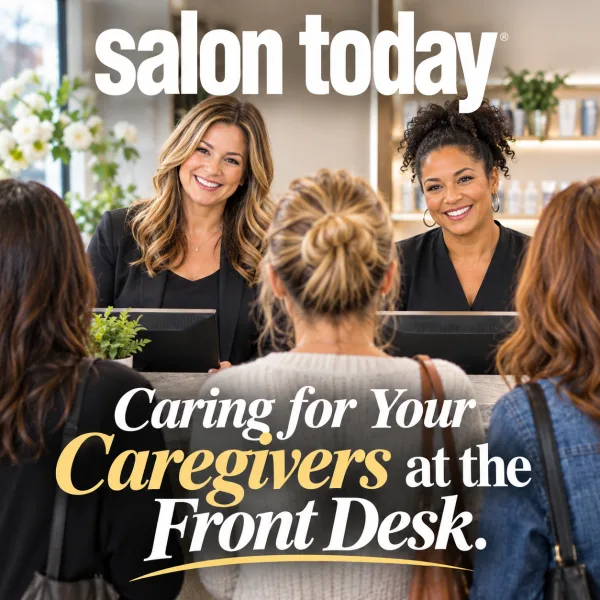
From managing air traffic on busy days to handling frustrated guests' complaints, your front desk team often serves as the salon's emotional shock absorber. From a customer service lesson from the DMV to a list of strategies for caring for your front line, our experts offer ideas for alleviating stress, celebrating wins, and setting goals.

According to the KIM Report, top-line salon revenue appears steady or slightly up, but that growth is driven primarily by service price increases. Beneath the surface, retail performance and client visit frequency (appointment drift) are under real pressure. In his latest blog, Alain Audet offers strategies for keeping your salon's retail sales strong.

Putting your family to work in the salon offers some real tax benefits, but you have you have to play by the rules of the tax code to claim them. Azarvand Tax Law's Leticia Skrabut, Esq., shows you how.

Discover how to create a true “WOW experience” for every client by first building a culture where your team feels engaged, empowered, and inspired. Drawing on Calvin Stovall’s Iconic Framework, this blog explores how salon, spa, and clinic leaders can strengthen culture, elevate customer experience, and build a business that stands out for the long term.
Sponsored by Phorest Salon Software

The wellness industry is growing fast, and salons and barbershops already are an important part of it. In her first blog, Tracy Rado shares where the wellness dollars are heading, and how salons can grow with this movement.

While salon sales are increasing, owners often feel they're working harder for the same or less profit. Leverage Q2 data from The KIM Report, Alain Audet reveals some of the structural changes that are dampening your growth and why your region and your salon size matters.

Weaknesses in your business are amplified during the Holiday Season. Spark Pro Global's Lucy Randall shows you five things to do now to have the strongest holiday season yet.

In Kati Whitledge's latest blog, she shares how salons have moved away from dress codes and embraced appearance standards. But by removing strict dress codes, some businesses may have unintentionally lowered their appearance standards. Whitledge helps you explain to your team why an appearance standard is important and how to smoothly implement a new appearance policy.

The Small Business Health Care Tax Credit is a non-refundable tax credit for for-profit businesses that provides a financial incentive for eligible employers who offer health insurance coverage to their employees. Leticia Skrabut, Esq., walks you through how to claim that credit.

Developing strong work habits early in one's career supports long-term success in the salon industry. Jesse Linares offers new stylists his top five tips.

Most salon owners have no idea what these numbers are. You can hit record sales and still have a profit problem. The difference comes down to four numbers almost nobody was taught to track.
Sponsored by Strata Salon Systems™
A five-area audit every owner-dependent salon needs to run. You built something that looks successful. Now find out if it can survive without you.
Sponsored by Strata Salon Systems™

Every month you put off fixing the problem, it gets bigger, more expensive, and harder to solve.
Sponsored by Strata Salon Systems™

At Janet St. Paul Studio for Hair and Beauty, Director of Operations Natasha McMillen helps bring her wife Janet St. Paul's vision to life, elevating every system from education to operations.

Expand your color service menu with the Pinstripe technique. Brooks and Brooks' Marlon Hawkins walks you through the technique.