It's Time to Give African-American Hair Stylists the Credit They Deserve
Jo Owens was intrigued to learn about a "new" hair replacement solution until she figured out it was a technique African-American stylists, including her sister Helen Owens, have been doing for decades. She's here to set the record straight.
by Jo Owens, and Op-ed piece
March 20, 2025
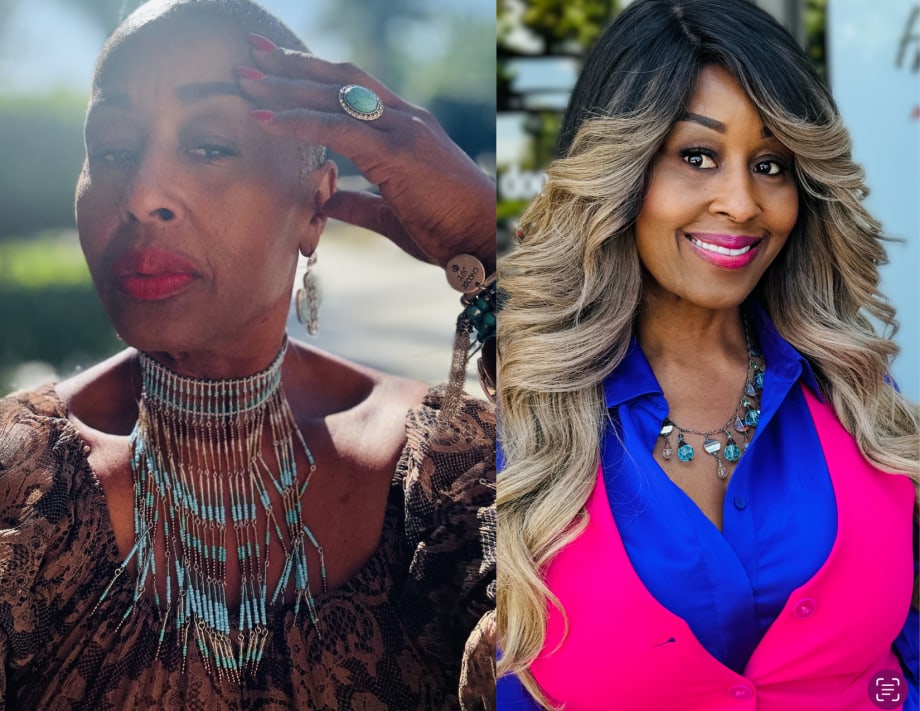
Helen Owens is an alopecia survivor as well as a salon owner and concierge stylist that champions women who suffer from hair loss.
6 min to read
As a woman with a family history of hair loss, I’m elated whenever a new hair replacement solution becomes available to our hair loss community. So, when I read recently about a new “mesh integration” method that’s starting to take off here in the US I was thrilled.
That is until I saw what it entailed.
Ad Loading...
I had to check twice to be sure I was seeing it correctly. And when I did, I was floored to discover that a technique used in various forms by my African-American/Black community for decades was being given a new name and "certification,” then sold to majority-Caucasian hair salons wanting hair loss solutions for their clientele.
My visceral reaction after coming across this information was the same as the one I had in the late 1970s when I read that the braids our African-American community has worn as both a crown of beauty and a protective hairstyle for generations, would now be known as “The Bo Derek Look.”
As an African-American woman I’m used to seeing the designs, creations, and inventions by our Black community overlooked and often credited to Caucasians, but this one was a particularly hard gut-punch. Here’s the reason: For the last three decades I’ve worked alongside my sister Helen Owens, an African-American hair loss specialist, who has been practicing this very technique on her white and Black clients throughout her entire 40+ year career. She calls it the Net Method and it's one of myriad staples in her hair-loss solutions toolbox. Helen worked to perfect this application to not only cover the bald spots of her clients but also induce hair growth.
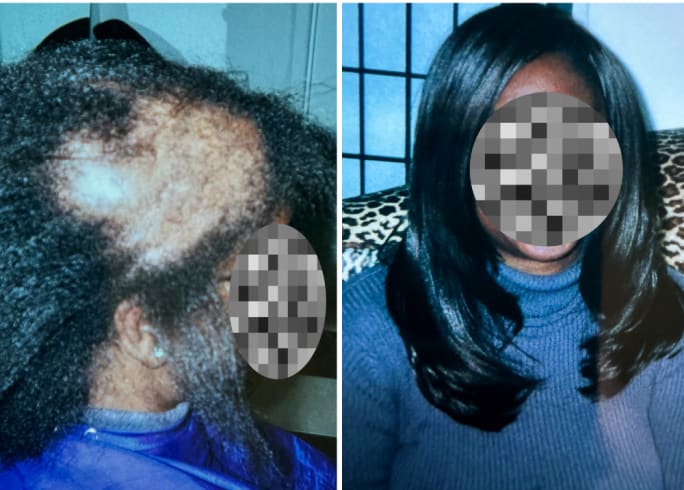
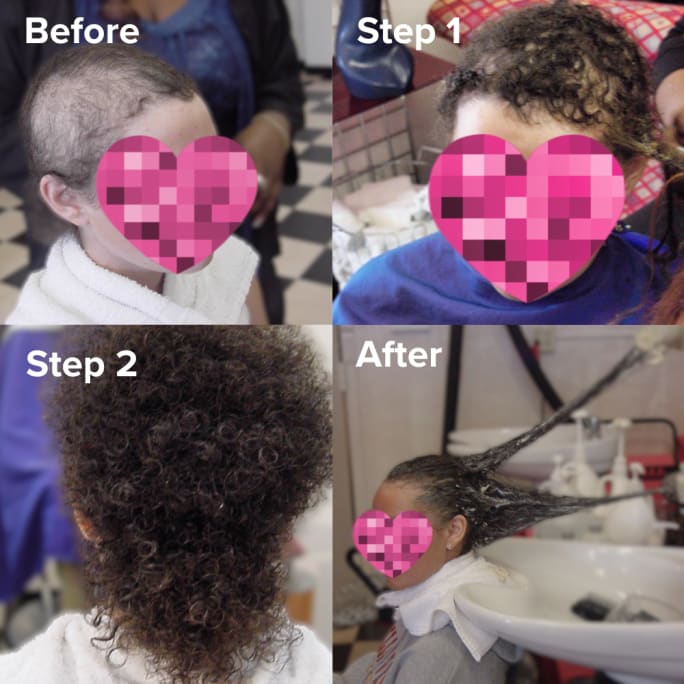
Before and After images of one of Helen Owens' clients who was helped with the Net Method Hair technique. (The pictures in this story are from Owens' archives and are digitized versions of printed pictures taken between 1999 and 2006)
Seeing this decades-old method being marketed as “something new” is challenging to say the least. But more important, it’s another gap that widens the Mason-Dixon line between white and Black stylists.
What makes the Net Method attractive—and only when it’s done correctly—is its ability to stay in place for an extended period (typically 3-4 months at a time) and allow the wearer to have an active lifestyle while wearing it.
Ad Loading...
African-American hair stylists for years have gravitated to some form of this method because of its reliance on a tried-and-true skill that every Black girl grew up either hearing about or learning: the ability to master hair braiding. Braids are a great way to keep our textured hair looking beautiful and protected from breakage, heat, and chemicals. Those braids became the basis of what many Black hair stylists have used for attachment methods in the practice of hair weaving (not to be confused with color hair weaving), which uses thread to interweave human hair into a client’s existing hair in order to cover bald spots and/or create the illusion of a fuller head of hair.
Like so many Black girls in the African-American community, Helen became a master braider at a young age. Since the beginning of her career she has used that talent to create intricate cornrow designs as a base attachment for her hair weaving creations. That braiding skill sparked an interest early in creating a similar attachment option that would allow for more space to weave in the human hair, cover any existing bald spots, and induce growth of the bio hair.
With this client's images, you can see the different steps involved.
The Net Method, which uses a variation of precisely placed braids that holds a strong fabric net in place, was the answer. It provided a foundation—a blank canvas—that allowed clients to experience a total makeover of their natural hair. Curly girls could now wear straight hair without chemicals, brunettes could be blond in an instant without using bleach, and balding girls could hide their spots, appear to have hair of any length, and get the benefit of growth of their natural hair. In each case, as Helen likes to say, “every woman who’d ever admired another’s hair could now have the hair everyone admired.”
While the Net Method traveled easily between Black stylists, what I noticed over the years was that white stylists had trouble correctly applying the braiding portion of it. Particularly for hair weaving patterns that require complex, labyrinthine braid patterns to ensure maximum coverage and overall hair health, mastering the braid attachment is paramount. Getting it wrong can lead to damage to the bio hair. That’s particularly true for Black women, whose “fragile hair structure makes them more susceptible to breakage.” Getting the braiding technique exactly right also means avoiding hair loss conditions like traction alopecia.
The use of braids as a successful attachment takes great skill and lots of practice. Their intricate designs, controlled tension, and unique placement is not at all easy to master. To that end, when I started seeing attachments like “microbeads” and “tape-ins” gaining popularity in majority salons and labeled as “hair extensions” to distinguish them from “hair weaving,” I wondered if this was yet another response to the limited knowledge of African-American hair care.
Ad Loading...
Rather than mastering the techniques Black women were using to build a hair community that included all women—particularly those with hair loss—I watched as my industry drew yet another proverbial line in the sand between white and Black stylists. Generally speaking, these “hair extensions” marketed to majority-white salons have a minimum “hair length” requirement which traditionally leaves out women with hair challenges.
Owens uses the net method to help clients of all ethnicities. In addition to her two locations, she is a concierge stylist who helps clients in their own home when they are concerned with privacy.
Similarly, what I experienced while seeing the hype around this “new” mesh integration technique was a familiar scene: In typical whitewashed fashion, a Black-stylist-created-product/service/method is “transformed” once financing and capital gets behind it, leaving the original creators who typically don’t have access to those investors and funds in the background.
I’ll summarize with this: An estimated 30 million women in the US alone suffer from hair loss so I celebrate educating all stylists on being able to help them. But I think it’s also important to recognize the impact African-American women’s creativity and outside-the-box thinking have had on hair loss solutions.
As a community, our textured hair has given us the gift of being able to create a host of unique hairstyles, and for years our creativity and creations have been overlooked, cast aside, and even held for political debate. It’s time to set the record straight and give African-American stylists and the hair designs we create the credit they deserve. It’s not only fair, it’s beneficial to an entire community of people.
Stylists can better serve their clients when they have access to the knowledge that help is everywhere, in every stylist of every color and every method. Each time a stylist presents her client with a solution she is instilling confidence, hope, and healing. Sharing the history of that solution ensures that clients can make the best choices for their health and that the stylists who helped create those solutions aren’t left behind.
Ad Loading...
About Helen and Jo Owens: Helen Owens, alopecia survivor and veteran hair replacement pro, and her sister Jo Owens are the team behind a movement to empower and uplift women with hair loss. Helen Owens owns Her Secret Hair, with two locations in Alamo and Livermore, California, where she champions women like herself. She also is a concierge stylist and custom wig maker. Jo Owens is her right hand, managing the business and working to share Helen’s talents with the world. Helen's Livermore location was recently awarded a NextDoor Neighborhood Fave award in the Wellness and Personal Care category. You can learn more about this team via Instagram, their 51-episode podcast, and their award-winning book Finding Our She-Compass.
Discover how to create a true “WOW experience” for every client by first building a culture where your team feels engaged, empowered, and inspired. Drawing on Calvin Stovall’s Iconic Framework, this blog explores how salon, spa, and clinic leaders can strengthen culture, elevate customer experience, and build a business that stands out for the long term.
The wellness industry is growing fast, and salons and barbershops already are an important part of it. In her first blog, Tracy Rado shares where the wellness dollars are heading, and how salon's can grow with this movement.
While salon sales are increasing, owners often feel they're working harder for the same or less profit. Leverage Q2 data from The KIM Report, Alain Audet reveals some of the structural changes that are dampening your growth and why your region and your salon size matters.
Weaknesses in your business are amplified during the Holiday Season. Spark Pro Global's Lucy Randall shows you five things to do now to have the strongest holiday season yet.
In Kati Whitledge's latest blog, she shares how salons have moved away from dress codes and embraced appearance standards. But by removing strict dress codes, some businesses may have unintentionally lowered their appearance standards. Whitledge helps you explain to your team why an appearance standard is important and how to smoothly implement a new appearance policy.
The Small Business Health Care Tax Credit is a non-refundable tax credit for for-profit businesses that provides a financial incentive for eligible employers who offer health insurance coverage to their employees. Leticia Skrabut, Esq., walks you through how to claim that credit.
Developing strong work habits early in one's career supports long-term success in the salon industry. Jesse Linares offers new stylists his top five tips.
Most salon owners have no idea what these numbers are.
You can hit record sales and still have a profit problem. The difference comes down to four numbers almost nobody was taught to track.
At Janet St. Paul Studio for Hair and Beauty, Director of Operations Natasha McMillen helps bring her wife Janet St. Paul's vision to life, elevating every system from education to operations.
The strongest salons, spas, and med spas know which numbers tell the real story of their business. In this practical guide, Phorest breaks down the five essential KPIs every business should track to improve retention, boost revenue, and make smarter decisions with confidence.
At Bella Style Salon in Slidell, Louisiana, Director of Operations Angela Meyer tackles inventory, team management, and guest relations. Read all about her in our latest Meet the Manager.
Starting at Impressions front desk in 2006 when he was 19 years old, General Manager Paul Petrowsky is a seasoned professional who owner Sarah Taylor says is responsible for much of her own success.
Planning is in full swing for the most anticipated events and promotions for the 2026 holidays. As owners share their favorite ways to celebrate, they prove that a carefully planned event can also build culture, increase client loyalty, boost sales, and set a business up for a successful 2027.
When things run amok at Mane Attraction Salon, Owners Chris and Jenny Knudsen say General Manager Sami Hernandez is their go-to resource and ultimate sounding board. Meet Sami in this installment of Meet the Manager.