First the owners of Brio SalonSpa in the Canadian city of Lethbridge, Alberta, did all of the salon’s social media the way salon owners tend to do everything themselves.
“For the longest time, Heather and I did it all,” Wayne Tytula says. “It was another hat you try to wear. Then we realized that trying to be relevant on so many different social channels—clients want you to be on all of them—was too much for us to do ourselves.”
Ad Loading...
The Evolution
The husband of a Brio team member ran a media company and was already managing the salon’s website, so it was an easy transition to hand over the social media duties. But after about a year, another idea emerged.
“We had two team members come in and tell us they wanted to do some of the social media,” Wayne says. “We agreed, and more team members joined. Soon the Social Media Squad was formed.” The “squad” now comprises a mixed group of stylists, master stylists, new talent, and one esthetician, all mostly younger people. Retaining the media company to shoot longer, more formal videos, Brio has greatly reduced the other costs associated with social media. It is now overseen by a senior team member who, Wayne says, “probably understands this stuff more than anyone.”
Every team member is encouraged to keep a professional page on whichever social platforms they choose, and the word “brio” must be part of their page name. This is separate from their personal pages. They can post anything from their guests’ before-and-after styles, color corrections, and pics from the celebration of their annual “brioversary” to hair trends and promotions going on that month.
While Facebook and Instagram continue as the major focus, now Reels and TikTok are in play as well, because one squad member loves to post those videos. The division of duties has happened organically as the members have gravitated toward the platform they enjoy.
Advantages of a Social Media Squad
In addition to appreciating how little they need to attend to the smooth operation of this arrangement, the Tytulas point to tangible results:
Ad Loading...
Connection to clients. Guests feel they’re personally in touch with their professional and know what they’re doing in the salon, which builds loyalty both to the professional and to the salon.
Multiple contact points. With the salon's ubiquitous presence on social, people can make appointments however they like to do that, whether it’s through Google messages at 2 a.m., Facebook comments, or a phone call.
Recruiting new clients. Tytula has noticed that the pandemic created a sort of pause that got people thinking about switching salons. Once they were ready to go back inside, they shopped. Where? On social media. “We were getting 50 to 75 new people a week,” Tytula reports. The salon didn’t see much loss of their regular clientele, so business has been building.
Introducing services. Tytula largely credits social media with growing the salon’s hair extension business. “We do lots of extensions work on social,” he says. “If you’ve never been able to grow your fine hair past your chin, it’s a life changer to walk out of the salon with full hair halfway down your back. These videos attract young guests who come in less often but spend big money at their visits—on extensions.”
Tracking. At Social Squad meetings, the team goes over all the engagement generated by social media to count the likes, see which posts are shared, and analyze whether it was social that inspired the business from, for example, a Valentine’s Day promotion. “It’s the first thing on the agenda,” Wayne says. “We go through all the metrics to make sure we’re moving in the right direction. We found out there’s always a spike when Heather and I are on a video. People like to see the owners!”
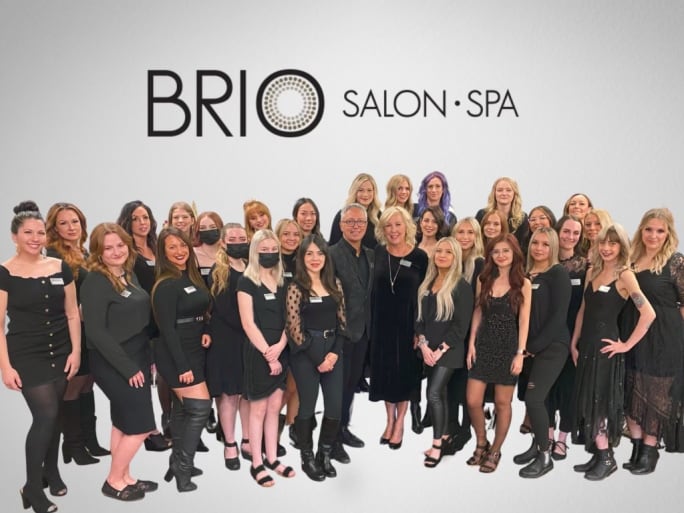
Brio full team
Another advantage is simply that it helps to create a fun culture. For the team members on the squad, this becomes an enjoyable task they can do at work.
“Owners want to oversee everything at the salon,” Tytula observes. “This is another lane. Heather and I are pretty good at keeping up with trends and technology, but social posting is not how we should be spending our time as owners.”
Are one of your traditional, handed-down salon management practices actually breaking the law. The pros from Paragon HR Consulting walk you through seven common Human Resources mistakes that could land you in hot water.
All beauty professionals should know how to identify when a client may need some health guidance. Tracy Rado discusses some common questions that clients ask in the chair, how to advise them, and when to refer them to a specialist.
From managing air traffic on busy days to handling frustrated guests' complaints, your front desk team often serves as the salon's emotional shock absorber. From a customer service lesson from the DMV to a list of strategies for caring for your front line, our experts offer ideas for alleviating stress, celebrating wins, and setting goals.
According to the KIM Report, top-line salon revenue appears steady or slightly up, but that growth is driven primarily by service price increases. Beneath the surface, retail performance and client visit frequency (appointment drift) are under real pressure. In his latest blog, Alain Audet offers strategies for keeping your salon's retail sales strong.
Putting your family to work in the salon offers some real tax benefits, but you have you have to play by the rules of the tax code to claim them. Azarvand Tax Law's Leticia Skrabut, Esq., shows you how.
Discover how to create a true “WOW experience” for every client by first building a culture where your team feels engaged, empowered, and inspired. Drawing on Calvin Stovall’s Iconic Framework, this blog explores how salon, spa, and clinic leaders can strengthen culture, elevate customer experience, and build a business that stands out for the long term.
The wellness industry is growing fast, and salons and barbershops already are an important part of it. In her first blog, Tracy Rado shares where the wellness dollars are heading, and how salons can grow with this movement.
While salon sales are increasing, owners often feel they're working harder for the same or less profit. Leverage Q2 data from The KIM Report, Alain Audet reveals some of the structural changes that are dampening your growth and why your region and your salon size matters.
Weaknesses in your business are amplified during the Holiday Season. Spark Pro Global's Lucy Randall shows you five things to do now to have the strongest holiday season yet.
In Kati Whitledge's latest blog, she shares how salons have moved away from dress codes and embraced appearance standards. But by removing strict dress codes, some businesses may have unintentionally lowered their appearance standards. Whitledge helps you explain to your team why an appearance standard is important and how to smoothly implement a new appearance policy.
The Small Business Health Care Tax Credit is a non-refundable tax credit for for-profit businesses that provides a financial incentive for eligible employers who offer health insurance coverage to their employees. Leticia Skrabut, Esq., walks you through how to claim that credit.
Developing strong work habits early in one's career supports long-term success in the salon industry. Jesse Linares offers new stylists his top five tips.
Most salon owners have no idea what these numbers are.
You can hit record sales and still have a profit problem. The difference comes down to four numbers almost nobody was taught to track.