









You Don't Own a Salon. You Own A Business.
In his latest blog, Leon Alexander Ph.D., challenges industry conventional thinking to help owners add more to their bottom lines.
 MENU
MENU SEARCH
Recruiting and retaining talent it tougher than ever. Adding to that pressure is the impact of inflation which may making your team members feel stretched. It may even prompt them to entertain the idea of a career outside the industry. Stef Fox illustrates the conversation you need to have with your team right now.

About the Author: Stef Fox is a beauty industry team-building pro, a recruiter and thought leader. She currently serves as the Executive Director of Salons for Aveda North America.

Stef Fox shows you how to check in with your team to see how inflation may be impacting them personally or shaping their career plans.
Provided by Stef Fox.
In August 2022, more people googled "inflation" than in any prior month since 2004. As a hair stylist or salon leader, you probably hear your clients talk about rising prices and inflation every day. It's a conversation conversation everyone indulges in because there is so much uncertainty around it and the media has tapped into the buzz.
One of the biggest areas of impact is food. Eggs alone have spiked by 40%. (Bureau Labor Statistics, 2022) With food being one of the harder-hit areas very few people are immune to the negative impacts of inflation.
The price hikes are so high that even people earning more than $100,000 a year have reported their budget feels tight. In a September 2022 survey, 45% of people earning over $100,000 said they were living paycheck to paycheck. And nearly 30% of people earning over $200,000 said they were living paycheck to paycheck. (Lenders Club, 2022)
What does this mean for your salon business? It’s not as cut and dry as we like to chalk it up to when we simply categorize inflation as “things costing more."
Yes, it means we are spending more on supplies.
Yes, it means that our salon's profitablity can be at risk.
Yes, it means we might see a sales dip as our clients feel the pinch.
Inflationary times like we are in, mean that a good portion of your staff might be struggling with a sense of financial security. The easy-to-miss reality here is shown to us from the data above. It will likely be that even your higher-earning stylists are feeling the pinch, not just your new talent.
This is not something you can afford to overlook and assume will just pass. If you need proof of the risk just do some reflection on the difference in your retention rate when you compare the tenure of a first-year stylist to the tenure of a 5th-year stylist.
In salons all around the US, retention rates are much lower for the first-year stylist. Mainly because the stylist feels broke, and money stress has serious impacts on our thinking and decision-making. Many stylists leave the industry at this time because they don’t feel like they can earn a living in beauty.
You don’t want any of your team feeling unaddressed financial stress. The emotions that arise when someone is living paycheck to paycheck especially if they are not used to that, are not good. Stylists can easily get trapped in their feelings and make rash decisions. Depending on the resiliency of your team members they will pick one of four paths should they find themselves feeling a financial pinch:
Thiy will just stick it out.
They will work hard to earn more and make up their deficit.
They will ask you about the possibility of raising their prices..
Or, they will quit.
Your opportunity right now as a leader is to lean in and find out how your team is feeling so that you can provide tools and resources to level up their resiliency.
Your action plan may look like this:
Survey your team to find out which of the above four categories they fall into. Consider asking these questions: Rate your level of financial stress right now from 1 to 5 (with 1 being the lowest and 5 being the highest.) How does financial stress make you feel? What is your plan for overcoming this trying time?
Plan to provide resources for each segment, focusing heavily on the are the majority of your team lands.
If you have team members who land in the "I'll just stick it out" or "I'll work harder to earn more" buckets, I would encourage you to think about fun and creative ways to show a little extra appreciation. These team members are naturally more resilient.
If you have team members who ask you about taking a price increase you need to evaluate if this makes sense for them and the business. Be sure to look at your financials and assess your expenses to see if there is anywhere you are overspending. Things to consider include when your last price increase was, the stylist’s current demand, and their client retention rate. Be cautious of just using productivity as a measure (like we did in the good old days pre-pandemic) because many stylists have adjusted their hours causing a natural increase in productivity.
If you have team members who identify as uncertain about how to solve the problem I’d recommend you schedule a private one-on-one conversation with them to learn more and help them make a plan. You might consider a financial expert visiting your salon to do a team-building exercise on budgets. You might consider investing in a session or two with a financial wellness coach. Or you might be able to do some brainstorming with the stylist to help them overcome the challenge with a little focus on growth opportunities.
Left unaddressed this reality can become an underbelly in salon cultures across the US. Remember that culture is a living breathing thing and every negative and positive situation influences it. This is the perfect opportunity to lean in and make some emotional deposits to your team’s bank accounts and keep your culture on the up and up.
In his latest blog, Leon Alexander Ph.D., challenges industry conventional thinking to help owners add more to their bottom lines.
In her latest blog, Amy Pal helps you develop your own clear guidelines around complimentary free employee services.
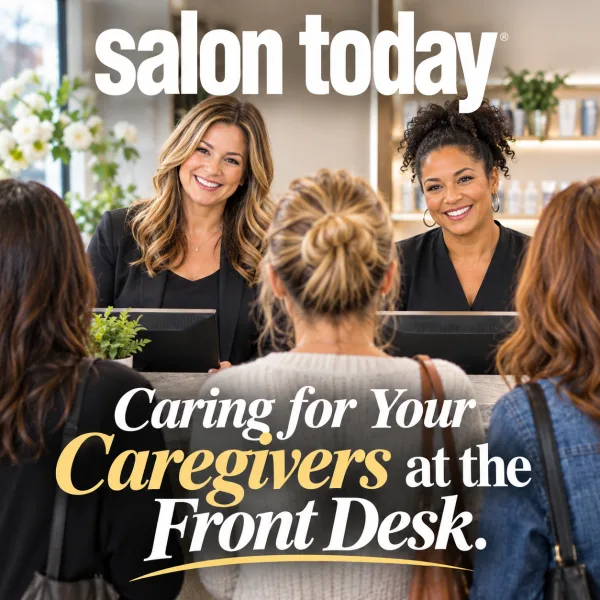
From managing air traffic on busy days to handling frustrated guests' complaints, your front desk team often serves as the salon's emotional shock absorber. From a customer service lesson from the DMV to a list of strategies for caring for your front line, our experts offer ideas for alleviating stress, celebrating wins, and setting goals.

According to the KIM Report, top-line salon revenue appears steady or slightly up, but that growth is driven primarily by service price increases. Beneath the surface, retail performance and client visit frequency (appointment drift) are under real pressure. In his latest blog, Alain Audet offers strategies for keeping your salon's retail sales strong.

Putting your family to work in the salon offers some real tax benefits, but you have you have to play by the rules of the tax code to claim them. Azarvand Tax Law's Leticia Skrabut, Esq., shows you how.

Discover how to create a true “WOW experience” for every client by first building a culture where your team feels engaged, empowered, and inspired. Drawing on Calvin Stovall’s Iconic Framework, this blog explores how salon, spa, and clinic leaders can strengthen culture, elevate customer experience, and build a business that stands out for the long term.
Sponsored by Phorest Salon Software

The wellness industry is growing fast, and salons and barbershops already are an important part of it. In her first blog, Tracy Rado shares where the wellness dollars are heading, and how salons can grow with this movement.

While salon sales are increasing, owners often feel they're working harder for the same or less profit. Leverage Q2 data from The KIM Report, Alain Audet reveals some of the structural changes that are dampening your growth and why your region and your salon size matters.
Weaknesses in your business are amplified during the Holiday Season. Spark Pro Global's Lucy Randall shows you five things to do now to have the strongest holiday season yet.

In Kati Whitledge's latest blog, she shares how salons have moved away from dress codes and embraced appearance standards. But by removing strict dress codes, some businesses may have unintentionally lowered their appearance standards. Whitledge helps you explain to your team why an appearance standard is important and how to smoothly implement a new appearance policy.

The Small Business Health Care Tax Credit is a non-refundable tax credit for for-profit businesses that provides a financial incentive for eligible employers who offer health insurance coverage to their employees. Leticia Skrabut, Esq., walks you through how to claim that credit.

Developing strong work habits early in one's career supports long-term success in the salon industry. Jesse Linares offers new stylists his top five tips.

Most salon owners have no idea what these numbers are. You can hit record sales and still have a profit problem. The difference comes down to four numbers almost nobody was taught to track.
Sponsored by Strata Salon Systems™
A five-area audit every owner-dependent salon needs to run. You built something that looks successful. Now find out if it can survive without you.
Sponsored by Strata Salon Systems™

Every month you put off fixing the problem, it gets bigger, more expensive, and harder to solve.
Sponsored by Strata Salon Systems™

At Janet St. Paul Studio for Hair and Beauty, Director of Operations Natasha McMillen helps bring her wife Janet St. Paul's vision to life, elevating every system from education to operations.

Expand your color service menu with the Pinstripe technique. Brooks and Brooks' Marlon Hawkins walks you through the technique.