Hair Extensions by the Numbers: Determining Hourly Rates, How To Charge, and the Revenue Opportunity for Your Salon
A Chicago salon owner gives a glimpse into how she prices her hair extension services and shares a true look at the revenue opportunities based on her team’s hourly rates and the three Hotheads hair extension methods: tape-in, sew-in weft, and Keraflex™ strand-by-strand.
April 27, 2021
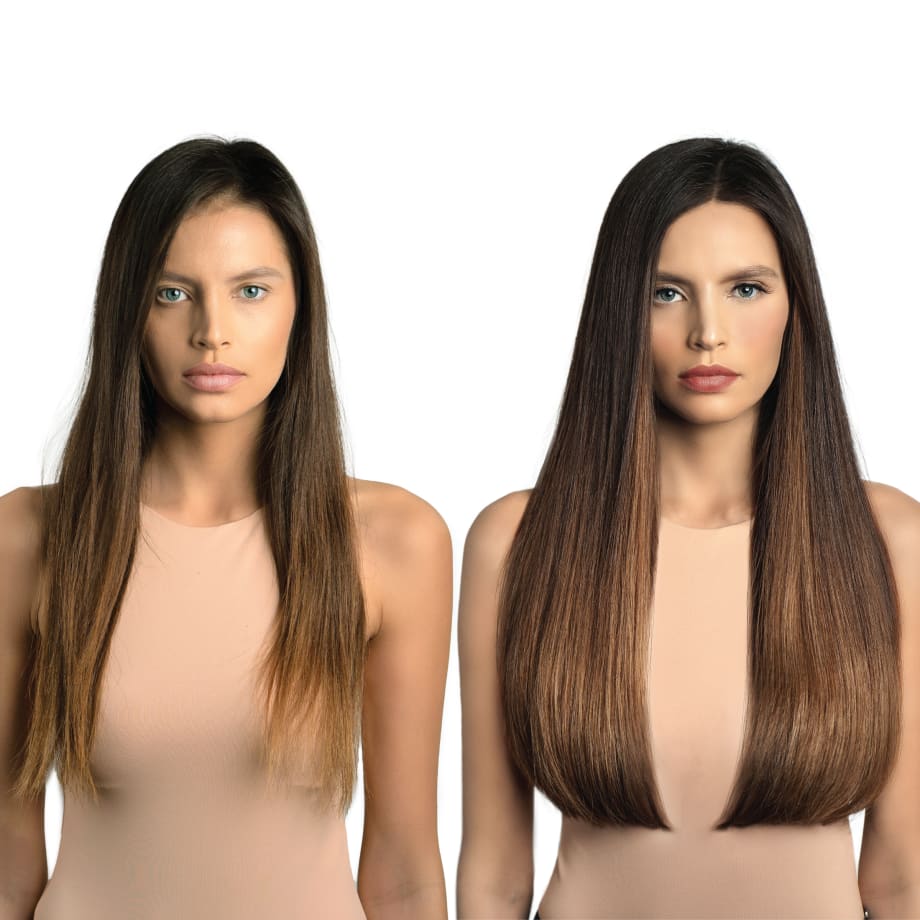
Before and after results of a Hotheads®Keraflex™ Extensions transformation. Keraflex™ Extensions command a higher ticket price since they take several hours to apply—but the client gets 3-5 months of wear out of the application. Featuring a matte, keratin bond designed for an application that’s completely undetectable, the bonds adhere to the hair via thermal fusion.
In partnership with
5 min to read
Natalie Ruzgis was just completing her most profitable quarter in the salon when her boss sat her down, scratching his head wondering how she had tripled her numbers.
“The only thing I had done differently was offer extensions,” she says. “He saw the huge increase in revenue I was generating, and a lightbulb went off: ‘Imagine the possibilities if all 15 of my stylists were offering extensions.’ It’s realistic to triple your numbers in a quarter by taking a one-day Hotheads® hair extensions class.”
Ad Loading...
It was an ah-hah moment for the salon owner, and an ah-hah moment for Ruzgis—so when she co-founded Thrive Hair Collective in Chicago, hair extension services were at the heart of it.
Now that Ruzgis is a Master Educator for Hotheads®, she says the number-one question she’s asked in every class is about pricing and how to charge for hair extension services.
“Pricing hair extensions gets confusing because each salon is different—from where the salon is based to their unique commission structure or rental agreement—and every stylist is coming in at different experience levels,” Ruzgis says. “A stylist of my caliber in Los Angeles or New York City could charge double what I charge in Chicago, but it’s important a salon stays in its market—don’t price yourself out or, more importantly, underprice yourself.”
When Ruzgis determined how to price her salon’s hair extension services, she decided on this formula: Double the cost of the hair extensions + the stylist’s hourly rate.
Ruzgis says her team’s hourly rates were established by adding an enhancement on top of what a traditional hair cut at the salon would cost. The enhancement goes up or down based on the stylists’ experience and expertise.
Ad Loading...
“Our formula for pricing is to mark up the hair by doubling its cost, and then adding in the hourly rate,” she says. “Because of my level of expertise, and experience with Hotheads, my hourly rate for extensions is $200 an hour, although other stylists in my salon have a lower hourly rate.”
With the launch of Hotheads Keraflex™ Extensions—which feature soft keratin bonds for strand-by-strand application with a discreet, matte finish—Hotheads allows salons to be a one-stop-extension-shop.
“By offering every hair extension method, along with a range of hourly rates, we can give clients options that work best for their budget and transformation goals,” Ruzgis says.
To help paint a picture of average ticket costs for three different hair extension methods, Ruzgis generously shared her salon’s pricing model based on her hourly rate.
TAPE-IN:
Ad Loading...
For a full head of tape-in extensions, Ruzgis says she’d typically need between 2-4 packs of Hotheads® hair, and the service takes just one hour—thanks to Hotheads’ pre-tapered ends that create a seamless blend, saving time traditionally spent on cutting and blending. Hotheads tape-ins can be reapplied up to three times, with 8-10 weeks of wear from each application.
Example pricing for a tape-in service:
Hair cost: $400
Hourly rate: $200
Service price: $1,000 (hair cost x 2 + 1 hour)
SEW-IN WEFT:
A Hotheads sew-in weft application ranges in price based on if the extensions are machine weft or hand-tied, as well as how many rows are sewn in based on the client’s hair goals. Hotheads Wefts can be re-sewn in 4-5 times, with up to 8 weeks of wear from each application. The service takes Ruzgis between 1.5 and 2 hours to complete.
Example pricing for a Weft service:
Hair cost: $400
Hourly rate: $200
Service price: $1,100 - $1,200 (hair cost x 2 + 1.5-2 hours)
Ad Loading...
KERAFLEX™ STRAND-BY-STRAND EXTENSIONS:
Hotheads’ newest strand-by-strand Keraflex™ Extensions command a higher ticket price since they take several hours to apply—but the client gets 3-5 months of wear out of the application. Featuring a matte, keratin bond designed for an application that’s completely undetectable, the bonds adhere to the hair via hot fusion for controlled delivery of volume, density, length, and color. Ruzgis estimates that she’d need between 4-6 packs of hair for a full head, and between 3-5 hours for the service.
Example pricing for a Keraflex service:
Hair cost: $500
Hourly rate: $200
Service price: $1,600 - $2,000 (hair cost x 2 + 3-5 hours)
Hotheads® Master Educator Natalie Ruzgis, co-founder of Thrive Hair Collective in Chicago, sews in a HotheadsWeft. “Money can be kind of funny and uncomfortable with so much out there on the internet, so I find clients respond really well to the transparency—it’s brought me a lot of success as an extensionist,” she says.
Clients get curious about the price range and estimates, and Ruzgis recommends a level of transparency to help guide the consultation.
“I don’t like to break down the cost of a pack because then clients like to try to negotiate how much hair they need—I’m the professional and I know what they need,” Ruzgis says. “I find it works best when I tell them I’m charging them for the cost of the hair—after the mark-up—and my hourly rate for the service installation.”
Ad Loading...
At the end of the service, Ruzgis continues the transparency and recommends her clients only add gratuity to the hourly rate, if they choose to tip, and not the service total.
“Money can be kind of funny and uncomfortable with so much out there on the internet, so I find clients respond really well to the transparency—it’s brought me a lot of success as an extensionist,” she says. “I tell clients, ‘The service charge today is $200—so the customer knows the price breakdown without really knowing the price breakdown. I don’t want my clients to know everything about the hair markup, but I also don’t want them to be tipping me on the full $1,000 service—that greatly changes someone’s beauty budget.”
Ruzgis says a potential landmine for owners to look out for when examining revenue opportunities is to pay close attention to how the commissions are paid out.
“I’ve seen salons make the mistake at payroll of splitting the ticket 50/50 with their stylists—not factoring in the cost of the hair, shipping and taxes,” Ruzgis says. “It’s important the salon always makes sure it’s covered its hard costs before paying commissions.”
Discover how to create a true “WOW experience” for every client by first building a culture where your team feels engaged, empowered, and inspired. Drawing on Calvin Stovall’s Iconic Framework, this blog explores how salon, spa, and clinic leaders can strengthen culture, elevate customer experience, and build a business that stands out for the long term.
The wellness industry is growing fast, and salons and barbershops already are an important part of it. In her first blog, Tracy Rado shares where the wellness dollars are heading, and how salon's can grow with this movement.
While salon sales are increasing, owners often feel they're working harder for the same or less profit. Leverage Q2 data from The KIM Report, Alain Audet reveals some of the structural changes that are dampening your growth and why your region and your salon size matters.
Weaknesses in your business are amplified during the Holiday Season. Spark Pro Global's Lucy Randall shows you five things to do now to have the strongest holiday season yet.
In Kati Whitledge's latest blog, she shares how salons have moved away from dress codes and embraced appearance standards. But by removing strict dress codes, some businesses may have unintentionally lowered their appearance standards. Whitledge helps you explain to your team why an appearance standard is important and how to smoothly implement a new appearance policy.
The Small Business Health Care Tax Credit is a non-refundable tax credit for for-profit businesses that provides a financial incentive for eligible employers who offer health insurance coverage to their employees. Leticia Skrabut, Esq., walks you through how to claim that credit.
Developing strong work habits early in one's career supports long-term success in the salon industry. Jesse Linares offers new stylists his top five tips.
Most salon owners have no idea what these numbers are.
You can hit record sales and still have a profit problem. The difference comes down to four numbers almost nobody was taught to track.
At Janet St. Paul Studio for Hair and Beauty, Director of Operations Natasha McMillen helps bring her wife Janet St. Paul's vision to life, elevating every system from education to operations.
The strongest salons, spas, and med spas know which numbers tell the real story of their business. In this practical guide, Phorest breaks down the five essential KPIs every business should track to improve retention, boost revenue, and make smarter decisions with confidence.
At Bella Style Salon in Slidell, Louisiana, Director of Operations Angela Meyer tackles inventory, team management, and guest relations. Read all about her in our latest Meet the Manager.
Starting at Impressions front desk in 2006 when he was 19 years old, General Manager Paul Petrowsky is a seasoned professional who owner Sarah Taylor says is responsible for much of her own success.
Planning is in full swing for the most anticipated events and promotions for the 2026 holidays. As owners share their favorite ways to celebrate, they prove that a carefully planned event can also build culture, increase client loyalty, boost sales, and set a business up for a successful 2027.
When things run amok at Mane Attraction Salon, Owners Chris and Jenny Knudsen say General Manager Sami Hernandez is their go-to resource and ultimate sounding board. Meet Sami in this installment of Meet the Manager.