Salon sanitation regulations are most often mentioned with respect to nail salons, but cleanliness could be a point of difference for all salons. Say “hello” to the clean revolution.
IN DEPTH IN THE SALON Nail technician Keri Siriscevich and salon manager Tracey Moran Maxine's Salon Chicago, IL maxinesalon.com
ST: Why is sanitation and disinfection so important to you? TM: We do high-volume, back-to-back business and take our clients' health very seriously. They see what we do in regards to sanitation, and comment on it all the time. It's a big reason we have a strong, regular client base for nails.
ST: What are a few things you do to ensure sanitary nail services? KS: I use disposable files, nail buffers and orange sticks or replaceable files, which have metal handles and disposable pads. I use the autoclave for anything metal, after cleaning and disinfecting the implements with hospital-grade disinfectant. I use hand sanitizer between each client. TM: Each technician has her own station, and a book she initials between each client and at the end of the day, indicating the pedicure bowls have been cleaned and disinfected with hospital-grade disinfectant for 10 minutes. To accommodate this, we book all pedicures for one hour. Most clients start with the pedicure, so the stations can be cleaned and disinfected during the manicure. We also have an extra pedicure station, which can be used if needed. We'd rather run behind than take any risks, and our clients agree.
ST: How can salon owners get technicians to become more sanitation conscious? TM: Establish standards when you open; it's harder to correct behavior. Be very regimented, and hold individuals responsible. Keep an eye on new technicians to ensure they follow procedures.
ST: Is it hard for technicians to learn proper sanitation procedures? KS: The information is available. As an OPI educator, I teach sanitation and disinfection all the time.
ST: What do you charge? TM: $48 for pedicures and $25 for manicures: We only do natural nail services.
Paul Bryson, Ph.D., director of research and development, OPI Products
Inc., summarizes, "Properly cleaning tools, followed by an appropriate
EPA-registered, hospital disinfectant, is sufficient for salon
purposes. However, an autoclave is certainly effective. Be aware that
autoclaves also require pre-cleaning or sanitation, you can't just
throw dirty tools in any more than you can with a liquid disinfectant.
Also, autoclaves require regular spore testing to verify effectiveness
and regular maintenance."
Pedi Perfect: Pedicure thrones have gotten a bad rap because
many techs simply spray the basin with bleach and move onto the next
client. They also say ones with jets are harder to clean, because they
require separate cleaning of removable parts at the end of every day.
Normal procedures are to drain, rinse, sanitize, rinse, disinfect for
10 minutes, re-rinse and wipe down basins between clients. A more
thorough end-of-day procedure is also commonly required.
Vicki Malo, the Toronto, Canada-based president of the North American
School of Pedicuring and director of sales for Footlogix, advises extra
understanding of disinfection when it comes to pedicure stations.
"Bleach must be mixed in the right ratio and used with soft water-hard
water renders it a lightening agent," says Malo. "Look for
disinfectants that claim to kill TB, the hardest bacteria to kill, and
Polio 1, the hardest virus to kill."
Bryson adds, "A one-step product, which contains grease-cutting
surfactants and chelating agents for removing hard-water scale, in
addition to the disinfectant chemicals, is the best choice. It cleans
and disinfects in one step."
He notes that if your state board requires regular bleach treatments,
bleach can be deactivated by grease and dirt, so pre-cleaning is
required.
Procedures and Protocol
In addition to between-client and end-of-day procedures, special ones
address infection control and blood borne pathogens. Anything exposed
to blood or body fluids must be handled with disposable gloves and
disinfected immediately. Porous instruments exposed to blood must be
double-bagged and discarded in a closed container. Some states have
separate procedures for cleaning electric file bits, as well as
guidelines for avoiding product contamination. Finally, always follow
all guidelines for storage, mixing, usage and labeling of disinfectants.
How do you keep track of it all? Set a realistic protocol for
technicians to follow and use support staff, says Malo. "Also, a second
set of implements for every technician is a must."
To save time, technicians can begin clean-up before the client's final
polish is done. Simply cover the basin with Plexiglas while the
disinfectant does its work. Or, add time to the service and build it
into the service charge.
At Metropolis in Princeton, New Jersey, co-owner Terry Cerf says she
uses a chart to track pedicure throne use and between-client
disinfection, and that she does random checks to be certain technicians
follow procedures. Also, her pedi-throne's removable parts are cleaned
at the end of every day.
"If you don't unscrew the caps and clean the jets, they can clog and
break," says Cerf. "Clients notice what we do and are impressed by it.
We even clean our bathrooms every 30 minutes, and they can see this on
the clipboard."
Kalberg uses a daily sanitation log that is updated after each client.
In California and increasingly, other states, such tracking systems are
the law.
Better Safe …
In 2007, a Dallas salon was fined $9,000 for 10 sanitation violations,
including having soiled disinfectant, failure to store implements in a
clean environment and failure to sanitize equipment between clients. In
July 2009, a Woodstock, New York, salon was sued for $150,000 by a
client who had a pedicure and woke up with a swollen toe. She was
eventually diagnosed with osteomyelitis, a bone infection caused by
bacteria or fungus, which required extensive treatment, including a
six-week course of antibiotics through a neck catheter. Time will tell
if the salon was at fault, but the possibility alone is reason enough
to make sanitation a salon priority.
TOP 10 TRIP-UPS According to California's State Board of Barbering and Cosmetology, these are the most common violations sited during a salon inspection. Seven of 10 involve sanitation or disinfection standards, and most are violations in any state. Check your salon and see how many apply to you.
1. Incorrect storage of disinfected non-electrical instruments. To avoid violation: Store all disinfected non-electrical items (combs, brushes, manicuring tools) in a clean, covered place that is labeled "clean" or "disinfected."
2. Incorrect storage of soiled non-electrical instruments. To avoid violation: Store all soiled non-electrical items in a receptacle that is labeled "soiled" or "dirty."
3. No disposal of non-disinfectable instruments. To avoid violation: Immediately discard items that cannot be disinfected, such as buffers, sponges, orange and wax sticks.
4. Unlicensed establishment/expired license. To avoid violation: Only perform services in an establishment that has a valid, current establishment license.
5. Liquids, creams, powders and cosmetics not properly labeled. To avoid violation: Distinctly label all bottles and containers of their contents.
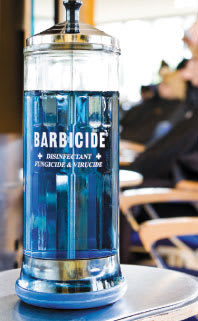
6. Incorrect disinfection of non-electrical instruments. To avoid violation: Before use on clients, clean instruments with soap, or detergent and water. Then totally immerse them in an EPA-registered disinfectant with bactericidal, fungicidal and virucidal activity, following the manufacturer's instructions.
7. Disinfectant not changed and/or covered. To avoid violation: Keep disinfectant solution covered and change it at least once per day or when it's visibly cloudy.
8.Liquids, creams, powders and cosmetics not in a clean and/or closed container. To avoid violation: Store all of the above in clean, closed containers.
9. Removal of liquids, creams, powders and cosmetics, causing contamination to remaining portion. To avoid violation: When using a portion of a cosmetic preparation, remove so as not to contaminate the remaining portion.
10. License not conspicuously displayed at work station. To avoid violation: Keep license posted and clearly visible.
THE DIFFERENCE IS CLEAR Dissolve Cleaner, an all-purpose cleaning product, is formulated to combat everyday grime in your salon; from sticky styling resins, hair spray residue, unwanted hair color stains, nail polish spills, to sticky adhesives and grease. Dissolve gets rid of stubborn stains on countertops, mirrors, sinks, curling irons, flat irons, salon furniture and more. The line consists of three products: Dissolve Concentrate-for heavy duty cleaning; Dissolve Ready-To-Use-for everyday clean up; and Dissolve Floor Concentrate-for floors and cabinets. Each of the Dissolve cleaners can be mixed with water to create different strength levels. For information, visit http://dissolvecleaner.com or call 616-957-1581.
CHEMICAL-FREE, ECO-FRIENDLY CLEANER Slightly larger than a spray bottle, the handheld Ionator EXP and Ionator HOM from Activeion Cleaning Solutions, ionizes tap water to create a powerful, general purpose cleaner without the risks that come with chemicals. When used as directed, the Ionator HOM kills more than 99.9 percent of harmful bacteria such as: E. coli, Salmonella, MRSA, Staph and even the 2009 Pandemic H1N1 influenza A-or swine flu. "With just a faucet and the Ionator EXP, people now have an abundant supply of effective cleaner that assists in the protection of public health," says Activeion Cleaning Solutions CEO Jim Wiese. "This is great news for budgets, cleaning staff and the environment."
Discover how to create a true “WOW experience” for every client by first building a culture where your team feels engaged, empowered, and inspired. Drawing on Calvin Stovall’s Iconic Framework, this blog explores how salon, spa, and clinic leaders can strengthen culture, elevate customer experience, and build a business that stands out for the long term.
The wellness industry is growing fast, and salons and barbershops already are an important part of it. In her first blog, Tracy Rado shares where the wellness dollars are heading, and how salon's can grow with this movement.
While salon sales are increasing, owners often feel they're working harder for the same or less profit. Leverage Q2 data from The KIM Report, Alain Audet reveals some of the structural changes that are dampening your growth and why your region and your salon size matters.
Weaknesses in your business are amplified during the Holiday Season. Spark Pro Global's Lucy Randall shows you five things to do now to have the strongest holiday season yet.
In Kati Whitledge's latest blog, she shares how salons have moved away from dress codes and embraced appearance standards. But by removing strict dress codes, some businesses may have unintentionally lowered their appearance standards. Whitledge helps you explain to your team why an appearance standard is important and how to smoothly implement a new appearance policy.
The Small Business Health Care Tax Credit is a non-refundable tax credit for for-profit businesses that provides a financial incentive for eligible employers who offer health insurance coverage to their employees. Leticia Skrabut, Esq., walks you through how to claim that credit.
Developing strong work habits early in one's career supports long-term success in the salon industry. Jesse Linares offers new stylists his top five tips.
Most salon owners have no idea what these numbers are.
You can hit record sales and still have a profit problem. The difference comes down to four numbers almost nobody was taught to track.
At Janet St. Paul Studio for Hair and Beauty, Director of Operations Natasha McMillen helps bring her wife Janet St. Paul's vision to life, elevating every system from education to operations.
The strongest salons, spas, and med spas know which numbers tell the real story of their business. In this practical guide, Phorest breaks down the five essential KPIs every business should track to improve retention, boost revenue, and make smarter decisions with confidence.
At Bella Style Salon in Slidell, Louisiana, Director of Operations Angela Meyer tackles inventory, team management, and guest relations. Read all about her in our latest Meet the Manager.
Starting at Impressions front desk in 2006 when he was 19 years old, General Manager Paul Petrowsky is a seasoned professional who owner Sarah Taylor says is responsible for much of her own success.
Planning is in full swing for the most anticipated events and promotions for the 2026 holidays. As owners share their favorite ways to celebrate, they prove that a carefully planned event can also build culture, increase client loyalty, boost sales, and set a business up for a successful 2027.
When things run amok at Mane Attraction Salon, Owners Chris and Jenny Knudsen say General Manager Sami Hernandez is their go-to resource and ultimate sounding board. Meet Sami in this installment of Meet the Manager.