Whereas 40 years ago women bought wigs as "fun" hair, today the market for what is now called "hair systems" tends to be both men and women who have lost hair for genetic, health or medical reasons.
"When women have a hair loss or hair thinning problem, the first person they'll talk to is their spouse, and after that they'll go to their hairdresser," says Napolitano. "Most of the styling work is already done [in our Raquel Welch wigs], and it can be a modest purchase for clients at between $100 and $500 retail. High-end, 100-percent human hair wigs attract some clients as well and, in that case, salons can charge up to several thousand dollars because that wig is a blank canvas and the stylist must create the cut."
Wigs are not the only option for clients with alopecia, chemotherapy-caused hair loss and other thinning hair issues. Hairdreams offers a sort of hybrid-the Microlines system, named for its micro-fine hair net with human hair strands that is bonded to the client's remaining hair.
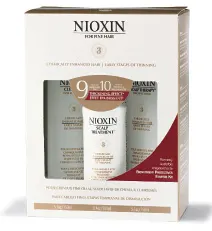
Topical and Ingestible Products While you may know that some of your clients take the pill Propecia or apply Minoxidil (also called Rogaine) directly to their scalp, the product in this category that is exclusive to salons is Nioxin, which is applied topically but includes a multi-vitamin supplement in the line as well.
"At Nioxin, we approach hair thinning as a skin care issue," says Trevor Attenborough, vice-president of marketing. "Nioxin is a skin-based, anti-aging solution for the scalp." Attenborough says that the product aims to cleanse and detoxify the skin on the scalp without stripping the hair.
"The best quality hair you can have is the hair that's just leaving the scalp," he adds. "Chemical, environmental and thermal damage affects it after that. So start by improving the skin on the scalp. The resin build-up from ordinary styling products impacts the hair, while our styling products actually benefit the scalp skin."
Nioxin has provided salons primarily with retail opportunities with its eight systems that cater to different needs and hair textures. However, the latest offering, Scalp Renew, is an in-salon service. The company suggests charging $50 to $75 for the 18-minute service, which includes 10 minutes of processing time.
"The average facial resurfacing treatment is priced at about double what we're suggesting," Attenborough says. "Spas that already have a resurfacing treatment on the menu tend to push the price to $75 for the scalp, and you can do two of these in the time it takes you to do one hair color."
Laser As the latest entry poised to potentially sweep the market, laser light hair therapy is the "one to watch." Gradually turning skeptics into believers, the technology is based on research indicating that light can promote healing and growth. Clients with anything short of "shiny bald" heads are candidates for laser therapy; as long as the follicle is not dead it can be nudged to grow more hair.
"This is cold laser," explains Robert Ward, president of Surf Side Laser. "It has no thermal component and cannot harm the operator. Thermal refers to every other type of laser-laser for eye surgery or to remove a tattoo, for example-and the difference is night and day."
The treatment routine varies. To grow hair, Miranda has her clients sit under the light for 30 minutes twice a week for eight weeks and then once weekly for anywhere from another two months to a full year. After that, she says, the client will likely need some type of periodic follow-up to keep hair strong and growing.
Ward suggests a 26-week treatment protocol with the client coming in for 25-minute sessions twice weekly during the first 20 weeks, then reducing it to once a week and following up with three final treatments. Salons charge between $1,500 to $3,500 for this package, according to Ward. Miranda launched the service package at $3,500 but has since scaled it back to $2,200 with payment plans available. From the expenditures side, salons pay anywhere from $5,000 to $23,000 for Surf Side Laser, with financing plans requiring as little as $150 per month.
Retail revenue is also part of the laser story, because lasers tend to come with their own line of hair care products that salons normally incorporate into the price of a full package. As a further retail option, the laser comes in a hand-held version that retails to clients for roughly $300. Equipped with only a fraction of the diodes supplied by the in-salon machine, the hand-held covers a much smaller surface area and therefore will require a lot of the client's time, but it still can be attractive to the client who wants to do this at home. The very latest laser equipment bridges the gap with an at-home, stand-alone model that's more powerful than the hand-held but still not nearly as efficient as the in-salon laser.
"There are huge opportunities for owners to incorporate both hand-held and clinic lasers in their salon," says Bill Blatter, president of Hair Loss Control Clinic. "You can pay a couple of hundred dollars per month and charge clients $2,000 to $4,000; it's a good return on the investment."
Ward maintains that owners will make up the investment after signing four clients to laser packages, while Blatter cites a South Dakota salon that invested $15,000 in products and equipment plus another $15,000 in advertising and rang up $145,000 in sales in one year.
More Hair: An Easy Sell? Whether the product is Nioxin, lasers, wigs or extensions, the manufacturers are eager to work with salons on the marketing end. Many of them advertise directly to the consumer to create demand, and they also supply salons with numerous materials and ideas. In marketing these products and services, however, the FDA does not permit you to claim that you can regrow hair, says Miranda, who was forced to remove the middle word from her formerly named "Hair Growth Solutions" salon.
Although Grubek does not build-in extra consultation time for a new client just in case there's a hair loss issue, she will mention what she observes during the consultation and, if necessary, book time at a future date to review all the options. "I'm not afraid to talk to clients," Grubek says. "I may ask a client whether she's noticed that her hair is thinning or tell her that it doesn't look like a full head of hair. If a client asks me to ‘fluff it up,' I say, ‘I can do more than that.' To ignore the fact is cheating clients of the right to look their very best."
Discover how to create a true “WOW experience” for every client by first building a culture where your team feels engaged, empowered, and inspired. Drawing on Calvin Stovall’s Iconic Framework, this blog explores how salon, spa, and clinic leaders can strengthen culture, elevate customer experience, and build a business that stands out for the long term.
The wellness industry is growing fast, and salons and barbershops already are an important part of it. In her first blog, Tracy Rado shares where the wellness dollars are heading, and how salon's can grow with this movement.
While salon sales are increasing, owners often feel they're working harder for the same or less profit. Leverage Q2 data from The KIM Report, Alain Audet reveals some of the structural changes that are dampening your growth and why your region and your salon size matters.
Weaknesses in your business are amplified during the Holiday Season. Spark Pro Global's Lucy Randall shows you five things to do now to have the strongest holiday season yet.
In Kati Whitledge's latest blog, she shares how salons have moved away from dress codes and embraced appearance standards. But by removing strict dress codes, some businesses may have unintentionally lowered their appearance standards. Whitledge helps you explain to your team why an appearance standard is important and how to smoothly implement a new appearance policy.
The Small Business Health Care Tax Credit is a non-refundable tax credit for for-profit businesses that provides a financial incentive for eligible employers who offer health insurance coverage to their employees. Leticia Skrabut, Esq., walks you through how to claim that credit.
Developing strong work habits early in one's career supports long-term success in the salon industry. Jesse Linares offers new stylists his top five tips.
Most salon owners have no idea what these numbers are.
You can hit record sales and still have a profit problem. The difference comes down to four numbers almost nobody was taught to track.
At Janet St. Paul Studio for Hair and Beauty, Director of Operations Natasha McMillen helps bring her wife Janet St. Paul's vision to life, elevating every system from education to operations.
The strongest salons, spas, and med spas know which numbers tell the real story of their business. In this practical guide, Phorest breaks down the five essential KPIs every business should track to improve retention, boost revenue, and make smarter decisions with confidence.
At Bella Style Salon in Slidell, Louisiana, Director of Operations Angela Meyer tackles inventory, team management, and guest relations. Read all about her in our latest Meet the Manager.
Starting at Impressions front desk in 2006 when he was 19 years old, General Manager Paul Petrowsky is a seasoned professional who owner Sarah Taylor says is responsible for much of her own success.
Planning is in full swing for the most anticipated events and promotions for the 2026 holidays. As owners share their favorite ways to celebrate, they prove that a carefully planned event can also build culture, increase client loyalty, boost sales, and set a business up for a successful 2027.
When things run amok at Mane Attraction Salon, Owners Chris and Jenny Knudsen say General Manager Sami Hernandez is their go-to resource and ultimate sounding board. Meet Sami in this installment of Meet the Manager.