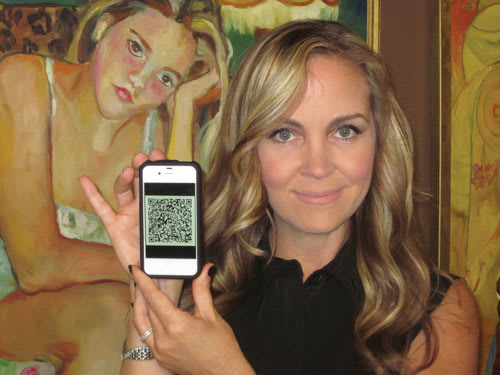
If you’re wondering about those bizarre two-dimensional barcode boxes you’re starting to see in magazines, they’re called QR (Quick Response) codes, and they can be your ticket to delivering information to the most tech-savvy of your clients.
If you’re wondering about those bizarre two-dimensional barcode boxes you’re starting to see in magazines, they’re called QR (Quick Response) codes, and they can be your ticket to delivering information to the most tech-savvy of your clients.
Sherri Jesse, owner of Sherri’s Hair Salon in Bristol, Virginia, developed a QR code to market instructional videos to stylists and her salon to clients.
Developed in the 1990s, the open-source QR codes have an early foothold in broad usage, while Microsoft’s similar Mobi Tags offer more extensive branding customization options and are gaining ground in the fashion industry. Both technologies can hold a link taking the consumer directly to wherever the marketer chooses—from an informational video or a landing page listing the business’s hours, location and services to the company’s website homepage or “buy now” section.
Ad Loading...
Online, people can click on them, but they’re really designed to be read “on the go” by a code reader app easily downloaded onto a smart phone. Free from the shackles of the computer, consumers are receptive to this brave new mobile marketing world, where swiping a phone replaces bookmarking and memorizing URLs.
“This is advertising that’s free, and it’s easy to learn,” says hair designer and owner Sherri Jessee who markets her instructional videos to stylists and her Bristol, Virginia salon, Sherri’s Hair Salon, to consumers. “My QR codes take people directly to my website. From there, they can go to my blog, Facebook page or Twitter Pics, which all have the QR code. That’s how everything links in a circle. I sold a video within two hours of adding PayPal to the mix.”
Even if consumers do not use the codes, they talk about whatever’s new and different. “I call this a parlor trick,” says Sherry McGuire, owner of Alchemy Hair Studios & Spa in San Jose, California, who slaps a QR code onto business cards, Facebook, Twitter, a vinyl in the window and, especially, the client consultation cards that clients take home. “People who know what a QR reader is immediately love that we’re operating on the edge of technology. For people new to the technology, I guarantee that eventually a QR reader will come up in some conversation they’re having, and they’ll take out their smartphone and say to a friend, ‘Let me show you what my hairdresser does.’ That means they’re out there talking about our salon.”
At Pravana, Mobi Tags were key in launching the new Perfection hair smoothing system. “Stylists aren’t carrying around laptops and DVD players,” says Marketing Director Bethany Kirschner. “They work off smartphones. So we made it easy for them by applying this technology to our packaging and magazine ads. Just scan it on your phone, and the educational video will pop up. It’s a clean way to deliver information that stylists really need.”
The company already had been using Mobi Tags in ads to instantly take stylists to a site that connects them with stores carrying Pravana products. “Someone in Wichita takes a pic of the code with her phone, which works with the phone’s geolocation device to identify the closest store and provide a phone number,” explains company founder Steve Goddard.
Ad Loading...
This is the “window to the future,” Goddard predicts. “The best thing about this technology is that it’s fluid communication,” he says. “We could have a QR code on a bottle of Twist Fiber Paste that links consumers to a video about how that product can be cocktailed with different Pravana products for different results. But then we could change that link to run a contest inviting people to send in images using the product. These tags let you keep the message timely and relevant.”
Are one of your traditional, handed-down salon management practices actually breaking the law. The pros from Paragon HR Consulting walk you through seven common Human Resources mistakes that could land you in hot water.
All beauty professionals should know how to identify when a client may need some health guidance. Tracy Rado discusses some common questions that clients ask in the chair, how to advise them, and when to refer them to a specialist.
From managing air traffic on busy days to handling frustrated guests' complaints, your front desk team often serves as the salon's emotional shock absorber. From a customer service lesson from the DMV to a list of strategies for caring for your front line, our experts offer ideas for alleviating stress, celebrating wins, and setting goals.
According to the KIM Report, top-line salon revenue appears steady or slightly up, but that growth is driven primarily by service price increases. Beneath the surface, retail performance and client visit frequency (appointment drift) are under real pressure. In his latest blog, Alain Audet offers strategies for keeping your salon's retail sales strong.
Putting your family to work in the salon offers some real tax benefits, but you have you have to play by the rules of the tax code to claim them. Azarvand Tax Law's Leticia Skrabut, Esq., shows you how.
Discover how to create a true “WOW experience” for every client by first building a culture where your team feels engaged, empowered, and inspired. Drawing on Calvin Stovall’s Iconic Framework, this blog explores how salon, spa, and clinic leaders can strengthen culture, elevate customer experience, and build a business that stands out for the long term.
The wellness industry is growing fast, and salons and barbershops already are an important part of it. In her first blog, Tracy Rado shares where the wellness dollars are heading, and how salons can grow with this movement.
While salon sales are increasing, owners often feel they're working harder for the same or less profit. Leverage Q2 data from The KIM Report, Alain Audet reveals some of the structural changes that are dampening your growth and why your region and your salon size matters.
Weaknesses in your business are amplified during the Holiday Season. Spark Pro Global's Lucy Randall shows you five things to do now to have the strongest holiday season yet.
In Kati Whitledge's latest blog, she shares how salons have moved away from dress codes and embraced appearance standards. But by removing strict dress codes, some businesses may have unintentionally lowered their appearance standards. Whitledge helps you explain to your team why an appearance standard is important and how to smoothly implement a new appearance policy.
The Small Business Health Care Tax Credit is a non-refundable tax credit for for-profit businesses that provides a financial incentive for eligible employers who offer health insurance coverage to their employees. Leticia Skrabut, Esq., walks you through how to claim that credit.
Developing strong work habits early in one's career supports long-term success in the salon industry. Jesse Linares offers new stylists his top five tips.
Most salon owners have no idea what these numbers are.
You can hit record sales and still have a profit problem. The difference comes down to four numbers almost nobody was taught to track.