









Are Your Stylists Doing Free Hair on Your Time? Introducing the 'Win-Win' Staff Services Playbook
In her latest blog, Amy Pal helps you develop your own clear guidelines around complimentary free employee services.
 MENU
MENU SEARCH
When it comes to surviving the holiday bustle, there are upbeat holiday tunes perfect for cutting hair and songs with slower tempos that help you unwind at the end of the day. Discover both and create your own holiday playlist.

Looking to unwind this holiday season? New research reveals the best Christmas songs to listen to if you need to relax this stressful festive season.
For many, the holiday season is a time of heightened stress. Financial pressures, family dynamics, and the endless quest for the perfect gift often turn December into a blur of tension. For bustling salons, add to that fact it's the busiest time of the year.
According to a recent survey conducted by MedStar Health, 74% of Americans said Christmas is stressful – and 55% said it's the most stressful holiday of the year.
Research shows that slow-tempo songs (around 60–70 BPM) are particularly effective for inducing relaxation, as they mirror the heart's natural rhythm in a calm state. This principle was highlighted in a study involving the song Weightless by Marconi Union, specifically composed at 60 BPM to facilitate stress relief. The track demonstrated a 65% reduction in stress and anxiety levels during trials, confirming the physiological impact of slow, consistent tempos.
To help you find your seasonal serenity, the mental health experts at The Support Networkanalyzed the most popular Christmas songs, identifying those with the slowest and most soothing BPMs.
In first place as the most relaxing Christmas song is A Winter’s Tale by Queen, which has a slow tempo of 54 BPM. Released in 1995, this ballad’s soft melody and gentle pacing make it perfect for creating a calm atmosphere during the busy holiday season.
Following is Little Saint Nick by Pentatonix, with a tempo of 68 BPM. This 2018 a cappella rendition tones down the original upbeat energy, offering a smoother, more relaxing take on the classic.
Little Drummer Boy/Peace on Earth by David Bowie and Bing Crosby takes third place with 72 BPM. Recorded in 1977, this duet blends the two traditional songs into a calm, harmonious arrangement.
Next is Nat King Cole’s The Christmas Song at 73 BPM. First recorded in 1946, this timeless track is soft and soothing, perfect for relaxing during the holidays.
Tied at 73 BPM is Whitney Houston’s Do You Hear What I Hear?. Released in 1992, Whitney’s rendition combines her powerful voice with a steady, calming tempo. Christina Aguilera’s version of Have Yourself a Merry Little Christmas shares the same BPM, offering a reflective and tranquil performance on her 2000 holiday album.
Top of My List by Jordin Sparks also clocks in at 73 BPM. This 2015 release brings heartfelt lyrics and a mellow rhythm to your holiday playlist.
Tony Bennett’s O Christmas Tree comes in at 74 BPM. Released in 2008, this smooth jazz version of the carol is both elegant and calming.
Somewhere in My Memory by John Williams, also at 74 BPM, is a soft, nostalgic instrumental from the Home Alone soundtrack released in 1990.
Lastly, I Don’t Wanna Spend One More Christmas Without You by NSYNC rounds out the list at 74 BPM. This 1998 ballad offers a heartfelt and relaxing melody to wind down after a long day.
At the other end of the spectrum is Christmas Without You by OneRepublic, the least relaxing Christmas song with a rapid 207 BPM. Released in 2020, its fast tempo creates a high-energy vibe that’s better suited to lively moments.
Mele Kalikimaka by Bing Crosby and The Andrews Sisters follows closely at 203 BPM. This 1950 track is cheerful but far too fast-paced for a calming effect.
Also at 203 BPM is Shakin’ Stevens’ Merry Christmas Everyone. This 1985 classic is fun and festive but not relaxing.
It’s the Most Wonderful Time of the Year by Andy Williams comes in at 202 BPM. Its lively brass and fast rhythm make it better for a party than for unwinding.
At 192 BPM, Ariana Grande’s Santa Tell Me brings a playful energy that doesn’t encourage relaxation. Bring Me Love by John Legend, with 191 BPM, adds soul to the season but maintains a pace more suited to excitement than calm.
Christmas Eve/Sarajevo 12/24 by Trans-Siberian Orchestra moves at 186 BPM, combining classical and rock elements for an intense and energetic sound. Please Come Home for Christmas by Eagles, at 183 BPM, blends emotion with a faster tempo.
Chris Rea’s Driving Home for Christmas, with its 180 BPM tempo, captures the busy feeling of holiday travel. Finally, Christina Aguilera’s Angels We Have Heard on High finishes the list at 176 BPM.
A spokesperson from the Support Network commented on the findings, “To put these figures into perspective, the average BPM for a Christmas song is 119.16. Iconic songs with tempos below this, like Wham!’s Last Christmas at 108 BPM and Michael Bublé’s It’s Beginning to Look a Lot Like Christmas at 95 BPM, lean toward the relaxing side with their softer, reflective feel.”
“On the other hand, tracks with tempos above the average, such as Mariah Carey’s All I Want for Christmas Is You at 150 BPM, bring festive energy and excitement.”
“If someone’s looking to enhance relaxation alongside the slower Christmas songs in our analysis, they can try pairing the listening experience with a breathing technique. Practice deep breathing by inhaling slowly for four counts, holding for four counts, and exhaling for four counts.”
About the Support Network: The Support Network is dedicated to crafting pathways for personal growth through individualized and affordable mental health care. They prioritize empathy-driven therapy sessions, ensuring a nurturing environment for clients. Their team of licensed therapists is committed to professional excellence, continuously trained in the latest techniques and supported by a strong community. Grounded in evidence-informed practices.
In her latest blog, Amy Pal helps you develop your own clear guidelines around complimentary free employee services.
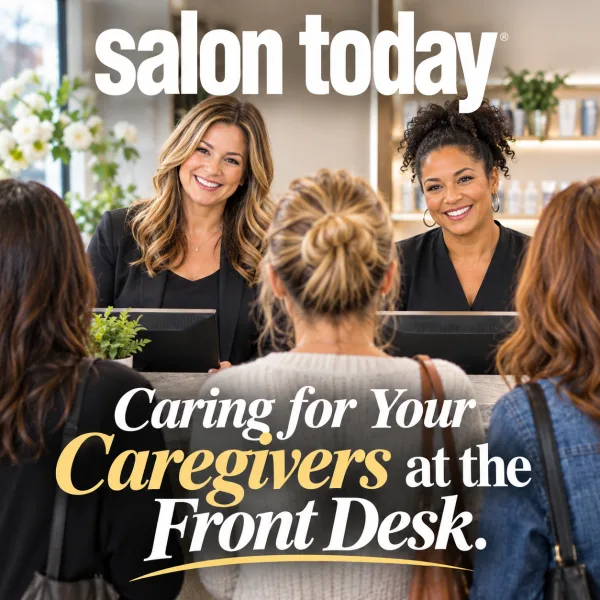
From managing air traffic on busy days to handling frustrated guests' complaints, your front desk team often serves as the salon's emotional shock absorber. From a customer service lesson from the DMV to a list of strategies for caring for your front line, our experts offer ideas for alleviating stress, celebrating wins, and setting goals.

According to the KIM Report, top-line salon revenue appears steady or slightly up, but that growth is driven primarily by service price increases. Beneath the surface, retail performance and client visit frequency (appointment drift) are under real pressure. In his latest blog, Alain Audet offers strategies for keeping your salon's retail sales strong.

Putting your family to work in the salon offers some real tax benefits, but you have you have to play by the rules of the tax code to claim them. Azarvand Tax Law's Leticia Skrabut, Esq., shows you how.

Discover how to create a true “WOW experience” for every client by first building a culture where your team feels engaged, empowered, and inspired. Drawing on Calvin Stovall’s Iconic Framework, this blog explores how salon, spa, and clinic leaders can strengthen culture, elevate customer experience, and build a business that stands out for the long term.
Sponsored by Phorest Salon Software

The wellness industry is growing fast, and salons and barbershops already are an important part of it. In her first blog, Tracy Rado shares where the wellness dollars are heading, and how salon's can grow with this movement.

While salon sales are increasing, owners often feel they're working harder for the same or less profit. Leverage Q2 data from The KIM Report, Alain Audet reveals some of the structural changes that are dampening your growth and why your region and your salon size matters.

Weaknesses in your business are amplified during the Holiday Season. Spark Pro Global's Lucy Randall shows you five things to do now to have the strongest holiday season yet.

In Kati Whitledge's latest blog, she shares how salons have moved away from dress codes and embraced appearance standards. But by removing strict dress codes, some businesses may have unintentionally lowered their appearance standards. Whitledge helps you explain to your team why an appearance standard is important and how to smoothly implement a new appearance policy.

The Small Business Health Care Tax Credit is a non-refundable tax credit for for-profit businesses that provides a financial incentive for eligible employers who offer health insurance coverage to their employees. Leticia Skrabut, Esq., walks you through how to claim that credit.

Developing strong work habits early in one's career supports long-term success in the salon industry. Jesse Linares offers new stylists his top five tips.

Most salon owners have no idea what these numbers are. You can hit record sales and still have a profit problem. The difference comes down to four numbers almost nobody was taught to track.
Sponsored by Strata Salon Systems™
A five-area audit every owner-dependent salon needs to run. You built something that looks successful. Now find out if it can survive without you.
Sponsored by Strata Salon Systems™

Every month you put off fixing the problem, it gets bigger, more expensive, and harder to solve.
Sponsored by Strata Salon Systems™

At Janet St. Paul Studio for Hair and Beauty, Director of Operations Natasha McMillen helps bring her wife Janet St. Paul's vision to life, elevating every system from education to operations.

Expand your color service menu with the Pinstripe technique. Brooks and Brooks' Marlon Hawkins walks you through the technique.

The strongest salons, spas, and med spas know which numbers tell the real story of their business. In this practical guide, Phorest breaks down the five essential KPIs every business should track to improve retention, boost revenue, and make smarter decisions with confidence.
Sponsored by Phorest