The Calendar Illusion: Why Your Salon's May Revenue Isn't What It Seems
Owners start to worry when a month's sales come up short compared to the same period last year, but that may have more to do with the days in the month than with an actual decline. The KIM Report's Alain Audet points to May 2026 as a prime example.
by Alain Audet, VP Sales and Marketing for SalonInteractive
July 10, 2026
Using data from The Kim Report, Alain Audet shows how certain months may appear to come up short because they contain more low-revenue days and fewer high-revenue days.
Credit:
SalonInteractive
4 min to read
Salon owners often experience concern over revenue decreases when comparing month-to-month figures, as seen in the reported 2% decline for May 2026 compared to the previous year.
The perceived revenue drop may be misleading due to varying income across different days of the week, rather than actual business performance issues.
*Summarized by AI
Every salon owner knows the feeling. You sit down at the start of the month, pull up last month’s numbers, and the revenue line is lower than it was a year ago. The questions start right away. Did we lose clients? Is the economy finally catching up to us? Is the new place across town pulling people away? It is easy to talk yourself into a problem before you have finished your first cup of coffee.
That is where many owners landed after May. According to The KIM Report, which gathers anonymous transaction data from thousands of U.S. salons every month, the average salon brought in about $16,859 in May. A year earlier, the figure was $17,212. On the surface, that reads as a 2% decline, and if you stopped there, you would have good reason to worry. But the number is misleading, and the reason why is something most of us never stop to think about.
Ad Loading...
Blame the Calendar, Not Your Clients
Not every day of the week earns the same money. In most salons, the gap is wide. When you break salon revenue down by day, the order barely changes from one month to the next. Thursday is the biggest day of the week, with the average salon doing roughly $1,394. Friday, Saturday, and Wednesday come next. Sunday and Monday sit at the bottom, at about $963 and $865.
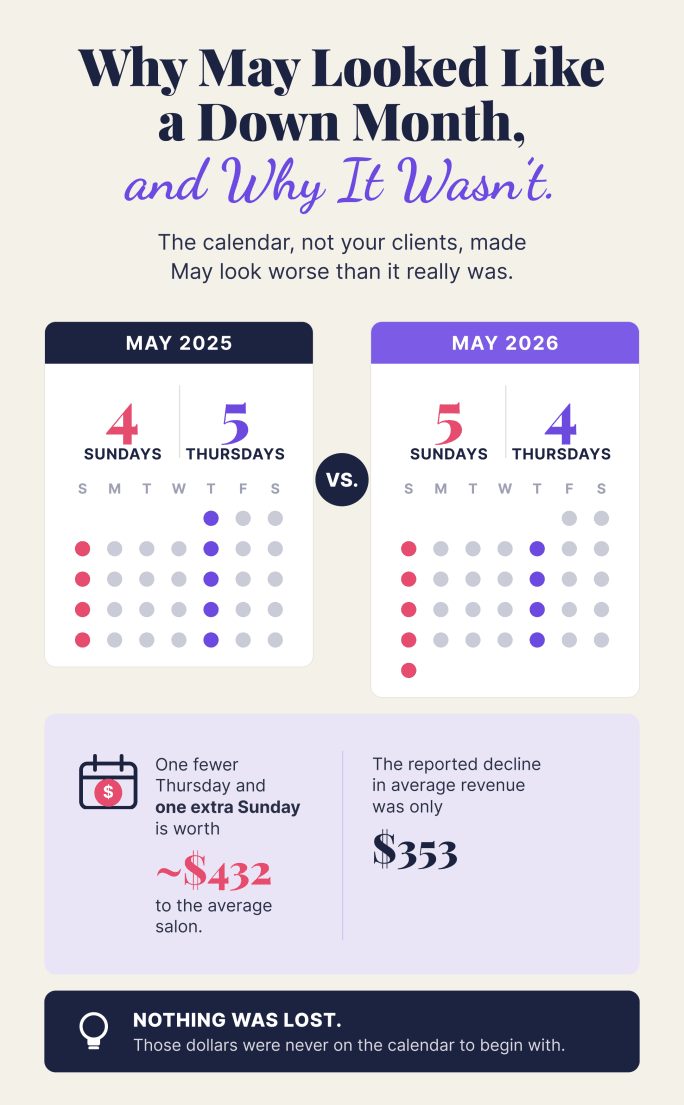
Here is what caught our attention. May of 2026 and May of 2025 did not have the same number of prime salon work days. This year, the calendar handed us five Sundays and only four Thursdays. Last year it was reversed, with five Thursdays and four Sundays. So, without a single thing changing inside any salon, May quietly lost one of its best-earning days and picked up one of its weakest in return.
That one swap is worth about $432 to the average salon. The reported decline was $353. Set those two figures side by side, and the whole story turns over. The drop that had owners worried is smaller than the revenue the calendar took off the table before anyone opened the doors. Nothing was actually lost, as those dollars were never on the schedule to begin with.
Taking a closer look at the days of the week in May 2026 versus May 2025 shows how an apparent sales decline is actually an illusion.
Credit:
SalonInteractive
Compare the Days Fairly, and May Grew
When you set the calendar aside and compare the two months day for day, Thursday against Thursday and Sunday against Sunday, the softness disappears. Business held steady, and per-day revenue came in flat to slightly higher than the year before.
The average service ticket points in the same direction, and it has nothing to do with which days fell where. In May, it reached $90.81, up nearly 3% from a year ago, and it has risen every month this year. Clients are still coming in and paying more per visit than they did last spring. That is not what a struggling industry looks like.
Ad Loading...
Keep an Eye on Sundays
There is a smaller trend worth pulling out of the same data. Sunday is still a lower-revenue day, but it is growing faster than any other day of the week, up nearly 5% from last year. It has now moved ahead of Monday. Demand is slowly shifting toward the weekend, yet most salons still treat Sunday as an afterthought when building the schedule.
If your own numbers look the same, it is worth a second look. The owners who put their stronger stylists on the floor on Sunday and actually promote services for that day are meeting demand where it is heading rather than where it used to be.
The Bottom Line
When viewed on its own, a single number can send you chasing a problem that was never there. It can talk you into cutting hours or dropping prices when the business underneath is perfectly healthy. The most expensive decisions in this industry tend to be the ones made in a hurry, over a number that was not telling the truth.
My advice? When a report is lower than expected, avoid immediately reacting. Instead, count your Thursdays and see if you traded a strong day for a weak one. Check your service tickets to see if the value of your work holds up even when the day count works against you. When you measure your salon against the right benchmarks and take into consideration how the calendar actually fell, you stop reacting to noise and start seeing what your business is really doing.
May was not a down month; it just came up a Thursday short, and knowing the difference is what keeps you from trying to fix a problem you do not have.
Ad Loading...
About the Author: Alain Audet is a beauty industry veteran who holds an MBA from the University of Hull in England. He has held leadership roles across professional haircare, salon technology, and industry organizations, with a special focus on growth and education for the salon channel. Alain currently serves as vice president of sales and marketing at SalonInteractive, where he leads market development, partnerships, and sales enablement initiatives for The KIM Report and On Behalf Marketing.
Quick Answers
May's revenue appears lower primarily due to the calendar effect, which impacts the distribution of high-revenue days within the month.
The calendar affects salon revenue as not all days of the week generate the same income.
Not necessarily; a decline in revenue can be misleading and may be caused by external factors, such as calendar variations, rather than a loss of clients.
While a 2% decline might seem concerning, it is important to analyze the context, including calendar effects, before drawing conclusions about client loss or other issues.
Stylists Yene Damtew and Jamal Edmonds launch Coil Event, a textured hair event for working stylists with hands-on education, live demonstrations, industry conversation, and networking.
The easily wearable formula delivers XL volume, extreme length, and a weightless, lifted finish without the heaviness of traditional volumizing mascaras.
The International SPA Association recently announced that Jefferson Fisher, Jamie Kern Lima and Zack Kass are the keynote speakers for its 2027 Conference, scheduled for March 3-5 at Mandalay Bay in Las Vegas.
Life of Riley Salon Supply and Riley Salon Resources are back in the family, as Kelly Huether acquires the professional distributor he co-founded in 2013.
BaBylissPRO and IGK have partnered to launch the BaBylissPRO Studio Trunk, transforming the professional tool brand’s digital Style Studio into a physical experience for the first time in its sixty-year history.
K18 Biomimetic Hairscience has partnered with Beauty Changes Lives to launch the K18 Future of Hair Scholarship, aiming to support aspiring professional stylists by reducing financial barriers to cosmetology education.
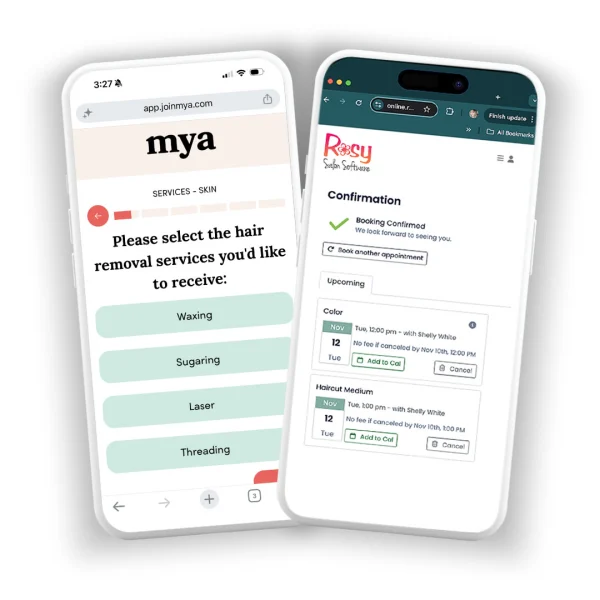
Rosy Salon Software integrates with Mya, empowering salons, spas, and barbershops to transform their websites into powerful, automated lead-generation machines.
Known for his buttery blondes and a technique for highlighting hair with more precision that he called chunking, Brad Johns died on August 27. His friend and fellow colorist, David Stanko, shares thoughts on his talented colleague and close friend.
The Green Beauty Community Foundation convenes beauty brands, salon-industry leaders, educators, and sustainability organizations for a collaborative professional beauty gathering on September 23rd in New York.
At 80, global feminist, former marriage and family therapist, executive coach, and powerlifter Barrie Zucal shows women how to stop letting “debilitating goodness” derail their dreams. Her empowering new book, BOLD: How Women Play BIG by Leading Instead of Pleasing, calls out the quiet conditioning that holds women back from achieving their ambitions — and shows them how to free themselves.
From a Santa Monica apartment startup to the nation's largest sugaring and sunless tanning brand, SUGARED + BRONZED reaches a major milestone with 50 locations across 10 markets.
The new service, which builds and maintains websites for fitness and wellness businesses, is the second in Playlist's suite of AI-powered apps, which includes AIConcierge, designed to improve client engagement and booking conversions.
The most iconic show in international hairdressing will celebrate its 43rd edition on November 14th at LOOK Madrid, IFEMA MADRID, in a historic night that will bring together some of its legendary teams and will also host the final of the International Visionary Award across its three categories: Cut & Colour, Men’s and Avant-Garde. LOOK Madrid celebrates its next edition from November 13-15th at IFREMA MADRID.