









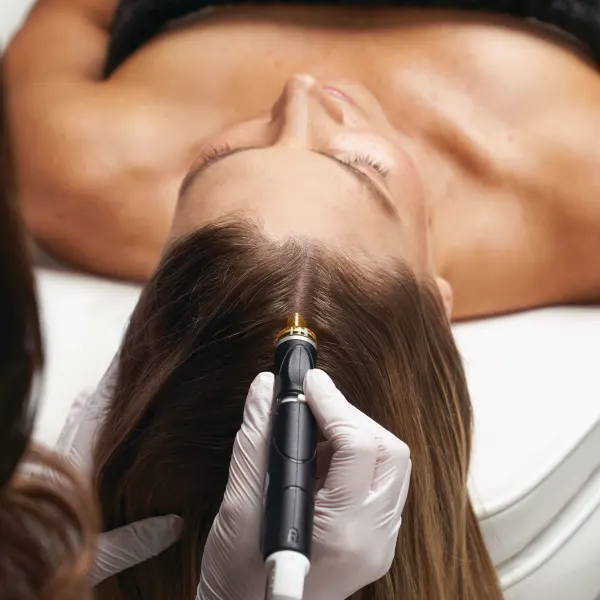
A HydraScalp Service that Addresses the Impact of Menopause on the Scalp and Hair
HydraScalp with Keravive is a scalp peptide treatment clinically proven to help reduce hair thinning and stimulate the hair's natural ability to grow hair.
 MENU
MENU SEARCH
Review Gating is the practice of filtering customers before they leave online reviews, and now Google is taking action to find and penalize the offenders. Find out what may happen if you're noncompliant, and learn from Salon Owner Kip Dodson's two-step system to keep salons compliant.

Salon Owner Kip Dodson explains what Review Gating is, why it's illegal, and how salons can get into trouble.
Kip Dodson
*Summarized by AI
A couple of years ago I wrote a column for Salon Today about Net Promoter Score — why I adopted it at A Moment’s Peace Salon and Spa, how one simple question changed how my team thinks about every client interaction, and how we turned feedback into more than 15,000 five-star reviews displayed live at amomentspeace.com/reviews.
That column was about building a better system. This one is about what happens when you build the wrong system or have paid someone else to build a wrong one for you.
In 2026, review gating became explicitly illegal. And a tool dozens of salons are currently paying for is the exact violation Google and the FTC are now hunting.
Review gating is the practice of filtering which clients get invited to leave a public review based on how happy they are. The typical setup: a client gets a text asking “How was your visit?” If they answer positively, they get a link to Google. If they answer negatively, they get quietly routed to a private form that no one ever sees.
Dozens of reputation management platforms were built around exactly this mechanic. It felt smart. It made ratings look clean. It was also always against Google’s policy — and now it is actively, aggressively enforced.
Between January and July 2025, Google’s review deletion rates increased by over 600 percent. In April 2026, Google deployed Gemini-powered AI to enforce the rules and updated its policy with new explicit bans: review kiosks and shared tablets are prohibited, staff review quotas are prohibited, asking clients to mention staff names in reviews is prohibited. Google blocked or removed 292 million policy-violating reviews in 2025 alone.
The FTC adds a second layer. Its Consumer Review Rule now carries civil penalties of up to $53,088 per violation for fake reviews, paid reviews, or review suppression. Warning letters are already going out.
The penalty ladder is real and it escalates:
Shadow-filtering — your review disappears silently. The client thinks it posted. You never know it happened.
New review pause — you temporarily cannot receive any new reviews at all.
Public warning banner — a notice appears on your Google Business Profile telling every potential client that fake reviews were removed. Everyone searching for your salon sees it.
Full profile suspension — your business disappears from Google Maps and Search entirely. Clients cannot find your hours, phone number, or location.
Here is what I have been doing at A Moment’s Peace since 2019, and what produced 15,000+ reviews without a single violation. It is not complicated. It just requires doing the steps in the right sequence and resisting the temptation to shortcut them.
STEP 1 — NET PROMOTER SCORE FIRST
After every visit, every client receives one question: “Based on your experience today, would you refer us to a friend or family member?” They respond on a scale of 0 to 10. That’s it. Low threshold to answer. Immediate signal.
What you do with the number is everything. Clients who score 9 or 10 — your Promoters — get a simple follow-up: “Thank you. Would you be willing to share your experience on Google?” One tap. Done. Clients who score 8 or below get a human follow-up — not a routed-to-private-form silence, but a genuine: “Thank you for letting us know. What could we have done better?” That response gets read. It gets actioned. The team sees it. The next client benefits from it.
This is not gating. The NPS question goes to every client. The review invitation goes to every Promoter. The difference between this and gating is that you are not pre-screening who gets asked to review based on predicted sentiment. You are asking everyone first — then routing appropriately based on what they actually said.
STEP 2 — ASK EVERYBODY FOR A REVIEW
Shortly after the NPS response — not instead of it, and not gated by it — every client receives a separate, standalone review invitation. This goes to all clients equally, regardless of their NPS score. A client who gave you a 7 gets the review invitation. A client who gave you a 10 gets the review invitation. You are not filtering. You are inviting.
Google’s own data shows that 96 percent of consumers specifically look for negative reviews before making a purchase decision. A profile that looks too perfect is already a red flag to your potential clients — before any enforcement ever happens. Real reviews from all clients build far more trust than a filtered 5.0 that nobody believes.
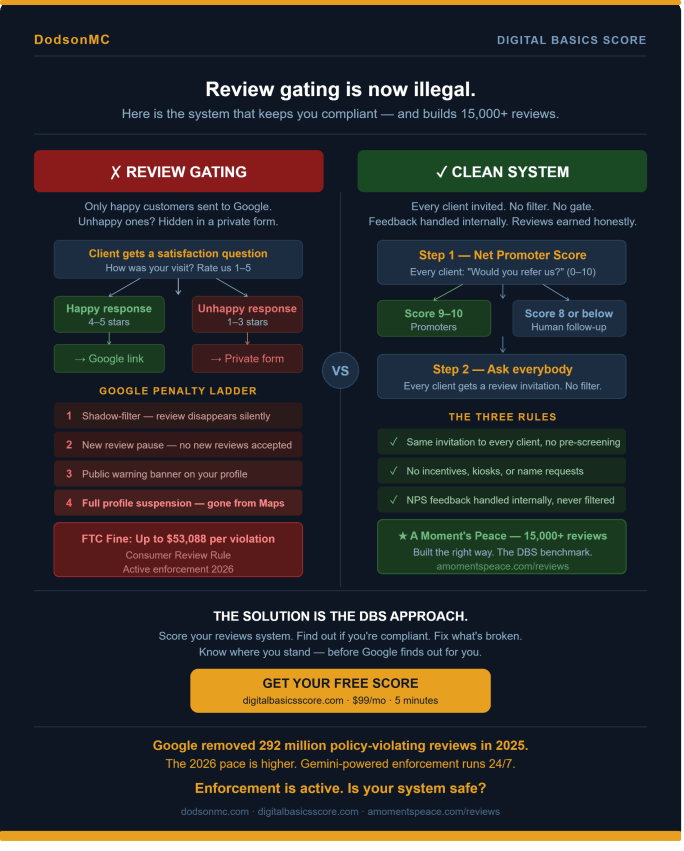
A chart that outlines the differences between review gating and a clean system.
Kip Dodson
A Moment’s Peace has captured over 15,000 reviews across Google, Yelp, Bing, TripAdvisor, and internal sources — all compiled and displayed live at amomentspeace.com/reviews. We have a Net Promoter Score consistently above 90. We have never used a gating tool.
The number is not the result of a clever software trick. It is the result of asking every client the right question at the right moment, handling every response with intention, and never routing anyone away from the truth. Over time, that system compounds.
There is also a dimension most salons miss entirely: AI search. When someone asks ChatGPT or Google AI to recommend a salon near them, the AI reads your website and your review presence across every platform. A salon with 15,000 reviews compiled on its website — with new reviews populating daily — sends a signal to AI models that no single-platform rating ever could. This is the new frontier of local search, and the two-step system is exactly how you build for it.
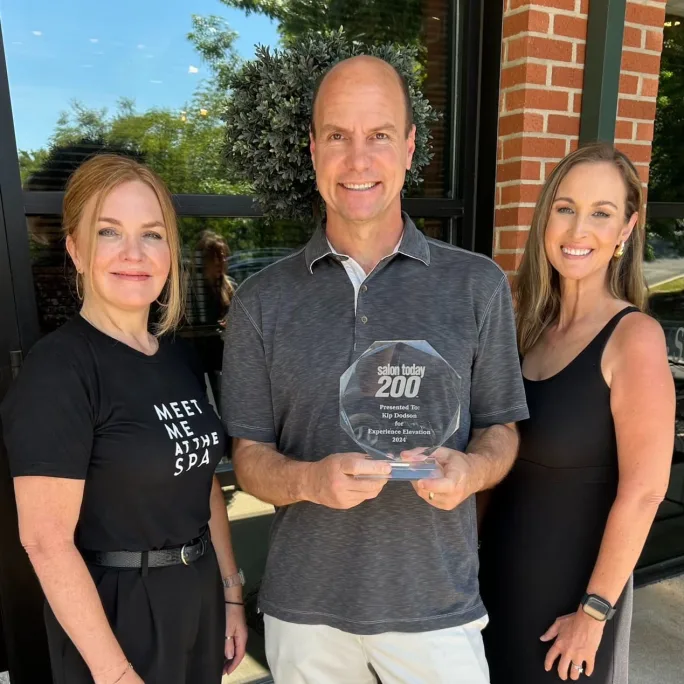
Owner Kip Dodson with the salon's two general managers Danielle Lafaye and Danielle Lolito with their Experience Elevation awards from the SALON TODAY 200.
Kip Dodson
If you are using a reputation management platform, ask these before your next billing cycle.
1. Does my tool send review requests to all clients equally — or only to those who respond positively to a pre-screen question?
2. Am I offering any discount, incentive, or reward tied to leaving a review?
3. Does my review request process go out from a shared device or kiosk inside my salon?
If the answer to any of those is yes, your current process is a liability. Fix it before Google’s systems find it for you.
Reviews and reputation are one of four areas scored by Digital Basics Score, an independent diagnostic platform I built for local businesses. It is vendor-neutral by design. It does not sell marketing services. It measures whether the services you are already paying for are working — and whether your review process is keeping you safe or putting you at risk.
A score takes five minutes. It starts at $99 a month. It tells you what your vendor never will. Learn more at digitalbasicsscore.com.
About the Author: Kip Dodson is a Salon Today 200 honoree for eight consecutive years (2017-2025) and owner of A Moment’s Peace Salon and Day Spa in Franklin, Tennessee — a 6,000 sq ft, 63-person team with a Net Promoter Score above 90 and 15,000+ reviews at amomentspeace.com/reviews. He is also the founder of DodsonMC and Digital Basics Score, an independent vendor-neutral platform that scores local businesses on digital readiness. He previously published “Net Promoter Score: A Single Metric to Measure Client Experience” in Salon Today (July 2024). Reach him at kip@dodsonmc.com or 615-717-7616.
dodsonmc.com | digitalbasicsscore.com | amomentspeace.com/reviews
Review gating is the practice of filtering customers before they leave online reviews to ensure only positive feedback is published. It has become illegal because it creates a biased representation of customer experiences.
*Summarized by AI
HydraScalp with Keravive is a scalp peptide treatment clinically proven to help reduce hair thinning and stimulate the hair's natural ability to grow hair.

In his first blog with SALON TODAY, Roei Cohen, general manager of Valery Joseph Salons with locations in New York, The Hamptons, and Miami, discusses all the little things that add up to a salon's brand.

All beauty professionals should know how to identify when a client may need some health guidance. Tracy Rado discusses some common questions that clients ask in the chair, how to advise them, and when to refer them to a specialist.

For Halloween, Sam Villa ArTeam's Ellen Devine creates witchy vibes with her Maleficent look.

Stylists Yene Damtew and Jamal Edmonds launch Coil Event, a textured hair event for working stylists with hands-on education, live demonstrations, industry conversation, and networking.

This weekend, walkers will brave the chilly waters of San Francisco Bay as they take a symbolic plunge to raise money and awareness for HairToStay. HairToStay is the first and only national nonprofit dedicated to making scalp cooling treatments affordable for cancer patients who want to preserve their hair through chemotherapy.

Salon Owners Mike Nass, Allyson Hurley, Martin White, and Tim Fisk join SALON TODAY to talk about how they're using different AI agents to book appointments, market to at-risk clients, attract new clients, improve the consultation, and boost the overall guest experience.
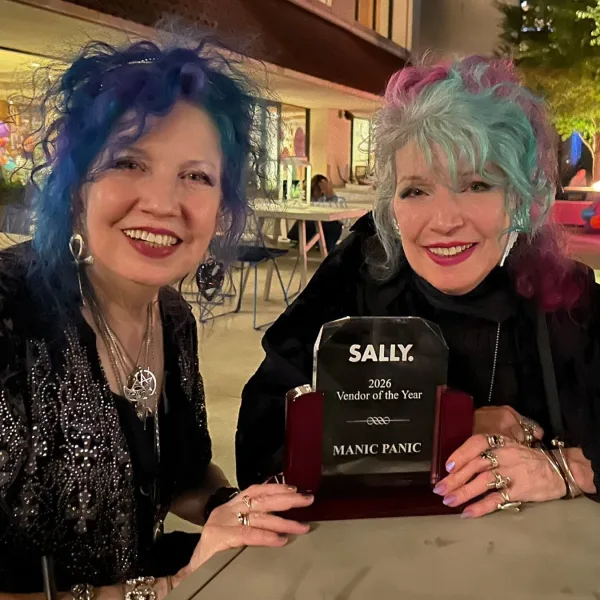
The award recognizes the partnership between Sally Beauty and Manic Panic.
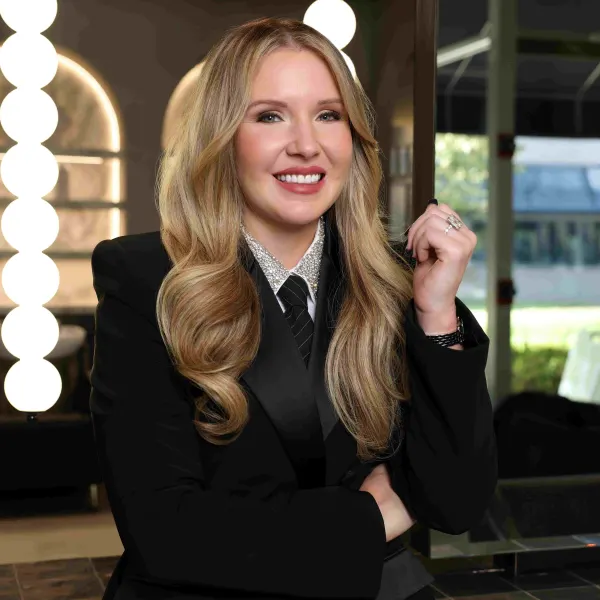
Terra Harvell is busy building the largest wealth-creation platform the salon industry has ever seen; one that shows owners how to build valuable, wealth-generating assets with an exit plan, while developing stylists into six-figure earners.
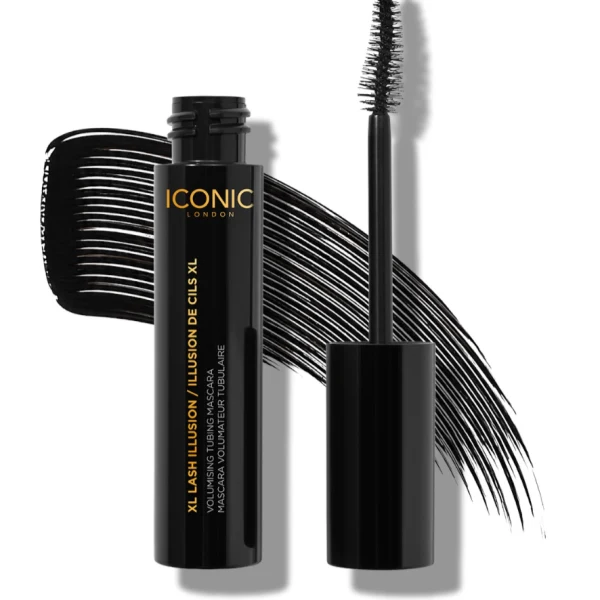
The easily wearable formula delivers XL volume, extreme length, and a weightless, lifted finish without the heaviness of traditional volumizing mascaras.
The professional haircare brand is certified under Standards Version 2.2, reflecting renewed accountability across seven social, environmental and governance impact topics
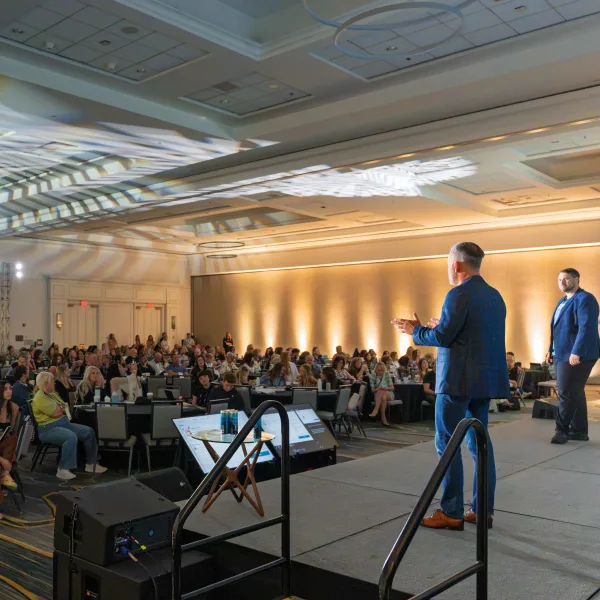
MeevoIQ brings a team of AI-powered Advisors to Meevo, giving salon, spa & med spa owners the growth tools, business intelligence, and front desk support they need with full visibility and control at every step.

In September 2024, Hurricane Helene completely destroyed 20-year-old Wink Salon's flagship location and 70% of its business. In this exclusive story for SALON TODAY, Owner Christine DiBenedetto shares their two-year rebuilding journey, and how their main location is a different business.

In his latest blog, Leon Alexander Ph.D., challenges industry conventional thinking to help owners add more to their bottom lines.

Your body doesn't necessarily tell the difference between a promotion and a deadline. In her first wellness blog for SALON TODAY, Wellify Co-Founder Laura Fuqua explains why even good stress has an impact.
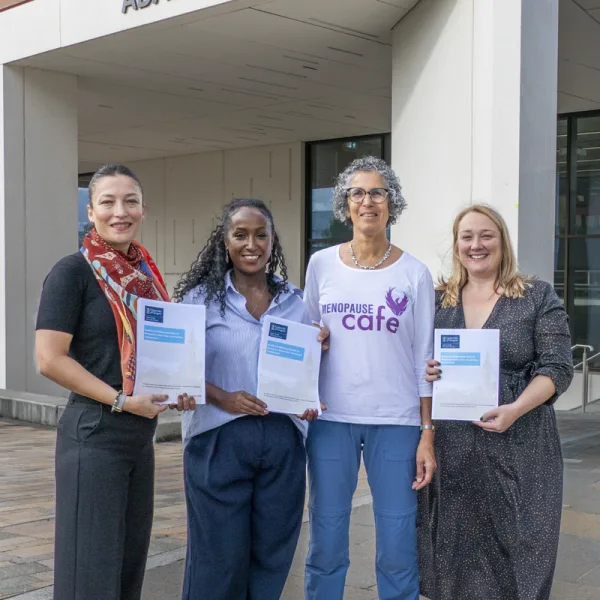
Popping up across the UK, Menopause Cafés are helping women seek professional help with their menopause journeys. What better place to play host to one of these gatherings than a spa?

In her latest blog, Amy Pal helps you develop your own clear guidelines around complimentary free employee services.