For Earth Month, we explore how the professional beauty industry is shifting its position as major waste contributor to a leader in sustainability. We take a closer look at Green Circle Salons, as experts and owners share their favorite environmental sustainable business tips. And, Nicole Rechelbacher shares what it was like to grow up with the industry's biggest environmental pioneer as her father.
This is an AI-generated image. Refer to our Terms of Use.
24 min to read
As the world comes together each April to celebrate Earth Month, it’s the perfect time to reflect on the environmental footprint the professional beauty industry is leaving on our planet. For example, did you know that 877 pounds of waste, including hair, paper, plastic, and metal, enter landfills and waterways from beauty-based businesses in the United States and Canada EVERY SINGLE MINUTE? That’s staggering to comprehend, but then you also need to factor in the industry's land footprint, the carbon footprint from the energy it uses, and the natural resources it consumes, such as water.
While it’s quite evident that reducing your salon’s environmental footprint is good for the planet, it’s also a solid business move for bettering your bottom line. Not only can things like conserving your energy usage and managing your color waste reduce your overall costs, but when you combine your green practices with marketing efforts, you’re building a strong magnet to attract both clients and new talent.
Ad Loading...
In this celebration of Earth Month article:
We explore how one company is helping salons prevent up to 95 percent of waste from entering landfills, as well as the unique business benefits its members are tapping into.
We have a candid conversation with Nicole Rechelbacher, the daughter of Aveda’s Horst Rechelbacher, an undisputed pioneer of holistic beauty and champion of environmental responsibility. She shares how his vision has shaped both her life and her career, offering pearls of wisdom along the way.
We offer a robust list of simple steps that salons, spas, and barbershops can implement to make them more environmentally sustainable.
Pursuing the Green Circle
One day, Shane Price was sitting in a salon chair enjoying a service when he looked around at the hair on the floor and the foils in his fellow clients’ heads, and he posed a simple question: “Where does all this waste go?”
Credit:
Green Circle Salons
Armed with a background in science, Price started pursuing the answer to that simple question. His innate curiosity led him to become an eco-preneur in 2009 when he launched Green Circle Salons, the world’s first comprehensive program designed to help salons, spas, and barbershops recover waste and operate more sustainably.
Today, Green Circle works with more than 40 specialized partners across North America, from recycling facilities and chemical waste experts to clean energy producers and bio-composite manufacturers. Together with its community of more than 16,000 beauty professionals (or Waste Warriors), it has helped recover more than 13 million pounds of beauty waste, shifting the beauty industry from a major waste contributor to a leader in sustainability.
“Over time, as the needs of the planet have changed and science has evolved, we went from collecting hair, plastic and paper to reclaiming used foils, color tubes, and unused hair color that used to be washed down the drain, as well as single use items, like wax strips, gloves, Q-tips and cotton pads,” says Sarah Babington, head of corporate accounts and partnerships.
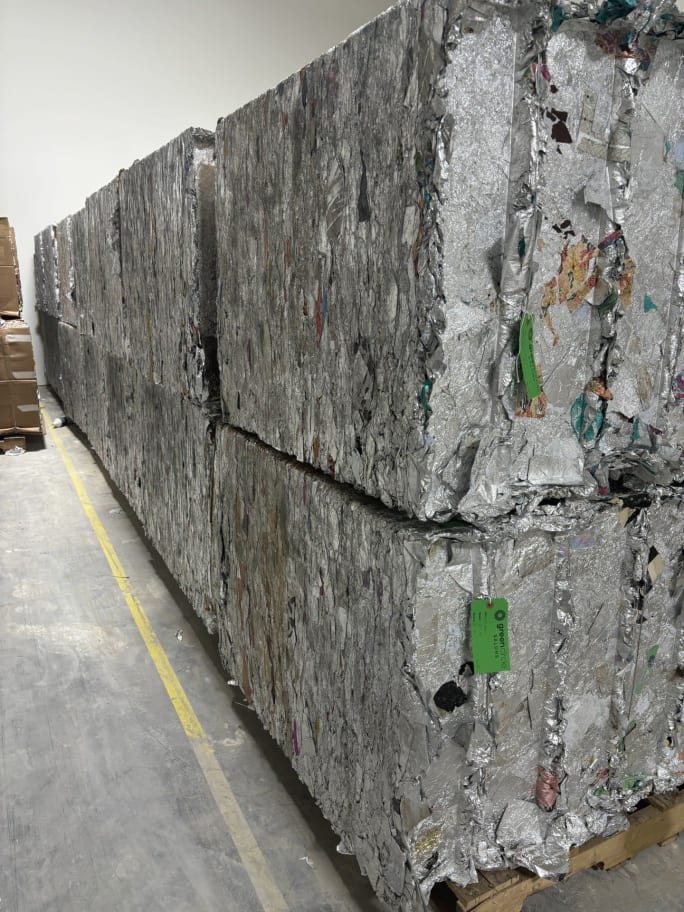
These bales of reclaimed aluminum foil weigh up to 2,000 pounds each and comprise color foils from approximately 7,000-8,000 services.
Credit:
Green Circle Salons
The beauty industry has had some pretty cool environmental wins over the years, according to Sarah Babington.
"In 2010, recycled hair was used to help clean up the Deep Horizon oil spill in the Gulf of Mexico. In 2016, there was a humanitarian need for pet beds for animals displaced by the Fort McMurray wildfires in Canada, and hair was used to make them. Today, we’re creating a comb duo set, which is made from reclaimed shampoo and conditioner bottles as well as human hair.”
Today, Green Circle Salons can tackle up to 95% of the waste a salon, spa, or barbershop produces, preventing it from entering landfills and waterways.
“Aluminum foil is a perfect example because most community-based recycling programs can't take foils with hair color on them, but we can. Aluminum foil is also infinitely recyclable, so to see any hair foils going to landfill is heartbreaking,” Babington says. “Today, we are baling these giant 2,000-pound cubes of aluminum from 7,000 to 8,000 services—and doing one a day in just one of our facilities. That reclaimed aluminum can be used in things like bicycle frames and aerospace parts."
Because most of the smelters that produce foil are in China, Babington stresses that it's even more important that this resource, which was purchased from China, remains a continuous supply in the U.S. or Canada. "If used foils go to the landfill it’s a double whammy. It is a powerful example, even for those who aren’t sustainability-minded.”
Studio Wish's Rowena Yeager (right) with her daughters Mahlaina Wheaton, on left who is a stylist in the salon, and Mia Yeager (center), who is an organismal biologist.
Credit:
Rowena Yeager
While Green Circle Salons was on Rowena Yeager’s radar, it was her adult daughters who drove her decision to bring them on board at Studio Wish Salon Spa in Twinsburg, Ohio. “My daughter Mahlaina is one of our stylists who was involved with onboarding Vish’s color management program, and she really saw the benefit of less waste in the salon, while Mia is an organismal biologist who has won awards with the Mentor Marsh Restoration Program,” she says.
"When I discussed the idea with the team, they were 100% on board," Yeager continues. “If you’re an owner, you know that any change you look at making will have those that support it and those that fight against it, so that was kind of shocking.”
What is even more interesting to Yeager is how fascinated guests are by the salon's approach to environmental sustainability. "For example, we talk about how we manage color and reduce waste with Vish, and that Green Circle can take any unused color, and they spin it in a centrifuge, which allows them to extract and purify the water to go back in the environment, and leftover sludge can be used to create energy."
In Flossmoor, Illinois, Larry Kane had pioneered his own recycling system in the basement of Jonathan Kane Salon & Spa. “I had done a lot of investigation about recycling programs, and we had seven big garbage cans, and every day I would go down there and separate the garbage. We were able to reduce our waste that was going into the landfill by 90 percent,” he says. “But as we got busier, this got harder to manage, and I started hearing about Green Circle Salons—I pulled the trigger and brought them on board just as things were loosening up post-pandemic.”
Offsetting the Costs
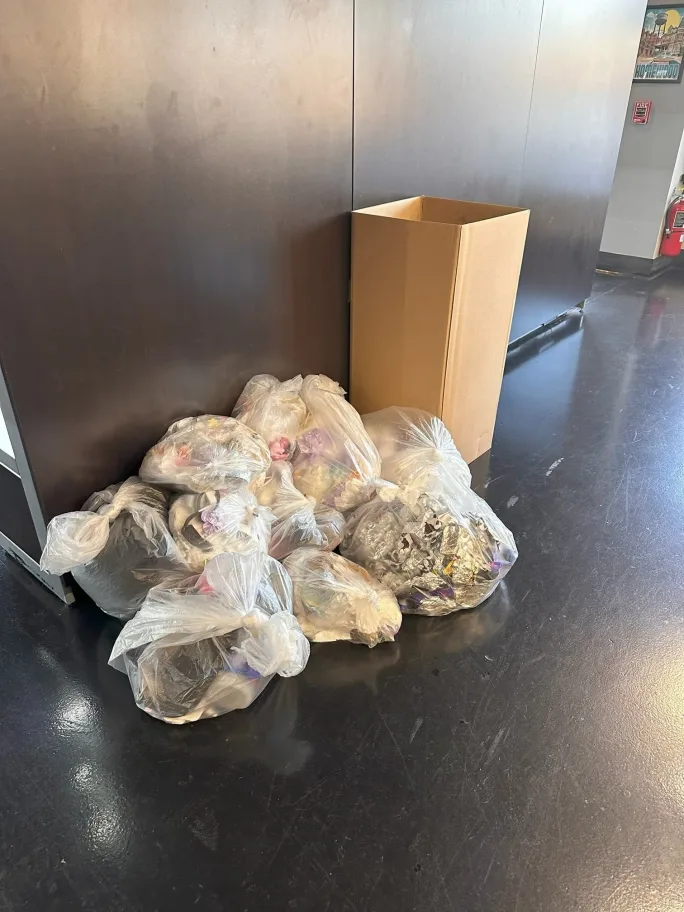
Once a Green Circle Salon becomes a member, the company sends them a welcome kit and has them sort waste by stream, with each stream getting its own bag. The bags then go into one simple collection box. Once the box is full, the salon books a pickup, requests its next box, then it's rinse and repeat. Salons are charged for each box they ship.
“Most of the program’s members implement a nominal $2-$4 green fee that is either calculated into service pricing or added onto the service ticket when a client checks out,” Babington says. “Many will do that by posting a small sign at the front desk that says something like, “A $2 charge from every service goes toward our green initiatives, including recycling up to 95% of the waste we produce.”
Different waste streams are collected in separate bags at Jonathan Kane Salon, then all the bags are loaded into the box and shipped to Green Circle.
Credit:
Jonathan Kane Salon
Kane implemented his Green Fee to coincide with Earth Month, weaving it into the narrative the salon was sharing about their environmental efforts. But before implementing the change, he had talked to a few clients, and they were all positive. “I haven’t really had a client complain about the Green Fee, but when I’m explaining the program to a client, I say, ‘Thank you for being such a good steward to the Earth,’ and that really takes the edge off,” he says. “We’ve always pounded our chest a bit about how eco-friendly we are—and we won our village’s Zero Hero Award and a SALON TODAY 200 honor for environmental sustainability, and it's become one more thing we can point to as proof.”
Since many salons collect more in Green Fees than they spend on the company's services, Babington says she’s witnessed salons use that money to further their green efforts, such as installing LED lighting that produces less heat, thereby reducing energy costs, or replacing old washers and dryers with energy-efficient models. “We’ve even seen some salons work it into benefits programs for their staff,” she says. “It’s all about charging your worth, and if you’re implementing programs that are betting the world around you, this becomes part of your worth,” she says.
Two years ago, Kane switched all his lighting, including the fluorescent lighting in the retail area, to LED. “There’s a softer glow to it that's nice, but I also haven’t changed a lightbulb in two years, and that’s wonderful,” he says. “Now I’m working with a green initiative in Chicago that’s helping me source the ability to put water reclamation in our building. Anything that goes down the drain would get cleaned and recycled on site and turned into potable water.”
Sharing how your business is taking strides in environmental sustainability can help build a magnet that attract both new clients and new talent.
Credit:
This is an AI-generated image. Refer to our Terms of Use.
Building A Green Magnet
While most salons become Green Circle members because they want to be better stewards of the planet, they tap into additional business benefits they hadn’t banked on.
“Since 2017, Green Circle Salons has enabled us to recover over half a million pounds of beauty waste while reinforcing our leadership position in the industry,” says Kelly West, CEO of Chatters, which has more than 100 locations in Canada. “This partnership strengthens our brand reputation, supports stylist retention, and meets growing consumer demand for sustainable beauty.”
Having an environmental story to tell not only establishes a point of differentiation for a salon relative to its competitors but also serves as a magnet for both cause-minded clients and prospective talent.
“Employee recruitment and retention is one of the biggest struggles salons have today, and I think when you can come to work and do something purposeful and feel pride in the business that you're doing it in because they stand for something, it just makes everyone feel great,” Babington says. “Many salons have told us there’s been a shift in retention and engagement, not only with stylists but also with clients, once they’ve brought Green Circle on board.”
Kane shares his green initiative with prospective talent and says it’s definitely helped to have that extra check mark in the Pro column. Owners stress that sharing a piece of their green stories in recruitment campaigns is a bonus, whether they're building out a social campaign, designing an ad, or talking to students at cosmetology schools.
Sarah Babington, Green Circle's head of accounts and partnerships, with foil in one hand and a comb in the other. The foil is infinitely recyclable and the comb is made from recycled shampoo and conditioner bottles.
Credit:
Green Circle Salons
Babington says Green Circle is part of many cosmetology schools and academies, so many recent graduates are already familiar with the program. “This next generation of stylists is born environmentally minded. It’s something they’ve learned about since elementary school," she says. "At Premiere Orlando, we had a number of stylists come up to us and mention the reason they are working at their current salon is that they wanted to work at a Green Circle Salon, so they did some research when job hunting.”
The salon directory on our site is a powerful tool, according to Babington. If a stylist or client is searching for a sustainable salon in their community, it will rank highly in search results. “I was looking at our analytics the other day, and we had one salon that had gotten 5,000 clicks on their listing.”
In this year’s SALON TODAY 200, 79% of salons listed staff recruitment and staff retention as one of their top three management challenges, so if building a green magnet helps, why not?
“When you come to work, and you get to do your craft, and there’s an added element of cause, I think that really grounds people and keeps them anchored in what they’re doing,” Babington says.
While Yeager was sure that her Green Circle story would help attract new talent, she initially was skeptical that being part of the program would do anything to attract clients. "But it definitely does, and it helps with client retention, too," she says. “When we give a new client a tour of the salon, our recycling bins are part of the tour. We explain what they are and what goes into each, and they are fascinated. I’ve had clients tell me that they came to us because they've heard great things about our services, but finding out what we're doing to make a difference solidifies their decision."
Green Circle Salons also supports clients in sharing their green stories by providing a press release and a library of graphics that salons can customize with their own images and branding. “Honestly, though, some of the best social posts come from our clients themselves," Babington says. "We had one salon post of a series of images with stylists proudly holding up bags of trash like fishermen would pose with their prize catch--those kinds of posts communicate your story but also give people a sense of your personality and culture."
What Gets Measured Gets Managed
Perhaps the most exciting part of the Green Circle Salons program for new members is seeing their dashboard and how its data can lead them to other business improvements. When a salon ships a box back to Green Circle, the various waste streams are weighed and recorded on the salon’s dashboard. “In February, I got an email that our salon had already hit its 100 pounds of waste mark—we downloaded a certificate of that and shared it on social,” Kane says.
When the team at Green Circle sees that a salon’s numbers are off, they also take that opportunity to suggest ideas to that member. “For example, if a salon has very high color waste numbers, we’ll take a moment with the owners and share that they have higher than average color weight output, and it might be a good idea to look at a color management system.”
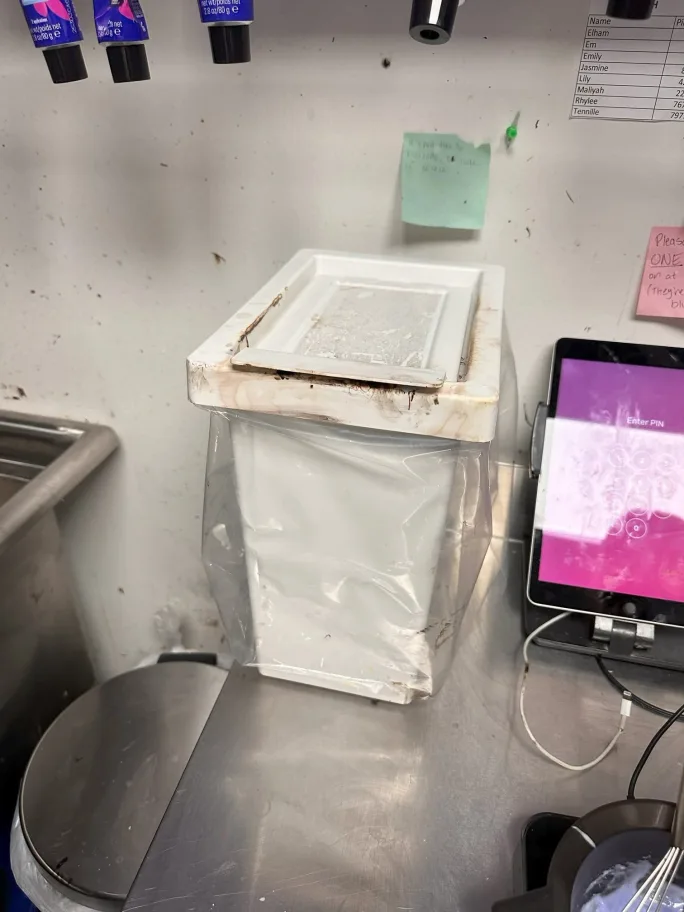
Colorists deposit unused color in this bin at Jonathan Kane Salon & Spa. Unused color This bin in the color room of Jonathan Kane Salon & Spa. Water can be reclaimed from the color and the existing sludge can be burned as a fuel source.
Credit:
Jonathan Kane Salon & Spa
Kane admits he was one of those. “They asked if I had ever thought about using Vish's color management software, and we ended up bringing it on. I used to send two bags of leftover color to Green Circle every month, and now I send back one bag every two months,” he laughs. “Vish really helps you reduce the amount of color waste because it helps you mix the exact amount you need. You know, I think I got a C in Algebra, and if we ran out of color with a client while applying it and needed a bit more, I'd always mix half a formula because calculating a third was too hard. Now, not only do we know how to mix the perfect amount, the front desk immediately knows exactly how much color was used for each service and can charge the client accordingly.”
Growing Up Green
When Aveda Founder Horst Rechelbacher passed away in 2014, the professional beauty industry mourned the loss of one of its earliest pioneers in plant-based haircare, holistic wellness, and environmental sustainability. Nicole Rechelbacher mourned the loss of her father.
Nicole Rechelbacher talks to SALON TODAY about upholding her family's legacy as she leads Intelligent Nutrients.
Credit:
Nicole Rechelbacher
“He really wanted to change the beauty industry in a positive way—it was his call to duty,” she says. “He instilled that in my family and me—that passion to keep the integrity and the love continuing. We continue to live his legacy of service and being in the mindset of looking at the Earth and its biological systems and supporting them, not depleting them, because if the planet’s not well, we’re not well.”
Nicole continues that legacy as she leads Intelligent Nutrients, the company her father launched after selling Aveda to Estee Lauder. (Nicole now co-owns that company with Horst’s widow Kiran Stordalen.) For this Earth Month feature, we sat down with Nicole to learn what it was like to grow up as that legacy was being created.
SALON TODAY: As you follow your father’s legacy, what is your core focus?
Nicole: “I’m a true Libra, a scale person. I believe that happiness will heal all, and that it’s important to laugh and connect with one another. Yes, there are going to be boulders you run into—distractions and negativity—but I believe in balance and harmony and respect—and the beauty within it.
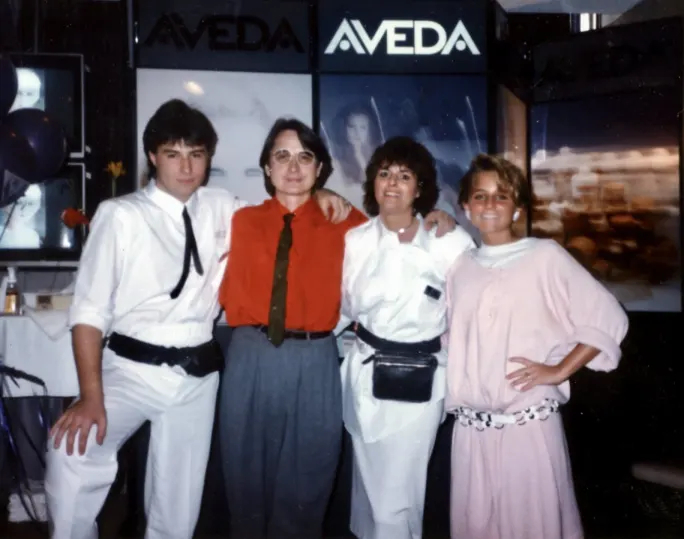
The Rechelbacher family--Peter, Horst, Michelle and Nicole at a hair show in the 1980s.
Credit:
Nicole Rechelbacher
“Growing up with the name Rechelbacher came with a huge responsibility, but I was taught the importance of hard work and working together from the beginning. It wasn’t about my Dad; it was about the community, your connection to it, and the importance of serving the client. That was Dad’s mantra. But also serving the Earth and creating that balance and harmony.
“My father was an activist at heart. He always wanted to get his hands in the dirt and his hands in his lab—being an alchemist was his happy place. He left many beautiful treasures that I keep discovering — thousands of notes, journals, and art. I feel the need to share that passion.”
SALON TODAY:How did you find yourself following in your father’s footsteps?
Nicole: “Some of my earliest memories were of growing up in the salon (Horst & Friends in Minneapolis) and probably running with scissors. I started at the Sassoon Academy at an early age, but I was also a student at the Fashion Institute of Technology, where I got into making clothes and accessories. But even then, I’d think about how I could make things sustainable, how I could be a good steward of the Earth?
“It’s always about performance and quality and putting the energy and dollars into what really matters, not creating smoke and mirrors and creating an illusion. That’s a short-term trend that’s dangerous.
Horst and Nicole on stage at an Aveda Congress in the early 1990s.
"At Intelligent Nutrients, we’re developing quiet luxury beauty. We invest in working with third-party certifiers who validate our products, formulas, and practices. We are beauty professionals, and the products we bring to salons and their clients offer a sensorial experience with 100% certified essential oils that won’t be disruptive. We feel it’s our responsibility to develop the best products we can and be true and transparent with no greenwashing.
“When products have that integrity that comes from plants, they have a soul, an amazing story, and they create a sensorial experience that connects back into the Earth. There’s nothing more beautiful than that.”
SALON TODAY:When you create products and deliver that experience, and clients take them home, doesn’t that just reinforce the connection the client has to their salon?
Nicole: “Yes, that honestly really excites me. I get chills thinking about it.”
SALON TODAY:Can you share how your father was inspired to follow the path that he led?
Nicole: “He grew up in Austria, and he struggled in school. He was intelligent, but dyslexic—it’s inherited, I’m dyslexic too. Dad’s teachers told him he needed to learn a craft, so he learned to cut and style hair in Italy, and he was passionate about it.
"He came to Minneapolis in the 1960s because a woman here owned a beauty school, loved his technique, and invited him to teach classes for months at a time. It was a time when everyone was doing roller sets, but few beauticians really knew how to cut hair. The second time he came to teach, he was hit by a drunk driver. He was stuck in a foreign country and couldn’t hold a comb or a pair of scissors because of his injuries, and he had to undergo physical rehabilitation.
Michelle Rechelbacher and Horst Rechelbacher (right) with the Swami Rama in India in the 1970s.
Credit:
Nicole Rechelbacher
"When he told the doctor how important it was to hold scissors again, the doctor told him to get a holster and two fake guns, take them out, swirl them, and put them back in the holster again and again. That was how he rebuilt his fine motor skills.
“It was during that time that he met my mother, Michelle, they got pregnant, and my brother Peter was born in 1966. I came along the following year. Dad had the two of us by the time he was 21. My parents were young, and they worked so hard. He was always on the road teaching, and he opened up his own salon. It was 24-7. He was burning the candle at both ends, and he knew he wasn’t well; he needed to heal himself. He was seeking a mentor.
“At the time, my mom was getting into yoga, and my dad was interested, and they pursued it together. Around that time, Swami Rama was speaking at the University of Minnesota. My father would talk about how that was a spiritual awakening for him. They stayed after the session and told Swami Rama they wanted to be his students, and the next thing we knew, they packed up and went to the Himalayas for a few months, leaving my brother and me with a nanny. She was probably sweet, but she was strict, and I wasn’t used to that.
“When my parents came back, it was all about being plant-based, doing meditation, mental health and wellness, and no artificial colors. Then, they began bringing mindfulness and wellness into the salon, opened a yoga studio, and tried to incorporate mindful products, which were hard to find at the time. At that time, he lost a lot of staff because they still wanted to smoke cigarettes in the backroom.”
SALON TODAY:So, did he develop Aveda because he couldn’t find the products he wanted to carry?
Nicole: “100%. He reached out to his mentor, Swami Rama, and he came to visit us. Even though I was really young, I remember he had a calming energy and a sense of happiness around him. Dad told him he couldn’t find the products he wanted and couldn’t serve his clients the way they needed to be served. Swami Rama told him he would send Shiv Nath to him—he was a yogi—and Shiv Nath Tandon is still at Aveda today.
Horst and Nicole enjoy a peaceful moment in India in the 1980s.
Credit:
Nicole Rechelbacher
“Together, Dad and Shiv Nath started cooking up formulas in our kitchen, and that was the beginning. Dad was attached to pioneers who saw a larger movement. It wasn’t about him; it was always about the movement. That's why he didn’t name either Aveda or Intelligent Ingredients Horst—he didn’t want it to be about him, but rather the lifestyle.
“Dad didn’t go to college, he didn’t even finish high school, but he knew how to connect the right people together—he saw a bigger vision and how to get there.”
SALON TODAY: How did your Dad’s study of environmental sustainability guide your work today?
Nicole: “Well, it’s just who we are. It’s how we do our work and the discipline behind it. Products always start with performance, but you have to do the work and research the raw ingredients and their cultivation. And, sometimes you’ll have a natural resource, but there’s a processing agent that isn’t sustainable or good for the planet. That’s why third-party certifiers are so valuable to our work.
“It’s not just about the product; it’s the packaging. Is it recyclable? What kind of footprint is it leaving? There’s so much that goes into it. But for me, I love to roll up my sleeves—I love the difficulty of it, because that is where real good work starts.
“I think the more we all get on board with being better stewards, that's going to be better for all of us on this planet. Because we’re only borrowing it from the future, other species, and our children. Who’s going to clean it up? We need to start now.”
Horst and Nicole working in his greenhouse in 2013.
Credit:
Nicole Rechelbacher
SALON TODAY:How does one get started?
Nicole: “Make small changes. Once you develop better practices, it becomes contagious. There’s amazing resources out there in your communities. As the salon owner, you serve that community and can have a big impact. Get involved, work locally, and be a place where people can connect to both a beautiful service and the experience within it.”
Top Tips on Going Green Without Driving Up Costs
Demand from beauty guests for greater sustainability is not going away. The trend is still ever upwards despite cost-of-living pressures, with major consumer and industry consultancies filing report after report of clients’ desire to change their allegiance to more sustainable businesses. Finding ways to green your systems doesn’t have to drive up your business costs.
“Financial pressures are hitting hard on the streets and in the salon,” says Valorie Tate, founder of Sustain Beauty Co, the market leader in sustainable salon supplies. “But that’s where we revisit the roots of sustainability--conservation.”
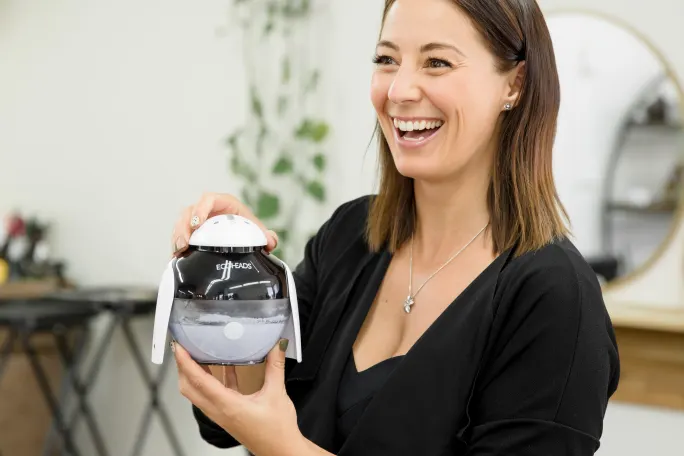
A stylist uses an Ecoheads shower head while rinsing a client, which can increase pressure while reducing a salon's water usage.
Credit:
Sustain Beauty Co.
Sustain Beauty Co has championed the concept of using less to do more since its inception, as it’s frankly good business. Using less water, looking at more efficient ways to do mundane tasks and save on labor, or removing unnecessary obstacles to good health, is at the heart of being a responsible salon. For the planet, your people, and your profits.
“We published the industry’s first sustainability checklist in 2023 with the intention of showing salons and stylists that it really can be as simple as changing a power strip or switching out plastic bottles,” adds Tate. “The checklist is now 125 ideas deep and includes large and small changes in a variety of areas, meaning anyone and everyone can do at least one new thing that may even save you money.
“Sustainability has this reputation of luxury, but it’s really a two-prong strategy of elevating your client’s perception of your business while simultaneously shaving off costs," she says. "The steepest savings come from things like installing water-conserving ECOHEADS nozzles at the basin, which not only impresses guests with softer water, but can slash water and energy use by as much as 65%."
“Go a step further and combine a color management system with an automated mixer like the Ping, and you will save even more," she adds. "The Ping blends so smoothly, the color goes further and is easier and quicker to apply,” says Tate.
A colorist with her Ping automated color mixer.
Some concepts on the Sustainability Checklist are major, but many are very simple steps that can start the shift towards greater sustainability. Here is a sample of those business-minded initiatives that will also pad your bottom-line.
HEALTH
Breathe Deep: Cut back on sick days and early retirement with efforts to boost air quality, like improved air flow and air filters in chemical areas.
Preventative Measures: Bring down toxicity levels with tools that limit your exposure to chemicals, such as an airtight closed mixer for color like The Ping.
Soap Swap: Suggest a salon-wide swap away from harsh chemical cleaners for floors, glass, and washrooms, as they can irritate the skin, exacerbate asthma, and induce migraines, as well as damage the environment. Jonathan Kane uses vinegar to wash mirrors and floors.
Laundry Day: Switch to plant-based or natural laundry detergents to ensure any linens touching your clients (and your stylists) don't have irritants. Kane uses detergent sheets that come 50 sheets to an envelope and the salon cuts each sheet in half, washing every load with a half sheet on cold. “Bonus points when you look for detergents that are sheets or powder as you’ll save money not buying huge, heavy jugs that are 90% water,” Tate says.
Take a Moment: Ward off inevitable burnout by caring for mental health. Give stylists regular breaks to eat, decompress, and recharge. Request that client communications go through the front desk,so stylists don’t use their breaks to answer client text messages.
SLASH WASTE
Energy Efficient: Turn your back on disposable culture by investing in equipment and appliances from manufacturers that have repair options and come with a warranty is a major step towards sustainability and can save you money in the long run.
Champion Reusables: Look for solutions in your own community that help you reduce packaging waste. Gaia’s Market & Refillery opened just around the corner from Jonathan Kane. “It carries glass containers that you can continue to bring back to fill up with hand sanitizer for bathrooms or liquid detergent for your sink,” Kane shares.
Watch the Water: Hot water is the biggest consumer of energy in the salon. Cutting back on your water and energy bills can be as simple as adding low-flow nozzles to your basins, like ECOHEADS.
Keeping it Hot: Investigate installing tankless water heaters which can save 24-34% of energy costs, while supplying endless hot water on demand. “I remember the days when the first thing you did in the morning was turn on all the faucets for a few minutes to get the hot water running in the pipes,” Yeager says.
Color By Numbers: Focus on each ounce of color with systems that not only track formulas, but track usage so you can eliminate wasted color and save both waterways and your bottom-line.
Playing Tetris: Since Green Circle charges salons for each box they ship back, owners have gotten savvy about packing those boxes. Kane says his packing methods have gotten so sophisticated, he’s been brought in to teach classes on his method. Yeager purchased a can crusher that helps her flatten cans and bottles, allowing more in each box.
CONSERVE RESOURCES
Power Down: Unplug your tools, appliances, and chargers when not using them. Even when off, they are draining energy for no purpose at all. This will save energy and improve the longevity of your tools. When Yeager opened up her new location a few years ago, she had the builders install a master switch at both the front and the back of the salon, so the last one out could always turn everything off at once. Upgrade to energy-efficient outlets and power strips that will automatically cut power when the main item is off.
Coffee Talk: Kane installed a commercial dishwasher in the salon and brought in china cups kicking those paper disposable cups to the curb. “During the pandemic, our clients weren’t crazy about the idea of a carafe of coffee, so we investigated and brought in Nespresso machines,” he says. “Their pods are recyclable, and they send you the bags with the UPS labels on them to ship them back to them. When they come to pick up our Green Circle boxes, the bags of pods are right on top.”
No More Paper Route: Integrate digital systems into business that reduce your paper usage. Even though her team rarely uses the printer, Yeager moved it away from the front desk to remove the temptation to use it. She also designs reusable salon signage, laminates it and pulls it out of storage when she needs it. “For example, we close between December 23 and New Year’s for the holidays, so I printed signs to that effect but left off the year—I think I’ve used those same signs for the past three years.”
Compost: One waste stream Green Circle Salons doesn't tackle it food waste. Babington says it doesn't make sense because collecting it in a salon produces bad smells and attracts insects. But Kane takes his home and subscribes to his town's composting program. "Every two weeks, I put out a yellow container of compost, and they pick it up. I've had at least three neighbors ask what that yellow container is, and now they compost too."
EE Upgrades: When you need to upgrade appliances or tools, use it as an opportunity to look for more energy-efficient options. Also check for tax write-offs when you install toilets, washing machines, faucets and nozzles that reduce water usage.
Make Your Own Waterfall: With a Starbucks right next to Jonathan Kane, one day Kane looked in the recycling bin to see a dozen Venti cups with the same number of water bottles in the plastics bin. “They were giving away bottles of water with their coffee,” he says. “I asked the team why they didn’t just drink the tap water, and they said they didn’t like the taste. So, we installed a water filtration system and gave them each branded water bottles. Now, we have the best tasting water.”
ATTRACT MORE CLIENTS & TALENT
Be A Green Showoff: Tate says research into salon guests shows that 56% of clients are impressed by your environmental efforts, while only 4% that aren’t interested in environmental responsibility. “So there’s only benefits to being obvious with your efforts, like ditching single-use plastic bottles for water in the salon,” she says.
Reveal Your Culture: Devise a social media plan that is inclusive and regularly features WHO you are as much as your beautiful work, Tate says. “Include stylists and their thoughts on topics close to your brand.”
Make a List: Dedicate a page on your website to list all of the things you are doing to be responsible and then look to sprinkle that across all your webpages. Talk to your SEO experts about using key words that attract clients looking for a salon that cares about the planet and get them adding regular blogs to build your local search prowess.
Finally, a bonus tip for those that love a good deal: Look for industry partners that match your ethos and are working towards greater sustainable options for you. These brands also offer ways to access sustainable programs through rewards programs (ahem, free stuff!) and utilize their resources to help educate the industry and support our collective growth.
Recruiting and hiring new talent continues to be one of salon owners' biggest management challenges, but social media and new tech tools and platforms are streamlining the hiring process, while ensuring owners hire the best talent available.
The winter holidays and Mother's Day are the most popular holidays for gift card campaigns in spas, salons, and medspas. SALON TODAY taps into industry experts for strategies in designing and marketing a successful campaign, as well as how to manage that cash flow influx while avoid getting into trouble with your bottom line or the IRS. Plus, five salons and spas share their case studies.
Planning is in full swing for the most anticipated events and promotions for the 2026 holidays. As owners share their favorite ways to celebrate, they prove that a carefully planned event can also build culture, increase client loyalty, boost sales, and set a business up for a successful 2027.
In a world dominated by e-commerce, salon owners push back with proven strategies to increase retail sales while motivating team members to educate their clientele and delighting clients with retail-themed events and clever merchandising displays.
Spit fests, hostile threats, and even an overachieving matchmaker--SALON TODAY readers share their craziest client tales and how their team handled these tough situations with professionalism and grace.
Ten salon and spa owners share their own proven success stories that have increased sales, saved costs and gained new clients. From hair toppers to festival braiding and bridal to all-inclusive color service pricing, these salons show you how they topped their own expectations.
For Earth Month, we explore how the professional beauty industry is shifting its position as major waste contributor to a leader in sustainability. We take a closer look at Green Circle Salons, as experts and owners share their favorite environmental sustainable business tips. And, Nicole Rechelbacher shares what it was like to grow up with the industry's biggest environmental pioneer as her father.
While color services are the clear revenue driver in most salons, it's up to owners and managers to ensure they also spur profitability. In this digital feature, we explore how owners can help their colorists deliver business-building color services and add-ons, and how today's technology and tools can help forward-thinking salons increase profit margins.
While new clients build your growth, retained ones build your profitability. We examine the importance of client retention and offer four salon-proven ideas for boosting your salon's retention rates.
In our first digital cover feature for MODERN Spa & Wellness, we investigate the business launches of three successful head spa operations, then offer six practical strategies for getting started.
SALON TODAY reached out to the industry’s leading business consultants and invited them to weigh in on what’s top-of-mind for today’s salon leaders. Take a read through this compilation of solid advice on a variety of topics, each designed to give you the managerial tools you need to tweak your business and make 2026 your best year yet.